Description
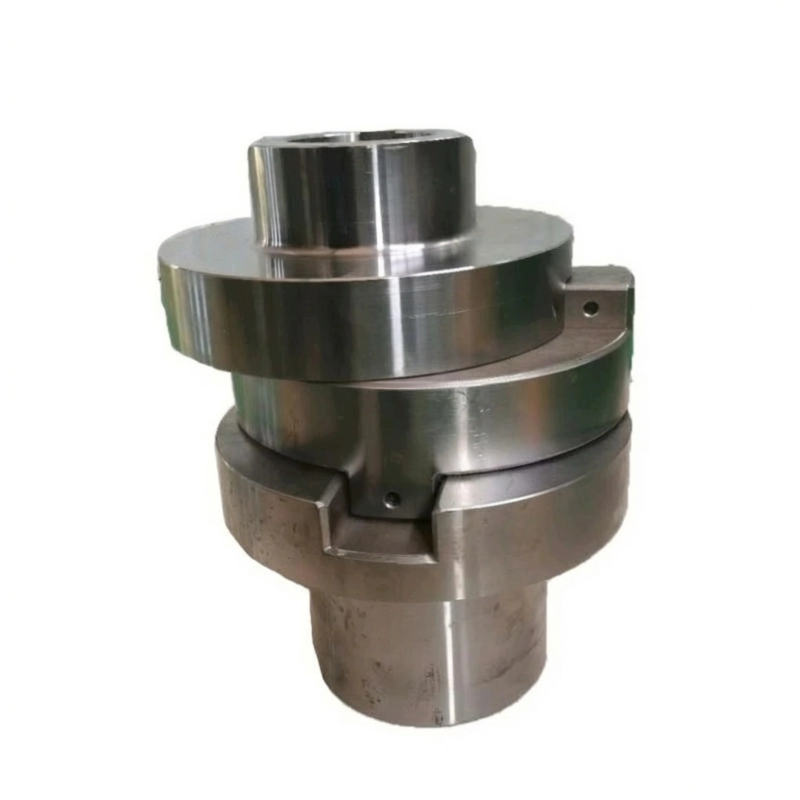
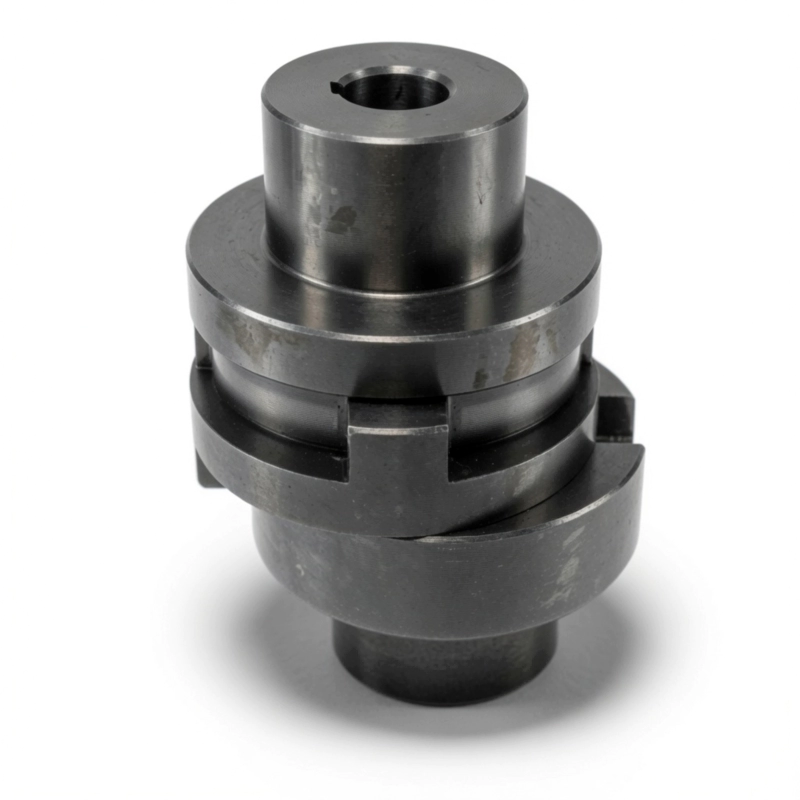
SL240 Heavy-Industrial Cross-Slider Oldham Coupling — 240 mm Cast-Iron Hub for Cement-Mill Main and Steel-Mill Auxiliary Drives
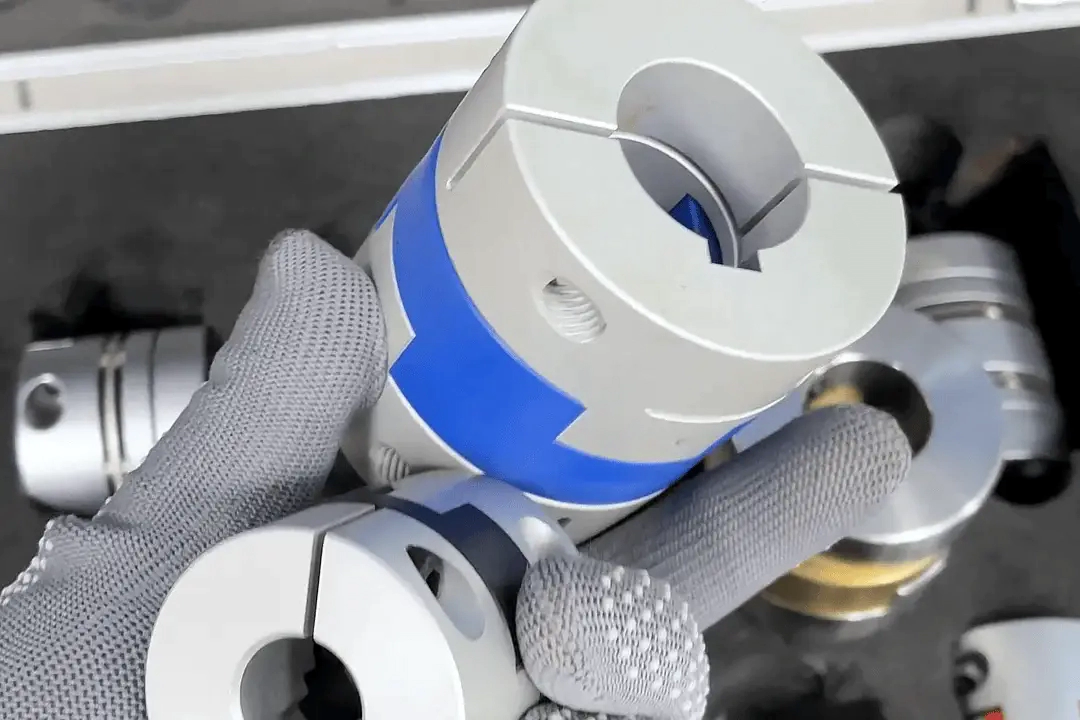
The SL240 industrial Oldham coupling moves the SL family firmly into the heavy industrial drive class. With 8 000 N·m rated torque, 240 mm hub OD, 95–100 mm bore range, and 250 r/min permissible speed, the SL240 transmits 150–210 kW of continuous mechanical power. This is the duty class of cement-mill main drives, hot-strip-mill auxiliary lines, larger hydropower-auxiliary trains, and the heaviest process-pump installations in the chemical, petrochemical, and metallurgical industries. At this scale the coupling is unambiguously a critical-asset component; specification involves a multi-discipline engineering review, and the deployment is expected to operate reliably across multiple cycles of host-equipment overhaul.
For the integrator specifying a coupling at this size, the engineering question moves beyond “which architecture is best for steady-state torque” to encompass three additional concerns: shock-load endurance over decades of duty, serviceability of wear parts during constrained planned-shutdown windows, and predictability of failure modes for maintenance-planning purposes. The SL240 addresses all three through its architecture. Cast-iron hub section provides shock-load capacity. Field-replaceable hardened-steel slider provides serviceability. And the gradual, inspectable wear mechanism delivers the predictable failure profile that maintenance planning depends on. These three structural advantages — invariant across the SL family — become especially valuable at the SL240’s power level.
Specifications
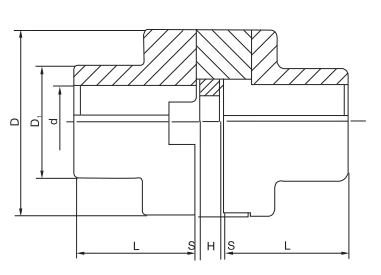
| Parameter | Value |
|---|---|
| Model | SL240 |
| Nominal Torque (Tn) | 8 000 N·m |
| Permissible Speed (n) | 250 r/min |
| Bore Range (d) | 95 – 100 mm |
| Outside Diameter (D) | 240 mm |
| Hub Bore Diameter (D₁) | 140 mm |
| Overall Length (L) | 180 mm |
| Slider Plate Thickness (H) | 33 mm |
| Slider Clearance (S) | 1.0 mm |
| Moment of Inertia | 1.6 kg·m² |
| Mass | 59.5 kg |
| Radial Misalignment (Δy) | 3.8 mm |
| Angular Misalignment (Δα) | 0.5° |
| Axial Misalignment (Δx) | 3.0 mm |
| Shaft Engagement | Keyway + setscrew |
| Lubrication | Grease (re-pack 6-monthly) |
Materials
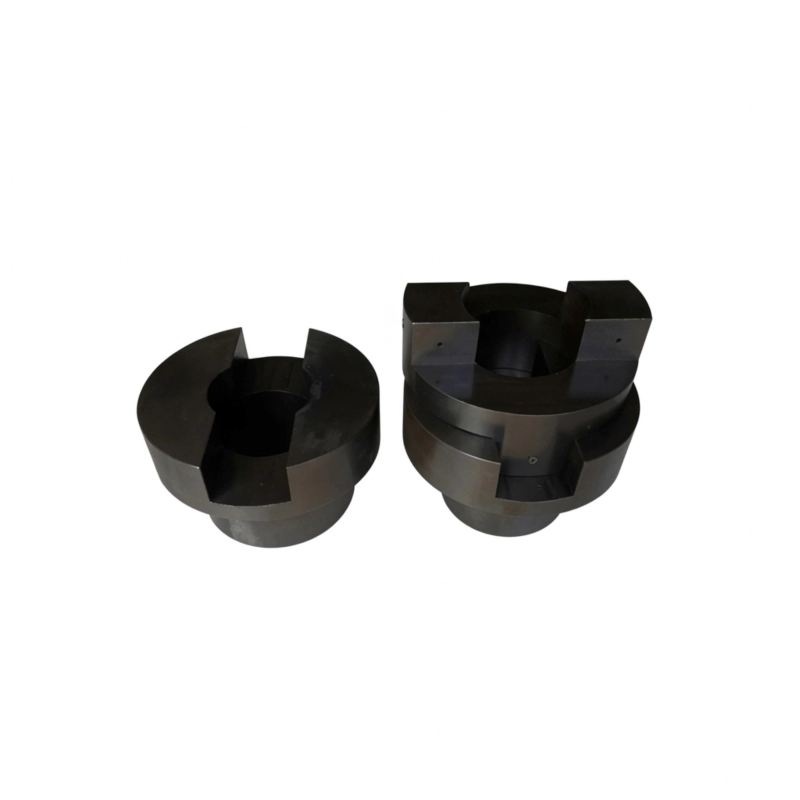
QT500-7 Ductile-Iron Hub (Standard at this Size)
At SL240 size and above, the QT500-7 ductile-iron hub variant is the documented standard specification, not just an upgrade option. The spheroidal-graphite microstructure’s superior fracture toughness addresses the dominant failure-risk vector at this duty class. HT250 grey-iron variant remains available for cost-sensitive light-duty installations, but engineering does not recommend it for cement-mill, steel-mill, or shock-load applications.
Heavy Section Steel Slider
33 mm thick cross-slider in induction-hardened 45-steel or 40Cr alloyed steel. The slider’s mass (approximately 6 kg) becomes a noticeable engineering parameter at this size; reflected inertia at the motor is approximately 1.6 kg·m². For reversal-duty deployments (steel-mill auxiliary, marine winches), the 40Cr alloy slider with HRC 55 surface is the documented specification.
Heavy Industrial Mounting
H7-reamed bore with parallel keyway to GB/T 1096. M20 set-screw for axial location. For cement-mill, steel-mill, and crusher applications, taper-bushed mounting via standard locking-assembly families is the documented engineering preferred approach — eliminating keyway shear under the realistic shock-load profile of these installations.
Engineering Considerations for 150–210 kW Drives
At this scale, the engineering calculus shifts: the SL240 is no longer competing primarily on unit cost — it is competing on lifecycle reliability and on the consequence cost of failure. A single unplanned shutdown of a 200 kW cement-mill main drive in a continuous-production plant typically costs more in lost production than the entire purchase price of the coupling several times over. Selection decisions are therefore driven by failure-mode analysis as much as by performance specification. On this front the SL240 has two structural advantages over competing flexible-coupling families at this size.
First, the failure mode is gradual wear of a non-energy-storing metallic element. The polymer-spider failure mode (sudden tearing of the elastomer) does not apply. The flexible-disc-pack failure mode (sudden fracture of fatigue-damaged discs) does not apply. The fluid-coupling failure mode (loss of fluid charge) does not apply. The SL240 fails by gradual slot-edge wear of the cast-iron hub and gradual face wear of the steel slider, both of which are inspectable during routine maintenance and replaceable during planned shutdowns. Second, the field-service workflow does not require precision laser alignment — a major scheduling advantage during the constrained shutdown windows typical of continuous-production plants.
For OEM equipment builders, these architectural advantages translate directly into reduced warranty exposure and improved customer-experience metrics. For end-user plants, they translate into reduced maintenance-management overhead. The combined value proposition has kept the SL240 on equipment specifications across multiple equipment generations. See Ever-power’s engineering portal for related selection materials.
Industry Applications
Cement-Mill Main Drives
Drive coupling between motor and reduction-input of cement-grinding mills. Cast-iron section and gradual failure mode are the architectural fit for continuous-production cement operations.
Hot-Strip-Mill Auxiliary
Roughing-stand auxiliary, edger-mill drive, and finishing-stand support drives in hot-strip rolling mills. Elevated-temperature cast-iron tolerance addresses the demanding ambient of hot-mill operation.
Hydropower Auxiliary Trains
Gate-actuator, trash-rake, and governor-aux drives on small-to-medium hydropower installations. Long-cycle reliability across decades of duty.
️ Heavy Process Pumps
Large centrifugal, gear, and lobe-pump drives in petrochemical, fertiliser, and process-chemical installations. Misalignment tolerance absorbs thermal-growth between cold-start and operating-temperature states.
⛏️ Mining Conveyor Head Drives
Drive-end coupling on heavy overland and underground mining conveyors. Shock-load tolerance addresses the inrush profile of conveyor start under loaded conditions.
Large Marine Winches
Anchor-winch and mooring-winch drives on commercial vessels and dredging fleet. QT500 ductile-iron hubs and calcium-sulfonate grease resist saltwater ambient.
Why Choose Ever-power
Quality & Compliance
SL240 production runs under ISO 9001:2015 with full melt-traceability per cast-iron heat. Documentation covers RoHS, REACH, and CE conformity declarations. For cement-plant customers, supplementary documentation covering dust-class compatibility of standard and synthetic grease specifications is available. For steel-mill customers, additional thermal-cycle endurance documentation is supplied on request.
Customisation
Catalogue bore range 95–100 mm; oversized variants up to 105 mm produced under engineering review. Imperial-bore variants (3-3/4″, 3-7/8″, 4″) supported for North American export markets. QT500-7 ductile-iron hub is the standard recommendation at this size; HT250 variant available for cost-sensitive light-duty applications. Taper-bushed mounting via standard locking-assembly families is the documented best practice for cement, steel-mill, and crusher installations.
Aftermarket
SL240 slider plates stocked under part SL240-SLIDER for 2-business-day shipment. 40Cr alloy slider available within 1 week. Mass per coupling 59.5 kg; sea-freight standard in heavy-duty crating. English-speaking engineering desk responds within 24 hours. For continuous-production customers, emergency-replacement protocols can be pre-negotiated to support major-plant shutdowns within 5 working days.
Customer Reviews & Case Studies
★★★★★
Sri Lanka — Cement-Production Facility
Used in: Cement-mill main drive coupling on a 75 t/h vertical roller mill installation.
Feedback: “Specified SL240 with QT500 hubs and taper-bushed mounting as a replacement for the original gear-coupling spec. Five years of continuous-production duty with zero coupling-attributable downtime events. Annual mill availability has improved measurably as a result of removing the gear-coupling-related downtime that had been a recurring incident category.”
★★★★★
Bangladesh — Steel Re-rolling Mill
Used in: Edger-mill auxiliary drive coupling on a hot-strip re-rolling operation.
Feedback: “Elevated-temperature ambient (60+ °C continuous) had been challenging for every flexible-coupling architecture we tried. The SL240 with synthetic high-temperature grease has now passed 4 years of continuous duty with one slider replacement during a planned mill overhaul. Cast-iron hubs show no measurable change in dimensional accuracy. Excellent specification for hot-mill auxiliary duty.”
★★★★☆
Mongolia — Mining-Site Conveyor Operator
Used in: Drive-end coupling on a 1 200 mm wide overland coal conveyor.
Feedback: “Inrush torque on loaded-conveyor start regularly exceeds 1.5× rated. The QT500-hub SL240 has handled this for 5 years with one slider replacement during a planned mine-site shutdown. Annual grease repack is the only routine maintenance touch point. Knock one star only because emergency air-freight shipment to our remote site location was logistically challenging during one urgent replacement event — eventually resolved but took an extra 4 days.”
Frequently Asked Questions
Is QT500 ductile-iron really the standard recommendation at this size?
Yes. At SL240 size and above, the engineering case for ductile iron over grey iron becomes unambiguous: the 3× higher fracture toughness translates directly into shock-load endurance that grey iron cannot match. For cement, steel-mill, mining, and crusher installations the QT500 variant is the documented standard specification. Grey iron remains available for cost-sensitive light-duty applications, but its use should be limited to low-shock-load duty profiles.
What is the recommended hot-mill ambient grease specification?
For continuous ambient between +80 °C and +150 °C (typical of hot-strip-mill auxiliary deployments), specify synthetic polyalphaolefin grease (e.g., Klüber Asonic GHY 72-72). This grease maintains its viscosity profile across the temperature range, resists oxidation, and remains compatible with the cast-iron and steel sliding interfaces. Grease-repack interval at this temperature range is 4 months.
How does the SL240 compare to a flexible disc-pack at this rating?
At the 8 000 N·m torque rating, flexible disc-pack couplings offer slightly lower mass (typically 45 kg vs the SL240’s 59.5 kg) but require precision laser-alignment for service-life predictability and offer roughly 1/10th the parallel-misalignment tolerance. For continuous-production plants where reliability and serviceability are paramount, the SL240’s lifecycle-cost economics are clearly favourable.
What is the typical planned-shutdown slider-replacement time?
For a trained maintenance crew, total time to replace the SL240 slider is approximately 90 minutes including documentation: 15 minutes to remove the coupling guard and inspect, 30 minutes to remove old slider and clean the slot interfaces, 30 minutes to fit the new slider and re-grease, and 15 minutes to refit the coupling guard and finalise documentation. This is well within the constrained shutdown windows of continuous-production plants.
Are emergency-replacement protocols pre-arrangeable?
Yes. For continuous-production customers, Ever-power offers pre-negotiated emergency-replacement protocols that guarantee 5-working-day delivery of replacement SL240 couplings or slider plates from confirmed PO. Air-freight logistics are pre-arranged to the customer’s nominated logistics hub. Programme terms are negotiated with the sales desk based on installed-base size and historical demand profile.
Quote SL240 for Critical-Path Drives
For cement-mill main, steel-mill auxiliary, hydropower-aux, and heavy process-pump installations in the 150–210 kW power class, the SL240 has been Ever-power’s reliability standard for continuous-production-plant duty. Browse the wider SL series catalogue, read about Ever-power’s heavy-industrial supply commitments, or move directly to enquiry below.