One of the most frequently asked questions during Oldham coupling selection is deceptively simple: how much misalignment can this coupling actually handle? The answer depends on which type of misalignment you mean, which coupling size you are using, how you define “handle” — whether that means surviving for one revolution or lasting 10,000 hours — and whether you are asking about the maximum possible value or the value that optimises service life. This article addresses all of these dimensions, providing a practical tolerance guide organised by coupling size and misalignment type.
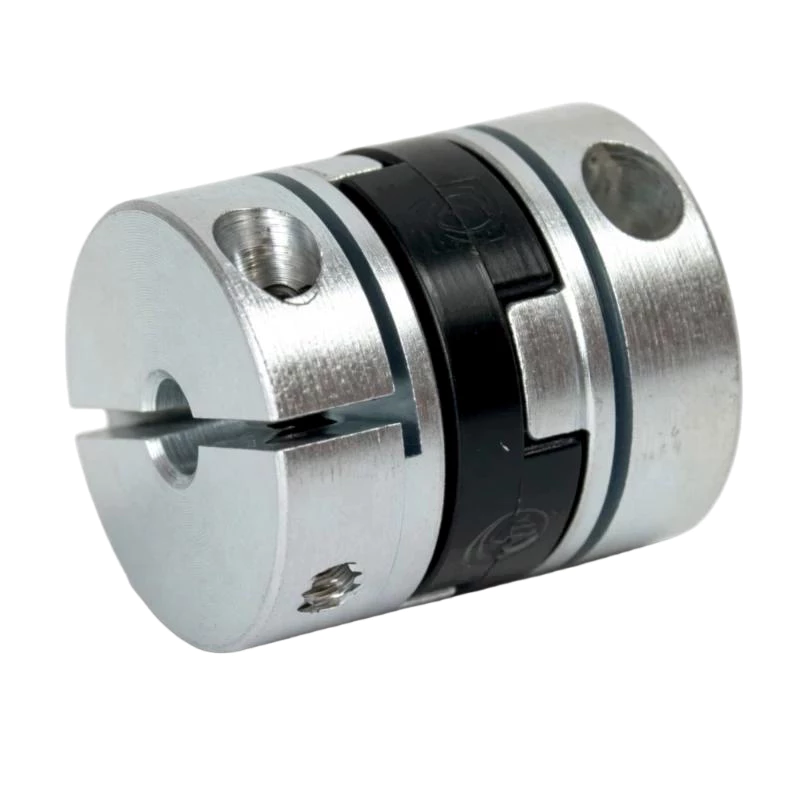
The Three Types of Shaft Misalignment
Before discussing numbers, it is important to be precise about the three distinct types of shaft misalignment that an Oldham coupling may encounter:
Lateral (parallel) offset is the condition where the two shaft centrelines are parallel to each other but displaced radially — they point in the same direction but do not coincide. This is the misalignment type the Oldham coupling is designed to accommodate, and it is the most common form encountered in motor-to-machine connections. Lateral offset is measured as the perpendicular distance between the two shaft axes, in millimetres.
Angular misalignment is the condition where the two shaft centrelines are not parallel — they converge or diverge, meeting at a point (or appearing to meet if extended). Angular misalignment is measured in degrees as the angle between the two shaft axes when viewed from the side. The Oldham coupling has very limited angular capacity and this type of misalignment must be corrected mechanically before installation.
Axial misalignment (end-float) is the condition where one shaft moves toward or away from the other along the shaft axis. This is not misalignment in the positional sense but rather an axial displacement that the coupling must accommodate without transmitting significant axial force to the bearings. The Oldham coupling has modest axial float capacity determined by the clearance between the disc faces and the hub inner faces.
Lateral Offset: Maximum Rated vs Recommended Operating
Manufacturers specify two lateral offset values that must be carefully distinguished:
Ten maximum rated offset is the largest lateral displacement at which the coupling can function without mechanical failure — the tenon does not bottom out in the slot, the disc does not contact the hub faces, and the hub slots are not overloaded. Operating at the maximum rated offset is technically permissible but results in maximum disc wear rate, maximum heat generation, and minimum service life.
Ten recommended operating offset is the offset at which the coupling is designed to provide good service life under its rated speed and torque conditions. This is typically 40 to 60 percent of the maximum rated value. Operating at or below this level gives the longest disc service life and leaves margin for thermal growth, frame deflection, and bearing wear over the machine’s service life.
When selecting a coupling, the application’s expected lateral offset should fall at or below the recommended operating value — not the maximum rated value. This is the most commonly misunderstood aspect of Oldham coupling misalignment specification.
Lateral Offset Capacity by Coupling Size
| Średnica zewnętrzna sprzęgła (mm) | Max Rated Offset (mm) | Recommended Operating Offset (mm) | Typical Bore Range (mm) |
|---|---|---|---|
| 16–20 | 0.20–0.30 | 0.08–0.15 | 3–8 |
| 25–32 | 0.40–0.60 | 0.15–0.30 | 5–16 |
| 40–50 | 0.60–1.00 | 0.25–0.50 | 10–25 |
| 63–80 | 1.00–1.50 | 0.40–0.75 | 20–40 |
| 100–125 | 1.50–2.50 | 0.60–1.25 | 30–60 |
Values are representative ranges for standard polymer-disc Oldham couplings. Always verify against the specific manufacturer’s datasheet for the coupling being specified.
Angular Misalignment: The Hard Limit
Oldham couplings are consistently rated for a maximum angular misalignment of 0.5 to 1.0 degrees across virtually all sizes and manufacturers. This is not a soft guideline — it is a hard mechanical limit imposed by the geometry of the tenon-and-slot interface.
When angular misalignment is present, the disc cannot slide cleanly within the hub slots throughout a full revolution. At certain rotational positions, one edge of the tenon contacts the slot wall before the opposite edge, creating a binding condition with a concentrated point load rather than distributed face contact. This point load is many times higher than the normal distributed contact stress at the same torque, causing rapid and asymmetric disc wear and generating intermittent impact loads that are transmitted to the shaft bearings.
The practical implication is unambiguous: angular misalignment must be corrected mechanically before the Oldham coupling is installed, not accommodated by the coupling. If the motor mounting plate is not perpendicular to the driven shaft axis, shim the motor feet until it is. If the drive frame geometry makes this impossible, the Oldham coupling is the wrong coupling type for the application — switch to a bellows or beam coupling which handles angular misalignment by design.
Axial Float Capacity
The axial float capacity of an Oldham coupling is determined by the gap between the disc faces and the hub inner faces when the coupling is installed at its nominal axial position. Most standard Oldham couplings provide axial float in the range of 0.5 to 2.0 mm depending on coupling size.
This axial float allows for thermal expansion of the shafts during warm-up, minor axial movement in motor bearings under load, and small axial positioning errors during installation. It does not allow for sustained axial displacement — if one shaft moves axially by more than the available float, the disc contacts a hub face and begins transmitting axial force to that shaft’s bearing.
For applications with significant thermal axial growth — long shafts with large temperature differentials, or shafts in high-temperature process environments — a bellows coupling provides better axial compliance. For most servo motor and stepper motor applications where axial motion is small, the Oldham coupling’s float capacity is more than adequate.
How to Measure Lateral Offset Accurately
Accurate lateral offset measurement requires a dial indicator and a clean reference surface on each shaft. The procedure:
Method 1 — Direct runout measurement: Mount the dial indicator on a magnetic base clamped to the driven shaft’s bearing housing. Position the indicator tip against the motor shaft surface. Rotate the motor shaft through 360 degrees while holding the driven shaft stationary. Record the total indicator reading (TIR). The lateral offset equals half the TIR (TIR = 2 × offset, because the indicator sweeps both sides of the eccentricity circle).
Method 2 — Straight-edge and feeler gauge (quick check): Hold a precision straight-edge against the outside diameter of the motor shaft hub and extend it toward the driven shaft. Use feeler gauges to measure the gap between the straight-edge and the driven shaft at a defined distance. Calculate the offset from the gap measurement and the measurement distance. This method is less accurate than the dial indicator method but requires no special tools and provides a rapid check during installation.
Always measure misalignment after the machine has reached operating temperature and full load, not just at cold startup. Thermal growth in the motor, gearbox, and machine frame during warm-up can change the lateral offset by 0.1 to 0.3 mm in typical industrial installations.
Combined Misalignment: When Lateral and Angular Are Both Present
In real installations, lateral and angular misalignment often appear simultaneously. The Oldham coupling handles this combined condition less well than pure lateral offset because the angular component adds bending stress to the disc that does not exist under pure lateral offset.
When both types are present, the angular component should be reduced to below 0.3 degrees before relying on the coupling’s lateral offset capacity. The combined misalignment capacity is approximately:
Combined rating factor = (lateral offset / max rated lateral) + (angular offset / max rated angular) ≤ 1.0
If the sum of these two fractions exceeds 1.0, the coupling is being asked to handle more combined misalignment than its design allows. Reduce one or both components through mechanical correction, or select a coupling with higher ratings for both parameters.
Effect of Misalignment on Disc Wear Rate
| Operating Offset (% of Max Rated) | Relative Disc Wear Rate | Expected Service Life (Relative) |
|---|---|---|
| 20% of max rated | 1× (baseline) | Very long |
| 40% of max rated | ~4× | Long |
| 60% of max rated | ~9× | Umiarkowany |
| 80% of max rated | ~16× | Short |
| 100% of max rated | ~25× | Very short |
The wear rate scales approximately with the square of the misalignment fraction, because disc wear is proportional to sliding velocity squared (velocity = offset × angular velocity). This non-linear relationship is why even modest improvements in shaft alignment produce disproportionately large increases in disc service life.
Wniosek
The Oldham coupling handles lateral shaft offset better than any other common zero-backlash coupling type — but it handles it best when operating well below its rated maximum, not at the limit. Angular misalignment is a hard constraint that must be corrected mechanically, not accommodated by the coupling. Axial float is modest but adequate for most servo and motion control applications. Using the recommended operating offset rather than the maximum rated offset as the selection criterion, measuring actual offset under operating conditions rather than at cold installation, and correcting any angular misalignment before coupling installation — these three practices together produce installations that deliver the full service life the coupling is designed for and protect the shaft bearings from coupling-induced loads throughout the machine’s operational life.
Przeglądaj nasze full Oldham coupling range with detailed misalignment specifications, Lub skontaktuj się z naszym zespołem inżynierów for assistance with misalignment measurement and coupling selection.