Description
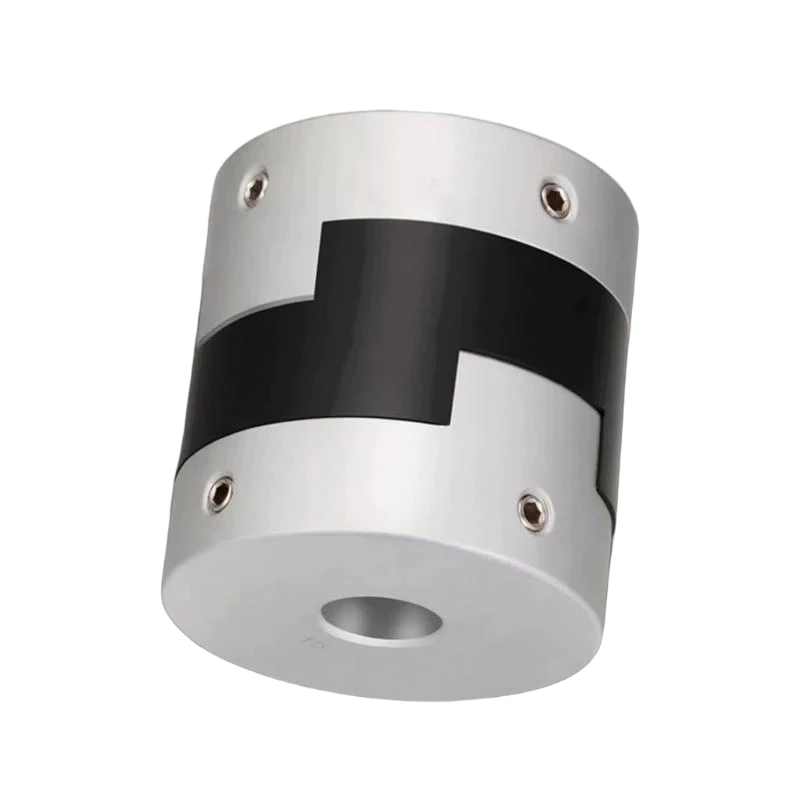
EP6-40 Set Screw Oldham Coupling — Medium-Duty Three-Piece Flexible Joint for Machine Tools and Automation Gantries
The EP6-40 Oldham coupling opens the medium-duty band of the EP6 family. At 40 mm outside diameter, 35 mm overall length, and a torque envelope of 9 N·m rated / 18 N·m peak at 3 600 rpm, this set-screw coupling sits at the crossover point where benchtop automation gives way to floor-mounted production hardware. Four catalogue bore options — 12, 14, 15, and 16 mm — cover the dominant shaft diameters of NEMA 23 and NEMA 24 servomotors, larger stepper drives, and the entry-level industrial ball-screws (Φ16 mm class) that anchor gantry routers, sub-spindle indexers, and pick-and-place arms.
The reason design engineers select the EP6-40 specifically — rather than dropping back to an EP6-32 with a hub adapter, or stepping up to an EP6-50 — is the marriage of substantial torsional stiffness (505 N·m/rad) with low reflected inertia (2.1 × 10⁻⁵ kg·m²). That combination places the first coupling-driven mechanical pole well above 200 Hz for typical drive lines, leaving the entire usable servo bandwidth clean of any parasitic compliance. In machine-tool spindle integrators’ language: the EP6-40 is “invisible” to the velocity loop.
Specifications
| Parameter | Value |
|---|---|
| Model | EP6-40 |
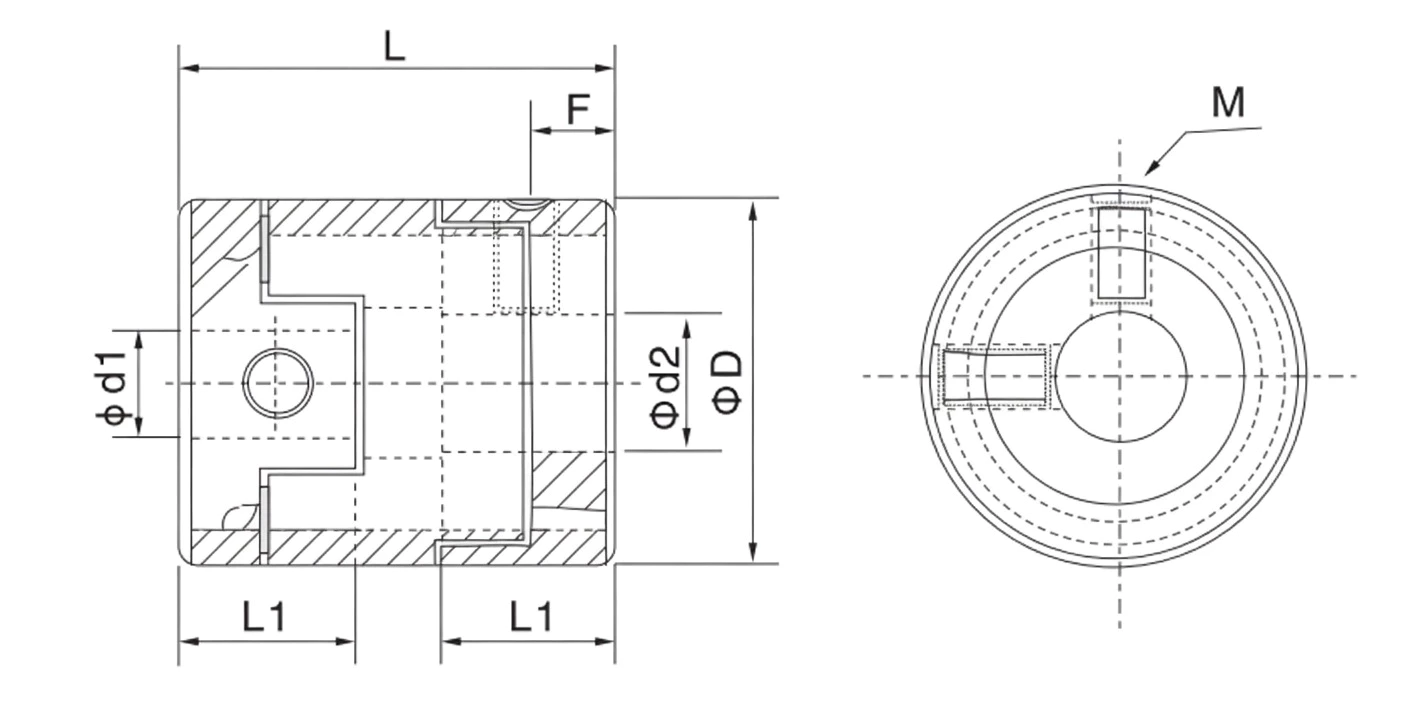
| Outside Diameter (ΦD) | 40 mm |
| Overall Length (L) | 35 mm |
| Bore Range (d1 / d2) | 12, 14, 15, 16 mm |
| Rated Torque | 9.0 N·m |
| Maximum Torque | 18 N·m |
| Maximum Rotational Speed | 3 600 rpm |
| Moment of Inertia | 2.1 × 10⁻⁵ kg·m² |
| Static Torsional Stiffness | 505 N·m/rad |
| Parallel Misalignment | 2.8 mm |
| Angular Misalignment | 3.0° |
| Set-screw Thread | M6 |
| Wrench Tightening Torque | 7.0 N·m |
| Mass (max bore) | 80 g |
| Backlash | Zero |
Materials
Reinforced Aluminum Hubs
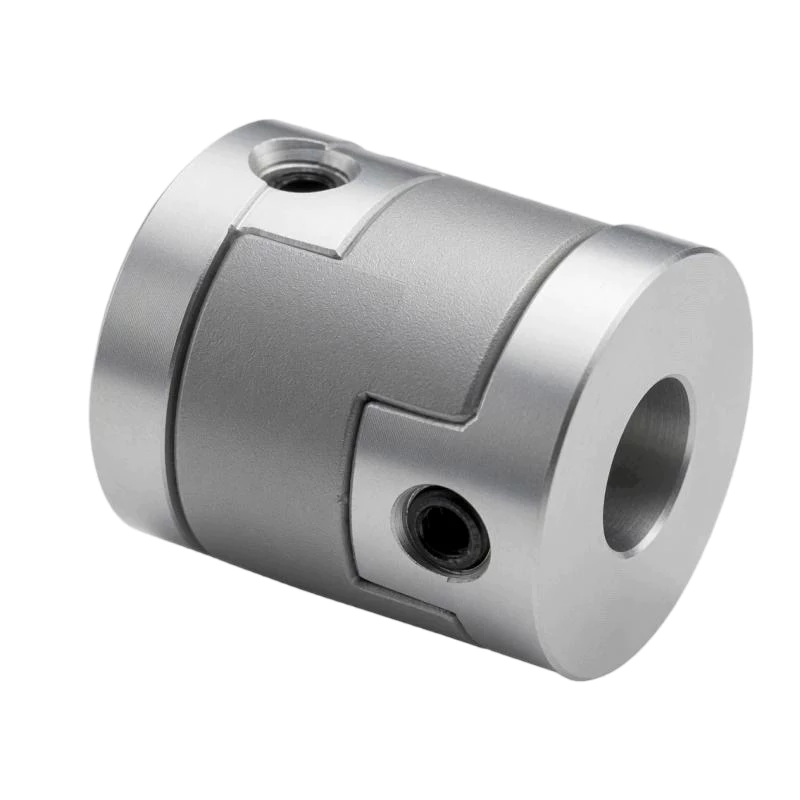
Hubs are CNC-machined from A6061-T6 aluminum, hard-anodised for surface hardness and dimensional stability. The 6061 alloy was chosen over the lighter 2017 grade used in smaller EP6 sizes because the higher copper content of 2017 raises stress-corrosion risk at the higher cyclic loads of an EP6-40 duty cycle. Stainless-steel hub variants are available for food, pharmaceutical, or marine deployments.
Glass-Reinforced POM Slider
The catalogue slider is 15 % glass-fibre-reinforced POM-H (GF-POM). This grade delivers the flexural stiffness needed at 9 N·m duty, retains its dimensional stability through repeated thermal cycles, and offers a slightly higher continuous-service temperature ceiling (+110 °C) than neat POM. PTFE-filled and PEEK alternatives are released through engineering review for high-temperature or chemically aggressive environments.
High-Strength Fastener Set
Two SUS304 M6 cup-point set screws per hub at 90°, with a 7.0 N·m wrench torque specification. For high-vibration applications the set screws are available with pre-applied dry-film thread locker, eliminating the operator step of dispensing liquid Loctite during installation.
How the EP6-40 Performs in Closed-Loop Drives
An EP6-40 commonly sits between a 400-W to 750-W servomotor and a ball-screw or belt-drive load. The mechanical question the design engineer must answer is: where does the coupling appear in the open-loop transfer function? At 505 N·m/rad of torsional stiffness, paired with a typical 5–10 kg·cm² reflected load inertia, the answer is: the first coupling pole sits above 250 Hz — comfortably above the 50–100 Hz unity-gain crossover frequency of a well-tuned servo loop.
That margin matters in practice because it means the velocity-loop gain can be tuned without the coupling becoming the limiting compliance in the system. The phase margin at crossover is preserved. The result is the snappy, well-damped step response that machine-tool buyers expect from a modern servo drive. By contrast, a bellows or beam coupling of equivalent size typically introduces a torsional pole below 100 Hz, which forces a backed-off velocity-loop gain — a tuning compromise that shows up as visibly slower settling time on production hardware.
For details on coupling-induced resonance and tuning interactions, our technical resources include open-loop Bode plot worked examples.
Industry Applications
Sub-Spindle & Tool-Turret Drives
Driven-tool and sub-spindle indexers on CNC turning centres. Zero backlash preserves the index-position repeatability that determines tool-change reliability.
Industrial Gantry Routers
X- and Y-axis ball-screw drives in mid-format CNC routers and laser cutters. The 2.8 mm parallel allowance forgives the welded gantry-rail mounting tolerance.
High-Cycle Filling Machinery
Bottle-twist and orient stations on beverage filling lines. The EP6-40’s GF-POM slider survives the 12 000+ cycle-per-hour duty without measurable wear.
Textile Machinery Drives
Take-up roller and tension-arm drives in narrow-fabric, label, and ribbon weaving lines. Constant-velocity transmission prevents the weft-density variations that show up as visible defects in finished textile.
️ Hydraulic Pump Drive Trains
Coupling between electric motor and low-pressure hydraulic pump in mobile and stationary hydraulic power packs. Misalignment tolerance protects pump bearings from premature failure.
️ Construction-Equipment Sub-Drives
Auxiliary drive lines on small construction equipment — concrete-pump grout dispensers, mortar-mixer auger drives. Coupling shock-loads damped by the polymer slider.
Why Choose Ever-power
Certifications & Quality Records
Ever-power is certified to ISO 9001:2015 for design and manufacture of flexible couplings. Every EP6-40 batch ships with traceable material certs, RoHS/REACH declarations of conformity, and on-request CE documentation for European integration. For automotive-grade OEMs, IATF 16949 audit history is shared on a confidentiality basis.
Customisation Beyond Standard Bores
Catalogue bores (12 / 14 / 15 / 16 mm) cover the bulk of NEMA 23 / Φ16 mm applications. Custom bores up to 18 mm, keyway broaching to DIN 6885 / JIS B 1301, D-cut shaft flats, asymmetric bore combinations, and stainless-steel hubs are all routine custom-build options with documented lead times.
Application Engineering & Logistics
English-speaking application engineers respond within 24 hours on selection, drawing, and de-rating queries. STEP, IGES, Parasolid, and SolidWorks native CAD models are available for integration into customer design files. Air freight, sea freight, and customer-nominated logistics provider all supported.
Customer Reviews & Case Studies
★★★★★
Japan — CNC Lathe Builder
Used in: Sub-spindle index drive on a Y-axis multi-tasking turning centre.
Feedback: “Velocity-loop tuning was straightforward — the coupling did not appear as a compliance pole in our open-loop sweep down to 150 Hz. Index repeatability measured at the spindle nose is well within our ±5 µm spec. Documentation pack supports our SEMI machine-data deliverables without rework.”
★★★★★
Netherlands — Beverage Line OEM
Used in: Orient-and-twist station of a high-cycle bottle filler running 18 000 BPH.
Feedback: “We needed a coupling that would survive 26 million cycles per year without elastomer fatigue. The EP6-40 has now passed 22 months at this rate. Pre-applied thread locker on the set screws eliminated a recurring assembly inspection step that had been a thorn in our QA process.”
★★★★☆
Spain — Industrial Textile Manufacturer
Used in: Take-up roller drive on a narrow-fabric weaving line, 24/7 duty.
Feedback: “The constant-velocity output is visible in finished cloth quality — weft density variations have been reduced compared to our previous jaw coupling. Mark down one star only because we wish a 17 mm bore option were available off the shelf. Custom-bored unit was delivered as promised.”
Frequently Asked Questions
What is the breakaway friction torque of the slider?
For a properly aligned EP6-40 with no offset, the slider’s breakaway friction is below 0.05 N·m — effectively negligible against the 9 N·m rated transmission. With 1 mm of parallel offset, breakaway rises to roughly 0.15 N·m, still well below 2 % of rated torque.
Does the EP6-40 require any preventive maintenance?
No scheduled maintenance is required for the catalogue duty cycle. Periodic visual inspection of the slider for unusual wear, and a torque check on the set screws every 5 000 operating hours, is the recommended best practice — no relubrication or replacement is needed until end-of-life is reached.
Are there marine-grade or wash-down variants?
Yes. A stainless-steel hub variant with PTFE-filled POM slider is released for direct salt-spray and wash-down environments. This variant has been tested for IP67-equivalent performance in customer applications, although the coupling itself has no IP rating — sealing is provided by the host enclosure.
Can the coupling absorb shock-load events?
The polymer slider acts as a sacrificial damper for momentary shock events up to the 18 N·m peak rating. For dedicated shock-protection applications — e.g., emergency-stop arrest loads — please specify “shock-absorbing slider” and engineering will release a softer-durometer POM variant.
How does the EP6-40 compare to the clamp-type EP6C-40?
Mechanically identical in terms of slider geometry, torque rating, and misalignment tolerance. The EP6C-40 substitutes a split-collar clamp for the two set screws — useful where the shaft cannot be marked by a set-screw point, or where set-up time must be minimised. Specify the EP6-40 for cost-sensitive installations; the EP6C-40 for hardened motor shafts or quick-service requirements.
Quote the EP6-40 for Your Next Build
From single-piece prototype builds to volume MRP supply contracts, Ever-power supports the EP6-40 across the lifecycle of your product. Browse the rest of our coupling catalogue, read about our manufacturing pedigree, or proceed directly to a B2B enquiry below.