Description
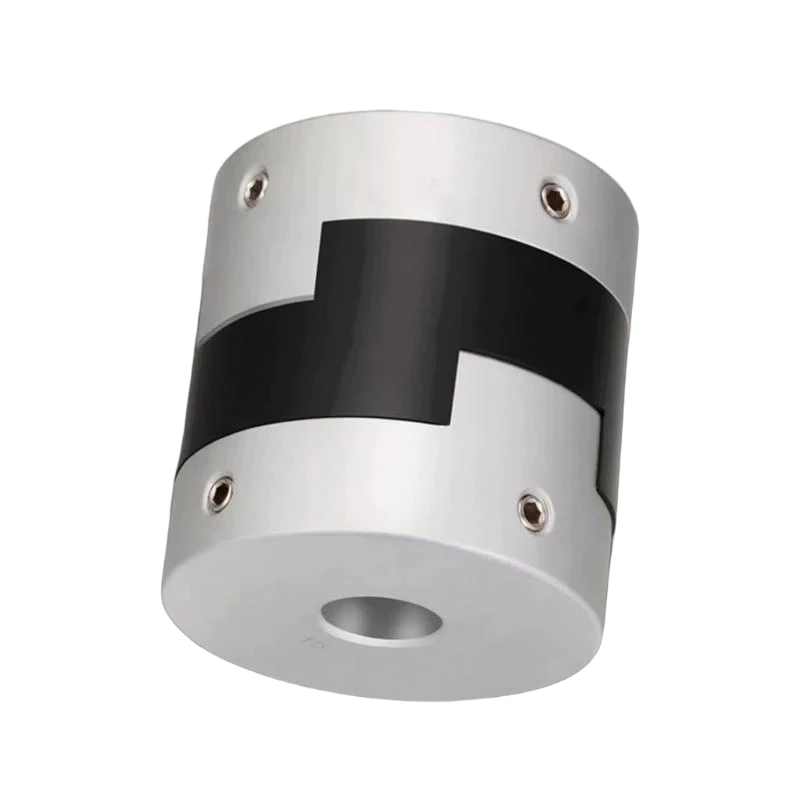
EP6-63 Set Screw Oldham Coupling — 63 mm Three-Piece Slider for Print, Textile and Process Drives
The EP6-63 Oldham coupling covers the upper-middle band of the EP6 set-screw family — the duty class where an integrator is no longer specifying for benchtop automation but for fully-fledged industrial drive lines. With a 63 mm outside diameter, 47 mm overall length, and six catalogue bore options that span 16, 18, 19, 20, 24, and 25 mm, the EP6-63 mates directly to the dominant shaft sizes of 1.5–3.0 kW servo-motor outputs, larger ball-screws, and the shaft-extension stubs of gear-reducer outputs. Rated 33 N·m continuous / 66 N·m peak at 2 400 rpm, it carries the design margin to survive the realistic shock-load profile of paper print rolls, textile take-up drives, and process-machinery agitators.
For purchasing engineers, the EP6-63 represents a price-performance breakpoint: it is materially less expensive to integrate than a steel-disc-pack coupling of equivalent torque, requires no disc-pack timing during installation, and tolerates roughly an order of magnitude more parallel misalignment than a comparable bellows coupling. The trade-off is the polymer slider’s gradual wear over years of service — a wear that is visible, predictable, and addressable through a simple disc-replacement operation that takes minutes rather than hours.
Specifications
| Parameter | Value |
|---|---|
| Model | EP6-63 |
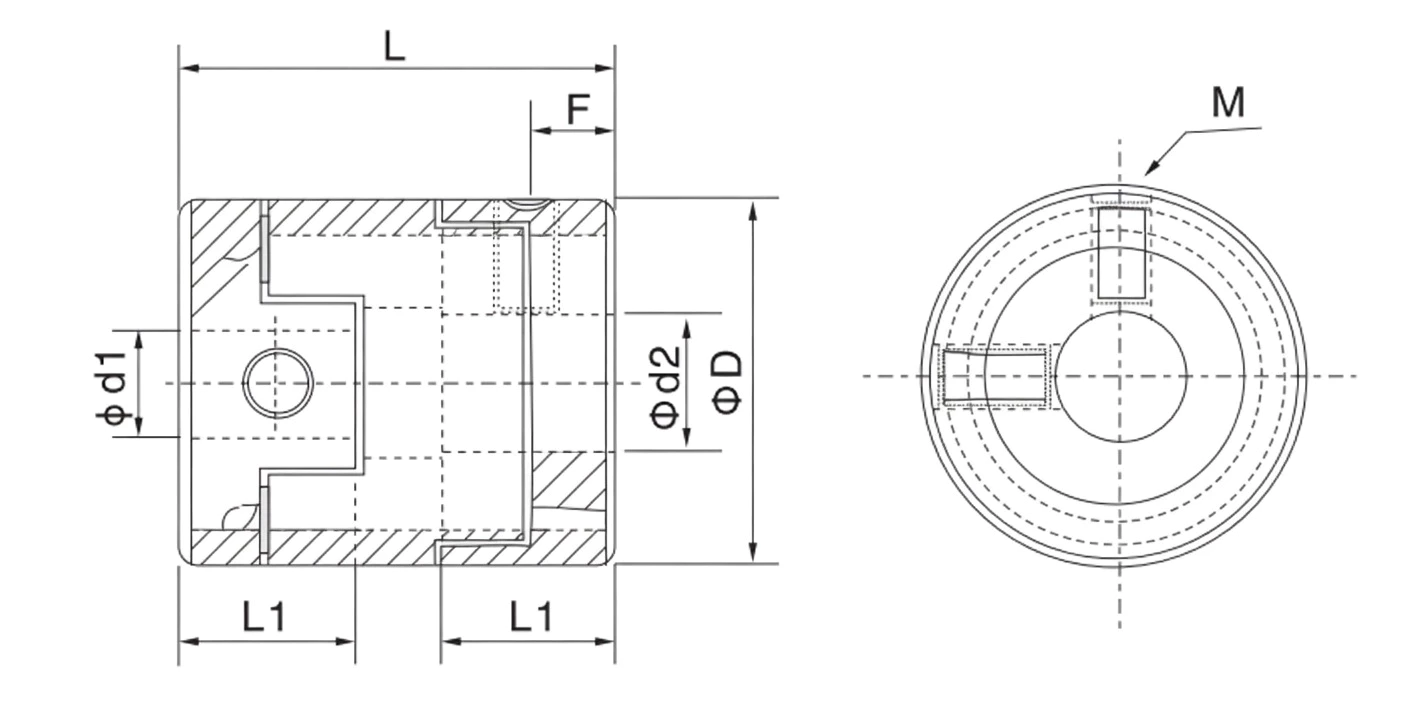
| Outside Diameter (ΦD) | 63 mm |
| Overall Length (L) | 47 mm |
| Bore Range (d1 / d2) | 16, 18, 19, 20, 24, 25 mm |
| Rated Torque | 33 N·m |
| Maximum Torque | 66 N·m |
| Maximum Rotational Speed | 2 400 rpm |
| Moment of Inertia | 2.1 × 10⁻⁴ kg·m² |
| Static Torsional Stiffness | 1 200 N·m/rad |
| Parallel Misalignment | 3.8 mm |
| Angular Misalignment | 3.0° |
| Set-screw Thread | M10 |
| Wrench Tightening Torque | 30 N·m |
| Mass (max bore) | 318 g |
| Backlash | Zero |
Materials
A6061-T6 Aluminum Hubs
Hubs are CNC-turned from 6061-T6 aluminum bar and hard-anodised to 50 µm coat thickness. The choice of 6061 over the lighter-but-more-stress-corrosion-prone 2017 alloy reflects the heavier-duty service profile: at 33 N·m continuous, with cyclic shock-load contributions, the 6061 alloy’s superior fatigue performance is the safer engineering bet.
High-Performance Polymer Slider
Standard slider is 15 % glass-fibre-reinforced POM-H. For high-temperature service (above +110 °C continuous), a virgin PEEK slider is offered as a documented upgrade — reach our engineering desk for the de-rating curve. PTFE-impregnated POM is the option for chemically aggressive environments such as pulp-and-paper or fertiliser handling.
M10 Heavy Set Screws
Two M10 SUS304 stainless set screws per hub, separated by 90°. The 30 N·m wrench torque specification develops a clamping force adequate to lock the hub against the 66 N·m peak torque envelope. Cup-point geometry digs into the shaft surface, providing positive engagement even on lightly oxidised motor shafts.
Application Considerations at This Power Level
At 33 N·m / 2 400 rpm, the EP6-63 transmits roughly 8 kW of continuous mechanical power. The engineering questions shift accordingly: thermal-growth tolerance becomes a primary design driver, and the consequence of coupling failure changes from “production-line slowdown” to “unscheduled outage with downstream value chain impact”. This is why fleet operators on large-format printing presses, continuous textile lines, and chemical-process trains specify the EP6-63 in preference to nominally similar jaw or beam couplings: the architecture’s failure mode is gradual polymer wear, which is detectable on routine inspection and replaceable in less than a shift, not catastrophic metal fatigue, which can fail at any moment of duty.
A second consideration that emerges at this size: the EP6-63’s 3.8 mm parallel-misalignment allowance is enough to forgive the manufacturing tolerance of welded steel-fabrication frames, which is typically ±2 mm per joint. Many integrators have used the EP6-63 specifically to relax the tolerance budget on their machine frame — saving substantial fabrication cost without compromising drive-train reliability. For a deeper discussion see our Oldham coupling selection guide.
Industry Applications
️ Print Roll & Press Drives
Plate-roll and impression-cylinder drives in flexographic and offset printing presses. Constant-velocity transmission preserves register-mark accuracy across multi-colour passes.
Textile Process Trains
Dyeing-machine, calender, and tenter-frame drive shafts. The 3.8 mm parallel allowance forgives the cumulative misalignment of long process trains.
Web-Handling & Slitting
Unwind/rewind drives, slitter shafts, and tension-controlled web carriages. Zero backlash is critical to maintaining web tension across speed transitions.
️ Process Pumps & Blowers
Mid-sized centrifugal pumps and lobe blowers in process and waste-water treatment plants. Thermal-growth tolerance protects pump alignment through start-stop cycles.
️ Light Construction Equipment
Mortar mixer drives, small concrete-pump auxiliary lines, and asphalt-mixer agitators. The slider absorbs the shock loads of intermittent material loading.
⚙️ Gear-Reducer Output Stages
Coupling between worm- or helical-gear reducer output shaft and downstream load. Acts as a thermal-growth buffer between the reducer housing and the load housing.
Why Choose Ever-power
Quality Documentation
EP6-63 production runs under an ISO 9001:2015 management system. Material certifications, dimensional reports, and conformity statements (RoHS, REACH, CE on request) ship with every order. For pulp-and-paper customers, supplemental statements covering chlorine-containing process-chemical compatibility are available.
Customisation
Standard catalogue bores cover the 16–25 mm range; oversized bores up to 28 mm and undersized bores down to 12 mm are produced regularly. Keyway broaching, asymmetric bore combinations, stainless hub variants, and PEEK slider upgrades are documented custom-build options. Lead times are quoted per request and typically add 5–10 working days over catalogue.
Aftermarket & Support
Spare PEEK and POM centre discs for the EP6-63 are stocked separately and ship in 2 business days. Engineering desk responds within 24 hours in English. For OEM partnerships, Ever-power maintains buffer stock at customer-specified levels to support JIT delivery to assembly plants in Europe, North America, and Asia.
Customer Reviews & Case Studies
★★★★★
Sweden — Flexographic Press Builder
Used in: Plate-roll drive on a 1.4 m wide 8-colour flexo press for flexible packaging.
Feedback: “Register-mark consistency across all 8 colours is visibly improved over our previous bellows-coupling specification. The wider parallel-offset tolerance also allowed us to drop one shimming operation from our cabinet assembly process — saving roughly 40 minutes per machine build. Ever-power’s documentation pack passed our internal QMS audit on first review.”
★★★★★
Czech Republic — Industrial Dyeing Machinery
Used in: Continuous-dye line take-up drive, running 24/6 with three-shift operation.
Feedback: “The PEEK slider variant we specified for compatibility with our reactive-dye chemistry has survived 18 months of continuous service without measurable wear. Misalignment tolerance was a clear improvement over the previous Lovejoy-style spider coupling. Lead time for the custom PEEK build was on-promise — 14 working days from PO.”
★★★★☆
Saudi Arabia — Process-Water Treatment Plant
Used in: Centrifugal-pump drive train, indoor MCC pump room.
Feedback: “Indoor ambient reaches 45 °C during summer. The catalogue GF-POM slider has handled this comfortably. Knock one star only because we wish for an inch-bore option without custom-build lead time. Ever-power’s flagged a future catalogue addition that should address this.”
Frequently Asked Questions
How long does a typical PEEK slider variant last?
PEEK sliders in chemical-process service typically reach 8 years of continuous duty before measurable wear, against 5–6 years for the standard GF-POM compound. PEEK is also more chemically inert, so process upset events that would degrade POM (acid spills, alkali wash) have less impact on the PEEK variant.
Can the EP6-63 be specified for explosion-hazard areas?
The coupling itself contains no electrical components and does not require ATEX or IECEx certification in isolation. For explosion-hazard zones, please specify a conductive (carbon-loaded) slider variant to prevent static-electricity buildup, and confirm the host motor and enclosure carry the appropriate Ex rating.
What is the minimum bore-to-OD ratio I can specify?
The catalogue minimum bore is 16 mm; engineering can release a 12 mm bore variant on request, although the reduced material section reduces the safety margin against set-screw stripping. For bores below 16 mm we recommend a smaller EP6 size to maintain the cataloged set-screw torque envelope.
Does the EP6-63 carry a CE mark?
As a sub-assembly, the EP6-63 does not require an independent CE mark — it is supplied with a Declaration of Conformity that supports the host machine’s CE-marking process under the Machinery Directive. Ever-power’s QMS documentation provides the audit trail required by integrators.
How do I order spare slider discs?
Spare slider discs for the EP6-63 are stocked under part number EP6-63-DISC (POM standard) and EP6-63-DISC-PEEK (PEEK upgrade). Order via the standard sales channel; minimum order quantity is 5 pieces, shipped in 2 business days from confirmed PO.
Specify EP6-63 for Your Build
The EP6-63 is one of Ever-power’s most widely supplied industrial Oldham couplings, with active installations across printing, textile, and process-machinery OEMs in over 40 countries. Browse the wider Oldham coupling catalogue, read about our supply network capabilities, or proceed directly to a B2B quote enquiry below.