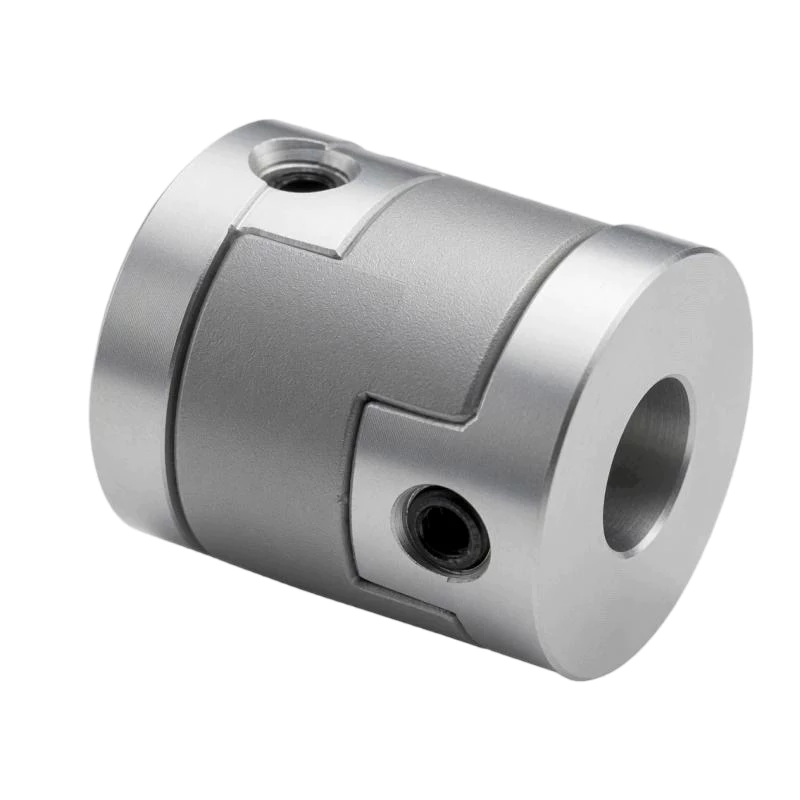
Of all the places an Oldham coupling appears in a motion control system, none is more demanding — or more revealing of the coupling’s unique strengths — than the connection between a rotating shaft and a rotary feedback device such as an incremental encoder, an absolute encoder, or a resolver. These devices convert shaft angular position into an electrical signal, and the quality of that signal depends directly on the quality of the mechanical coupling between the shaft and the device’s input rotor. A coupling with backlash, compliance, or bearing-loading effects will corrupt the signal in ways that cascade through the entire control system.
This article explains why the Oldham coupling — particularly in its miniature form — has become the standard for encoder and resolver shaft connections in precision motion systems worldwide.
What Encoders and Resolvers Actually Measure
A rotary encoder or resolver is fundamentally a transducer: it converts the angular position of a shaft into an electrical output that a motion controller can interpret. Incremental encoders output a pulse train with a defined number of pulses per revolution; the controller counts pulses to determine relative position change. Absolute encoders output a digital word that directly represents the shaft’s angular position within one revolution (single-turn) or over multiple revolutions (multi-turn). Resolvers output a pair of sinusoidal voltages whose amplitude ratio encodes shaft angle.
In all cases, the electrical output is only as accurate as the mechanical input. If the coupling between the driven shaft and the encoder’s input shaft introduces any angular error — however small — that error is reported to the controller as if it were real shaft motion. The controller then acts on incorrect position data, producing positioning errors, velocity ripple, or instability in the control loop that cannot be corrected in software because the controller does not know the error exists.
The Backlash Problem in Feedback Couplings
Consider a servo axis using a motor-mounted encoder for position feedback. If the coupling between the motor shaft and the encoder has 0.1 degrees of backlash, here is what the controller experiences at every directional reversal:
The motor begins rotating in the new direction. The encoder, however, does not report any movement for the first 0.1 degrees because the backlash dead zone must be traversed before the coupling transmits motion to the encoder rotor. During this dead zone, the controller sees no position feedback change and therefore continues commanding increasing torque to close the position error. By the time the backlash is taken up and the encoder begins reporting movement, the motor has overshot the target slightly. The controller now needs to reverse slightly to correct — and at that reversal, the 0.1-degree dead zone reappears.
The result is a limit cycle: a small, sustained oscillation around the target position that the controller cannot damp because the coupling backlash makes the plant model discontinuous. On a machined surface, this manifests as a characteristic flat spot or directional reversal mark. In a velocity-controlled system, it produces velocity ripple at the reversal frequency.
Even 0.01 degrees of backlash — an amount that seems negligible — can cause measurable degradation in a high-resolution encoder system. A 5,000-line encoder has a native resolution of 0.072 degrees per quadrature count; 0.01 degrees of backlash represents roughly one count of positional uncertainty at every reversal.
Why the Oldham Coupling’s Zero-Backlash Property Is Critical Here
The Oldham coupling’s tenon-and-slot mechanism creates a positive form-fit connection with no angular free play. When the driving shaft reverses direction, the encoder shaft follows immediately — within the mechanical play tolerance of the coupling, which in a precision miniature Oldham coupling is measured in arc-seconds, not arc-minutes.
This immediate, backlash-free response means the encoder reports the actual shaft position at all times, including during direction reversals. The control loop receives clean, accurate feedback data and can operate at its designed bandwidth without the limit cycling or gain limitation that backlash would impose.
For comparison, a bellows coupling also provides zero backlash — but as discussed below, it has a critical limitation in encoder applications that the Oldham coupling does not share.
Electrical Isolation: Protecting the Encoder Electronics
Rotary encoders and resolvers are precision electronic instruments. Their internal optical discs, magnetic sensors, or transformer windings are designed to operate in a clean electrical environment. Many are sensitive enough that stray currents of a few milliamperes flowing through the encoder shaft and housing can damage the internal electronics or corrupt the output signal.
In motor-driven systems, the motor shaft is often at a different electrical potential from earth due to capacitive coupling through the motor’s winding-to-rotor parasitic capacitance. Variable frequency drives (VFDs) and servo amplifiers using pulse-width modulation switching frequencies of several kilohertz generate particularly aggressive shaft voltage waveforms. If the encoder is electrically connected to the motor shaft through a metal coupling, these shaft voltages can drive bearing currents and switching transients through the encoder’s sensitive electronics.
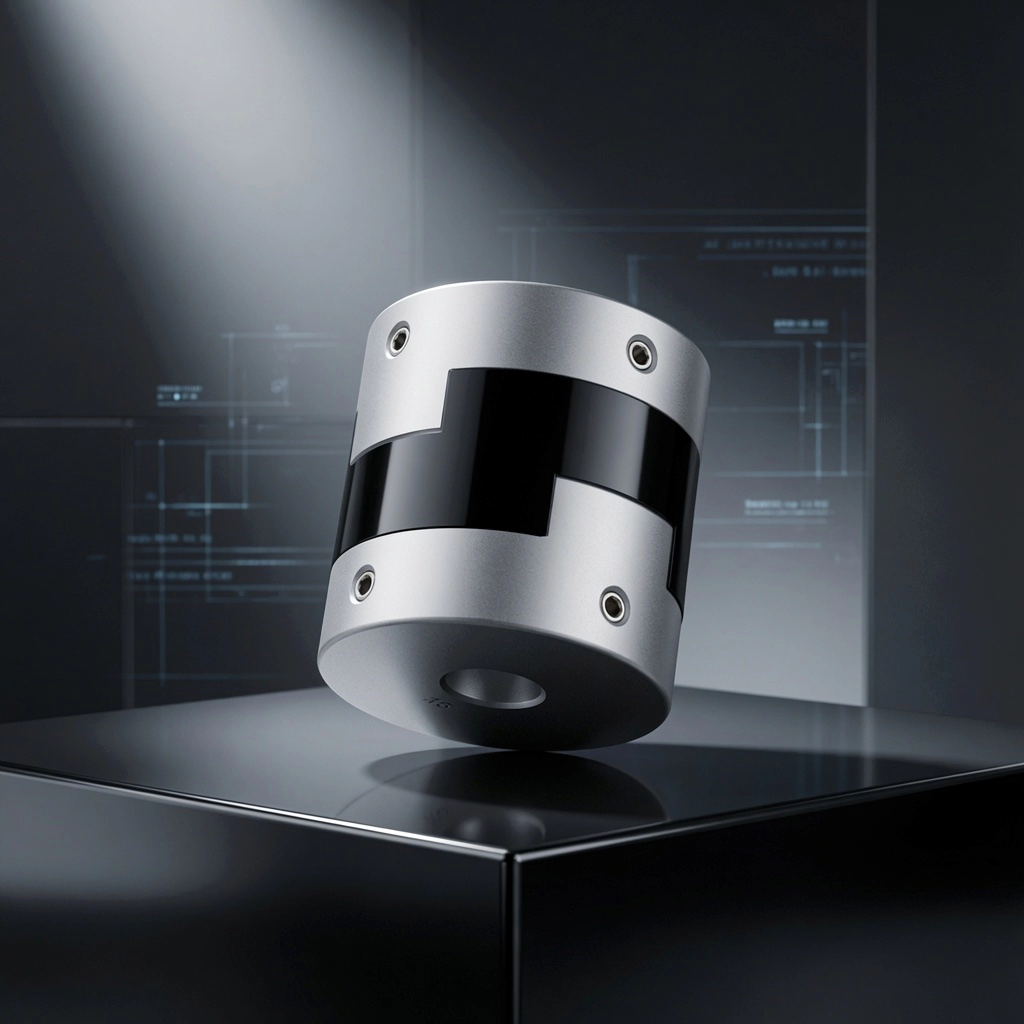
The Oldham coupling with a polymer centre disc provides complete galvanic isolation between the driving shaft and the encoder shaft. No electrical current can flow between the two shafts through the coupling because the acetal or nylon disc is a non-conductor. This is a unique property that no all-metal coupling type can replicate without the addition of separate insulation elements.
In practice, this electrical isolation eliminates an entire class of encoder failures that occur regularly in drive systems using metal couplings — premature bearing failure in the encoder, corrupted output due to induced noise, and electrostatic discharge damage to CMOS circuits inside the encoder housing.
Why Bellows Couplings Cannot Replace Oldham Couplings Here
Bellows couplings are also zero-backlash and are widely used in encoder connections. However, they have a critical weakness in this application: they transmit radial reaction forces to the encoder’s internal bearings when lateral shaft offset is present.
Encoder and resolver bearings are typically miniature precision bearings — 6900 or 6800 series deep groove ball bearings with bore sizes of 10 mm or less. These bearings are designed to carry only the axial preload applied by the encoder manufacturer to maintain the rotor’s axial position. They are not designed to carry significant radial loads.
A bellows coupling with 0.3 mm of lateral offset will apply a radial restoring force of several Newtons to the encoder shaft. On an encoder bearing that is rated for a few Newtons of axial preload, this radial force dramatically reduces bearing life — potentially from tens of thousands of hours to a few hundred hours. It also increases the friction torque that the coupling must overcome to drive the encoder rotor, which can introduce velocity-dependent angle errors in some encoder types.
The Oldham coupling applies essentially zero radial force to the encoder bearings regardless of lateral offset. The offset is absorbed entirely by the sliding disc, and the encoder bearings see only their designed preload. This is why encoder manufacturers consistently recommend Oldham couplings — or couplings that function on the same sliding-disc principle — for their products.
Low Inertia: Maintaining Encoder Response Fidelity
The coupling inertia adds directly to the inertia that the encoder rotor and shaft must accelerate and decelerate. In a servo system operating at high bandwidth — with axis accelerations of 10 m/s² or more on a linear stage, corresponding to thousands of degrees per second squared at the encoder shaft — a coupling with high inertia acts as a low-pass filter between the shaft motion and the encoder’s reported position.
Miniature Oldham couplings, with their lightweight aluminium hubs and small polymer disc, have among the lowest inertia values of any zero-backlash coupling type in the same bore size range. For encoder applications, coupling inertia values in the range of 0.1 to 1.0 g·cm² are typical — low enough to have a negligible effect on encoder response fidelity even at high servo bandwidths.
Specific Application Scenarios
Motor shaft to external encoder (dual feedback): High-performance servo systems sometimes use a second encoder mounted directly on the load side (for example, at the end of a ballscrew) in addition to the motor-mounted encoder. The Oldham coupling connects the ballscrew shaft to this load-side encoder, compensating for any lateral offset between the screw axis and the encoder centreline while providing the clean, backlash-free signal that makes dual-feedback control meaningful.
Rotary table to angle encoder: High-accuracy rotary tables use a large-diameter angle encoder (such as a Heidenhain RON or SICK HIPERFACE device) mounted directly on the table’s output shaft. The coupling between the table bearing journal and the encoder input must be rigid enough to avoid torsional compliance while absorbing the thermal and mechanical runout of the bearing system without loading the encoder. Miniature Oldham couplings in the 20–50 mm bore range serve this function.
Gearbox output to position encoder: Many industrial robots, rotary actuators, and index drives use an encoder on the gearbox output shaft rather than the motor input to measure load position directly. The coupling between the gearbox shaft and the encoder must tolerate the angular and lateral runout of the gearbox output bearing — a function the Oldham coupling handles with its standard lateral offset capacity.
Spindle speed encoder on machine tools: Lathes and machining centres often use an encoder on the spindle to measure spindle speed for threading cycles and spindle-speed override feedback. The spindle bearings have a much larger radial runout than a precision servo bearing; an Oldham coupling absorbs this runout without loading the encoder.
Selection and Installation Guidance
For encoder and resolver applications, the following parameters typically govern selection:
- Bore sizes: Match driving shaft diameter (motor or machine shaft) and driven shaft diameter (encoder shaft — typically 6, 8, or 10 mm for standard industrial encoders). Many miniature Oldham couplings allow different bores on each hub.
- Torque rating: Encoder applications require very little torque — typically 0.05 to 0.5 Nm for most industrial encoders. Almost any miniature Oldham coupling will be more than adequate on this metric; bore size and inertia usually govern selection rather than torque capacity.
- Lateral offset capacity: Specify a coupling whose maximum rated offset is at least twice the expected installation offset, to maintain margin for thermal and mechanical drift over the machine’s service life.
- Hub style: Clamp hubs are strongly preferred for encoder connections. The zero-backlash requirement extends to the hub-shaft interface: a set screw that allows hub micro-slippage under vibration will produce position noise in the encoder output.
At installation, the most important step is to verify that the coupling is not placed under axial compression between the motor shaft and the encoder shaft. Axial compression forces the disc tenons against the hub slot ends, creating a hard stop that transmits axial force into the encoder’s bearings. The correct installation has a small axial clearance — typically 0.5 to 1.0 mm — between the disc and each hub face when the hubs are tightened in their final positions.
Conclusion
The Oldham coupling is not just one option for encoder and resolver connections — it is the technically superior choice for the vast majority of these applications. Its zero backlash eliminates positional dead zones in feedback loops. Its polymer centre disc provides electrical isolation that protects sensitive encoder electronics from shaft voltage and bearing currents. Its sliding disc mechanism absorbs lateral offset without loading the encoder’s miniature bearings. And its low inertia preserves the full bandwidth of the encoder system. No other standard coupling type combines all four of these properties in a single compact package.
View our miniature Oldham coupling range for encoder and resolver applications, or contact our engineering team for selection assistance.