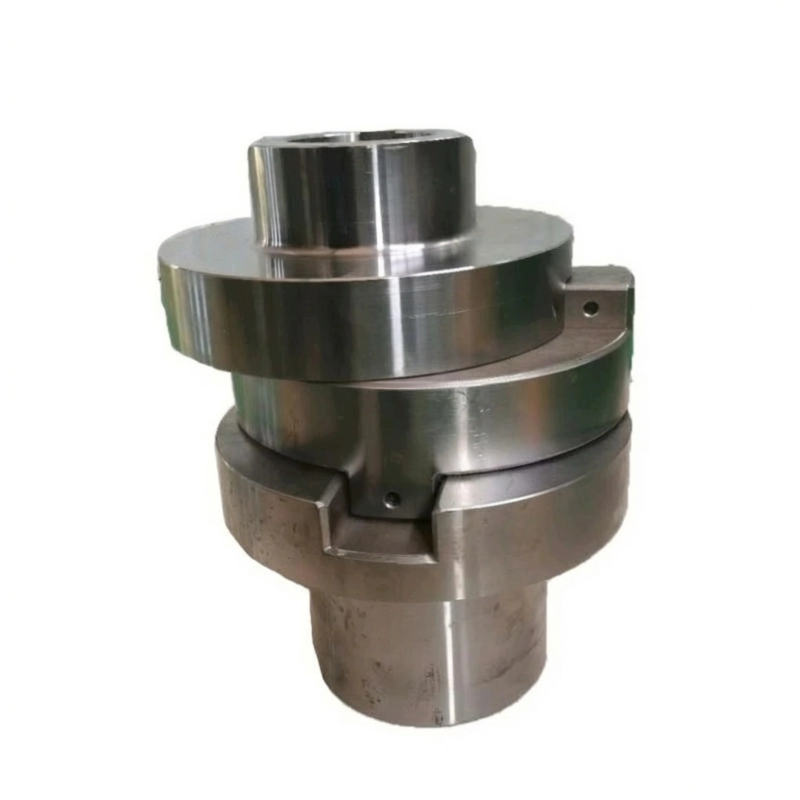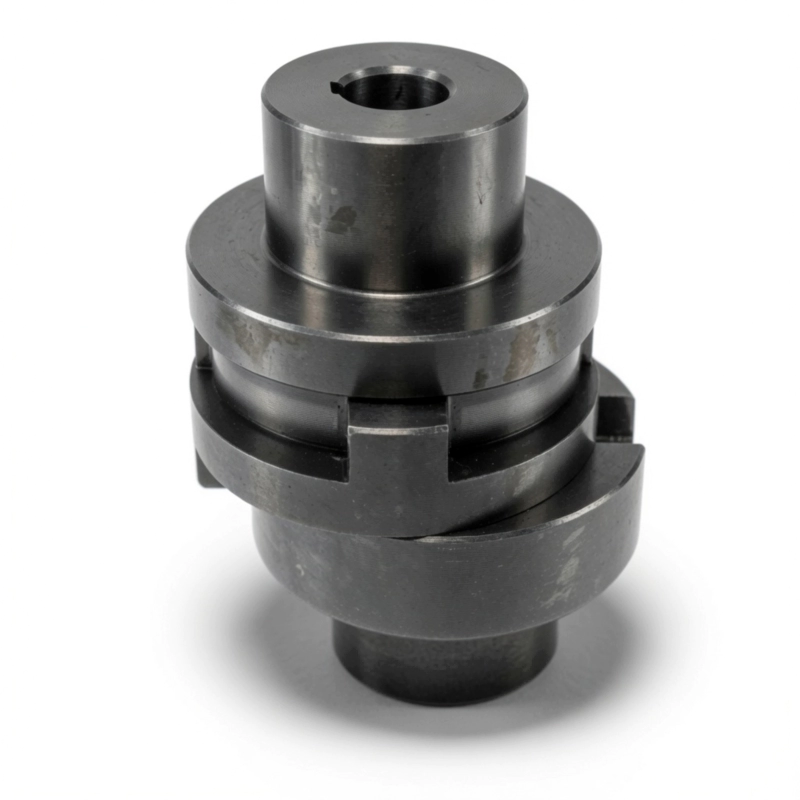
Description
SL170 Heavy-Industrial Cross-Slider Oldham Coupling — 170 mm Cast-Iron Hub for Paper, Dredge and Heavy-Process Drives
The SL170 industrial Oldham coupling marks a step into the territory of genuinely heavy industrial drives. At 2 000 N·m rated torque, 170 mm hub OD, 65–70 mm bore options, and 250 r/min permissible speed, the SL170 transmits continuous mechanical power in the 35–55 kW band. This duty class anchors the workhorse drives in pulp-and-paper machine auxiliaries, large dredge-pump trains, primary process-plant mixers, large bulk-material conveyors with significant headlift, and the heavier end of cement-plant feed-and-handling systems. At these power levels, the coupling specification process moves from commodity selection to engineering review: a senior maintenance or reliability engineer typically signs off on the choice, and the decision will likely outlive that engineer’s tenure with the facility.
For an engineer weighing SL170 against alternatives — gear couplings, disc-pack couplings, fluid couplings, or larger spider-elastomer designs — the SL170’s strongest argument is the breadth of its operating envelope. The 2.6 mm radial-misalignment tolerance, 0.5° angular allowance, and 2.1 mm axial-displacement budget combine into a parallel-offset envelope that no flexible-disc coupling can match without going to a double-coupling spacer-shaft arrangement. At the same time, the cast-iron hub plus hardened-steel slider architecture delivers a failure mode that is gradual and inspectable — not the energy-storage-release failure mode of a flexible disc-pack, not the elastomer-fatigue mode of a spider design.
Specifications
| Parameter | Value |
|---|---|
| Model | SL170 |
| Nominal Torque (Tn) | 2 000 N·m |
| Permissible Speed (n) | 250 r/min |
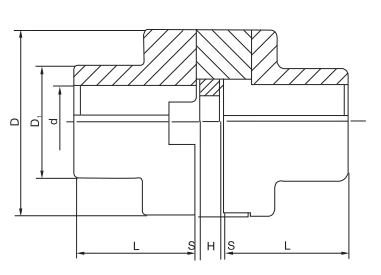
| Bore Range (d) | 65 – 70 mm |
| Outside Diameter (D) | 170 mm |
| Hub Bore Diameter (D₁) | 105 mm |
| Overall Length (L) | 125 mm |
| Slider Plate Thickness (H) | 24 mm |
| Slider Clearance (S) | 0.5 mm |
| Moment of Inertia | 0.25 kg·m² |
| Mass | 22.4 kg |
| Radial Misalignment (Δy) | 2.6 mm |
| Angular Misalignment (Δα) | 0.5° |
| Axial Misalignment (Δx) | 2.1 mm |
| Shaft Engagement | Keyway + setscrew |
| Lubrication | Grease (re-pack annually) |
Materials
HT250 / QT500 Hub Casting
At the SL170’s size and load, hub-section design becomes more demanding. Catalogue specification is HT250 grey cast iron with full stress-relief annealing prior to all machining operations. For paper-mill, pulp-mill, and dredging applications where the shock-load profile is harsh, the QT500-7 nodular-iron variant is documented and recommended — the spheroidal-graphite microstructure raises fracture toughness by approximately 3× over HT250, addressing the dominant failure-risk vector at this scale.
Induction-Hardened Steel Slider
Cross-slider is 45-steel medium-carbon bar, induction-hardened to HRC 45–55 on the four wear surfaces. The 24 mm slider thickness gives substantial section modulus against the 2 000 N·m peak loads, with effectively infinite fatigue life under steady-state torque. 40Cr alloy slider with HRC 55 surface is the documented upgrade for reversal-duty and abrasive-environment installations.
Heavy Industrial Mounting Interface
H7-reamed bore with parallel keyway to GB/T 1096. M16 set-screw for axial location. For larger bore variants (70 mm catalogue, 75 mm engineering-released), taper-bushed mounting using locking assemblies (RINGFEDER 7012, KTR-Clampex) is documented as an alternative that eliminates the keyway-shear failure mode entirely.
Working Principle in 35–55 kW Drive Trains
At 35–55 kW continuous, drive-train designs typically include a soft-start mechanism on the host motor (VFD ramp, slip-clutch, or fluid coupling) specifically to limit the inrush torque that the downstream mechanical components see during start-up. Even with these protections in place, the realistic torque profile on the coupling includes routine 1.5–2× rated-torque excursions, intermittent shock loads from material-feed events, and the cumulative thermal-growth misalignment that accumulates as the drive train reaches operating temperature.
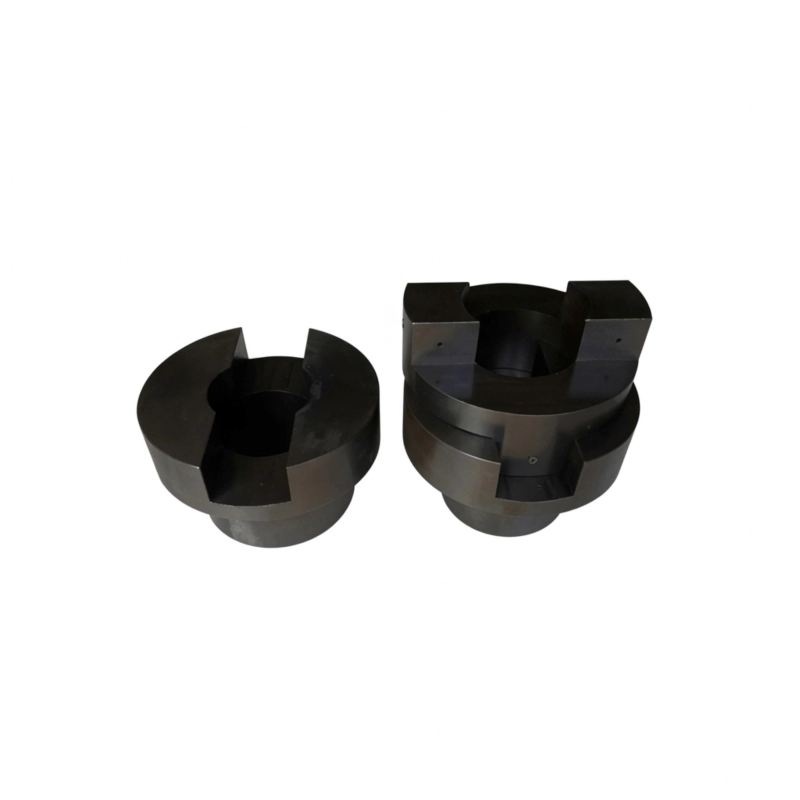
The SL170’s three-piece architecture handles all three of these load profiles without flexure of any metallic component. The slider absorbs misalignment as friction work at four orthogonal sliding interfaces, distributed across the 24 mm thickness. The cast-iron hubs absorb shock-load events through their substantial section modulus, with no fatigue-cycle exposure that would erode service life over time. The grease-lubricated metallic interface tolerates the slow viscosity changes that occur as ambient temperature shifts through annual cycles. The net result is a coupling that exhibits a flat reliability profile across years of duty — exactly the failure characteristic that maintenance planners value above all else.
For broader engineering background on cross-slider mechanics in industrial drives, the Oldham coupling engineering page covers the kinematic and tribological theory in detail.
Industry Applications
Paper-Machine Auxiliary Drives
Press-section, size-press, and calender auxiliary drives on tissue, board, and newsprint machines. Thermal-growth tolerance absorbs the 1–2 mm of frame drift that occurs as a paper machine reaches running temperature.
️ Dredge Pump Trains
Coupling between drive motor and centrifugal dredge-pump suction shaft. QT500 hub variant tolerates the brackish-water spray ambient typical of dredging operations.
Large Mixer Outputs
Reduction-output to impeller-shaft couplings on 40+ kW industrial mixers and blenders. Shock-load absorption protects upstream gear-reducer output bearings during charge-loading events.
Large Grain-Handling
Bucket-elevator head drives on commercial grain elevators and large feed-storage facilities. The 2.6 mm parallel allowance forgives tall-frame deflection under load.
Marine Auxiliary Trains
Bow-thruster auxiliary, capstan, and winch drives on inland barges and small coastal vessels. Cast-iron section resists chloride pitting better than aluminum architectures.
Aggregate Plant Auxiliaries
Conveyor-head and stockpile-feeder drives on aggregate crushing-and-screening plants. Slider absorbs the shock loads of inhomogeneous rock loading.
Why Choose Ever-power
Quality & Documentation
SL170 production runs under ISO 9001:2015. Cast-iron melt traceability with chemical-composition certification per heat. Standard documentation pack covers RoHS, REACH, and CE conformity. For paper-and-pulp customers, supplementary documentation covering pulp-stock and white-water contamination compatibility is available. For marine customers, optional NACE MR0175 sour-service material compatibility statements are issued for QT500-stainless variants.
Customisation Beyond Catalogue
Catalogue bore range 65–70 mm; oversized variants up to 75 mm produced under engineering review. Imperial bore variants (2-1/2″, 2-5/8″, 2-3/4″) supported for North American export. QT500-7 ductile-iron hub upgrade is documented and lead-time-stable for paper-mill, dredge, and marine deployments. Taper-bushed mounting via standard locking assemblies is the documented alternative for installations where keyway shear is a service-life risk factor.
Aftermarket & Supply
SL170 slider plates stocked under part SL170-SLIDER for 2-business-day shipment. 40Cr alloy variant available within 1 week for reversal-duty deployments. English engineering desk responds within 24 hours. For fleet operators, buffer-stock programmes at customer-nominated 3PL warehouses are supported.
Customer Reviews & Case Studies
★★★★★
Lithuania — Paper-Mill Modernisation
Used in: Press-section auxiliary drives across a tissue-paper machine retrofit.
Feedback: “Specified the SL170 across 6 auxiliary drives in this rebuild. Three years of continuous production-mode operation with no coupling-related downtime events. Thermal growth between cold-start and steady-state running has consumed roughly 1.4 mm of the 2.6 mm parallel allowance — clear margin, as designed. Total ownership economics favours this specification over the original Falk grid-coupling design by a clear margin.”
★★★★★
Estonia — Port Dredging Contractor
Used in: Drive coupling on a 250 m³/h cutter-suction dredge pump.
Feedback: “Operating profile is brutal — debris-impact events, brackish-water spray, 12-hour daily duty cycles. QT500 variant has now passed 4 years with one scheduled slider replacement during a planned dry-dock. Cast-iron hubs show no measurable corrosion or wear. Our dredge fleet has now standardised on SL170 across this size class.”
★★★★☆
Latvia — Adhesive & Polymer Manufacturer
Used in: Mixer-output drive coupling on a 5 m³ adhesive reactor.
Feedback: “Reactor temperature cycles between 40 °C cold-charge and 110 °C reaction-peak. The SL170 absorbs the thermal-growth misalignment without imposing radial loads on the reduction-output bearing. Six years in service with one slider replacement. Knock one star only because we wish the synthetic high-temp grease specification were more prominent in the standard documentation — easy to overlook during initial commissioning.”
Frequently Asked Questions
How is torque-de-rated for elevated temperature?
For continuous ambient between +80 °C and +120 °C, apply a 10 % torque de-rating from catalogue. For +120 °C to +150 °C, apply 20 % de-rating and specify a synthetic high-temperature grease (Klüber Asonic GHY or equivalent). Above +150 °C continuous, please consult engineering for a custom slider-clearance variant that accommodates the thermal-expansion behaviour of the metallic stack.
What vibration grade does the SL170 carry?
Standard SL170 production balance meets ISO 1940 G6.3 grade up to 250 r/min. For high-speed special applications above this range, ISO 1940 G2.5 balance is available — please specify at order entry. The cast-iron hub geometry inherently delivers low residual unbalance owing to its rotationally-symmetric mass distribution.
Can the SL170 be used in long-shaft installations?
Yes — a “double-Oldham” spacer-shaft arrangement using two SL170 couplings flanking an intermediate spacer doubles the parallel-misalignment capacity. This is the recommended approach for installations where motor-to-load distance is 0.5–2 m. Ever-power engineering supplies the spacer-shaft assembly drawing on enquiry.
Is the SL170 suitable for TEFC drip-proof installations?
The SL170 has no IP rating in isolation — the slider lubrication is open to ambient. For TEFC drip-proof installations the coupling can be specified with a sealed coupling guard that achieves IP54 enclosure-class performance. The host motor’s TEFC rating is preserved by maintaining a small annular clearance between the coupling guard and the motor end-bell.
What is the recommended commissioning torque check?
After initial installation and the first 100 operating hours, re-check the M16 set-screw torque to 70 N·m. The cast-iron hub will have completed its initial seating onto the shaft by this point, and a small re-tightening pass eliminates any settling-induced slack. Subsequent annual grease-repack visits should include a set-screw torque-check; in routine service no re-tightening is typically needed beyond the 100-hour check.
Quote SL170 for Heavy-Process Drives
For paper-machine, dredging, large mixer, and heavy bulk-handling OEM equipment, the SL170 is one of Ever-power’s most-supplied upper-mid-range cast-iron Oldham couplings. Explore the full SL series catalogue, read about Ever-power’s heavy-process supply capability, or proceed to a B2B enquiry below.