Description
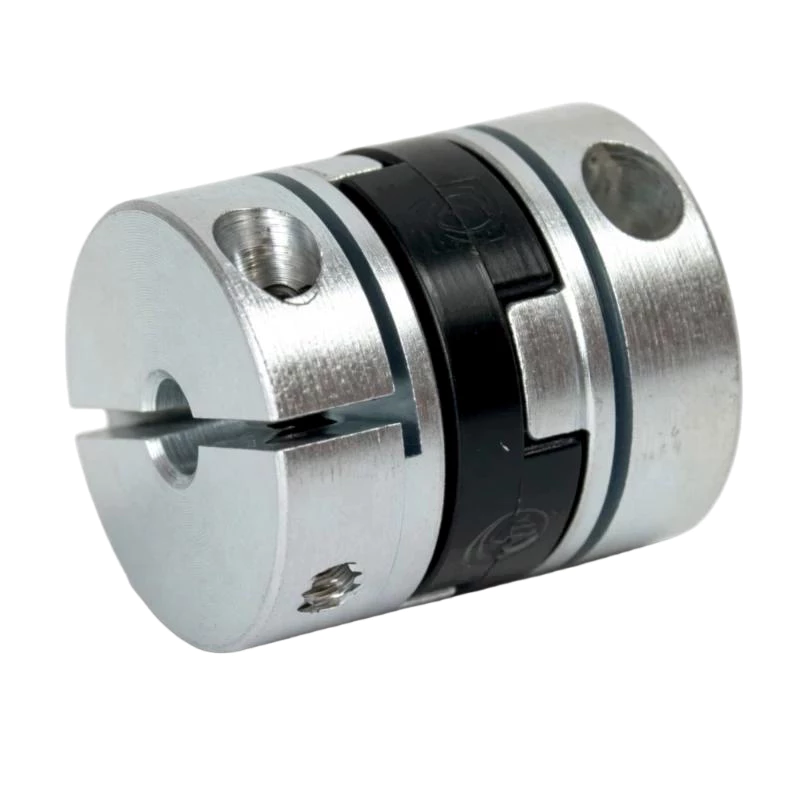
EP6C-32 Clamp Type Oldham Coupling — 32 mm Split-Collar Slider for Modular Industrial Drives
The EP6C-32 clamp Oldham coupling brings the clamp architecture into the duty class where industrial automation begins. With a 32 mm outside diameter, 43 mm overall length, six catalogue bores from 8 mm through 14 mm covering NEMA 23 servomotor and Φ14 mm ball-screw standards, and a torque envelope of 5.5 N·m continuous / 11 N·m peak at 4 700 rpm, the EP6C-32 is sized for the production-machinery drives where rigid couplings would compromise serviceability and set-screw couplings would mark the shaft over years of duty.
Two engineering choices distinguish the EP6C-32 from comparable couplings at this size. First, the clamp screw is upsized to M4 with a 4.0 N·m wrench torque specification — developing approximately 2 400 N of distributed clamping force, sufficient to hold against the 11 N·m peak rating with margin. Second, the slider is upgraded from neat POM to a 15 % glass-fibre-reinforced grade (GF-POM), raising the continuous-service torque capacity at elevated temperature. The combination gives the EP6C-32 the duty profile a service technician on a production floor expects: confidently transmits the load, releases cleanly for service, restores the same clamping force on reassembly, and survives years of duty between any kind of intervention.
Specifications
| Parameter | Value |
|---|---|
| Model | EP6C-32 |
| Outside Diameter (ΦD) | 32 mm |
| Overall Length (L) | 43 mm |
| Hub Length (L1) | 14.0 mm |
| Clamp-Gap Width (F) | 6.0 mm |
| Bore-Centre Distance (E) | 21 mm |
| Bore Range (d1 / d2) | 8, 9.525, 10, 11, 12, 14 mm |
| Rated Torque | 5.5 N·m |
| Maximum Torque | 11 N·m |
| Maximum Rotational Speed | 4 700 rpm |
| Moment of Inertia | 1.2 × 10⁻⁵ kg·m² |
| Static Torsional Stiffness | 260 N·m/rad |
| Parallel Misalignment | 2.4 mm |
| Angular Misalignment | 3.0° |
| Clamp-Screw Thread | M4 |
| Wrench Tightening Torque | 4.0 N·m |
| Mass (max bore) | 66 g |
| Backlash | Zero |
Materials
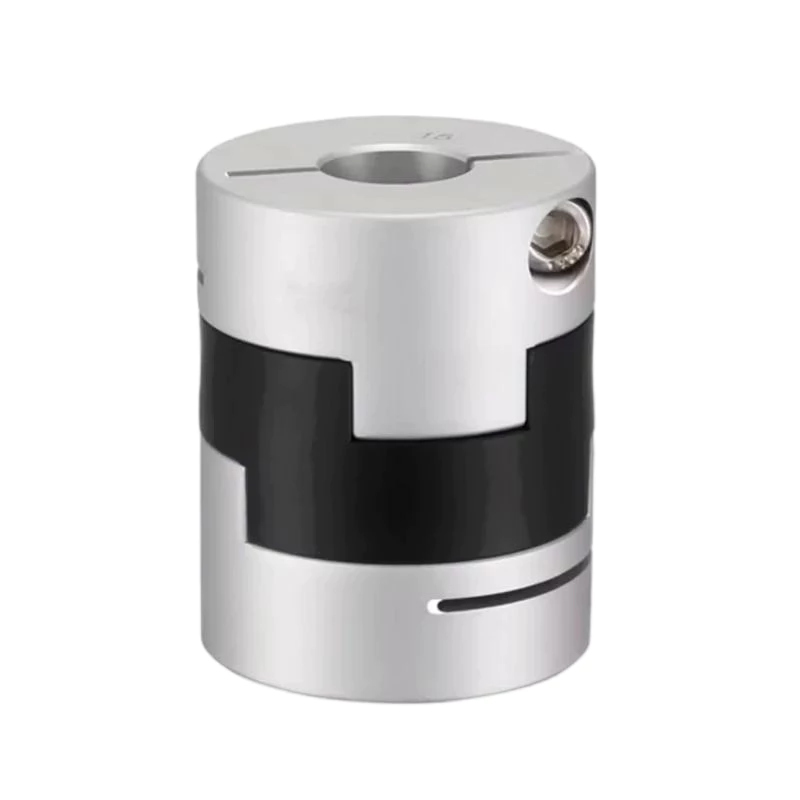
A2017-T4 Aluminum Hubs
CNC-machined from A2017-T4 aluminum bar with hard-anodised surface finish. Clamp-slot width is held to ±0.05 mm — tighter than industry-typical ±0.1 mm — ensuring uniform clamping pressure around the shaft and consistent performance across production batches. Hub mass is held below 30 g per side to keep reflected motor inertia low.
15 % GF-POM Centre Slider
Slider is 15 % glass-fibre-reinforced POM-H, the same compound used on the equivalent EP6-32 set-screw model. The glass loading raises continuous-service torque capacity at the +60 °C to +100 °C ambient range typical of industrial drive cabinets. Carbon-loaded POM is available where ESD-safe operation is needed; PEEK is available for chemically aggressive or high-temperature service.
M4 Heavy Clamp Screws
Single M4 socket-head cap screw per hub, SUS304 stainless A2-70, with cup-point head form for tool-friendly engagement. The 4.0 N·m wrench torque specification develops 2 400 N of clamping force at the split — well in excess of what the peak 11 N·m torque requires. Service torque is reproducible across hundreds of cycles within the screw’s elastic range.
Why the EP6C-32 Earns Production-Floor Approval
The selection battle between set-screw and clamp type Oldham couplings often gets decided in the maintenance review at the end of year one. By that point, a production line has accumulated enough service history to expose the operational characteristics of every component. A set-screw coupling that has been pulled and reinstalled five times has five overlapping dimples on the shaft, gradually shifting the angular reference of the drive train. A clamp coupling that has been pulled and reinstalled fifty times has zero dimples — and the angular reference is whatever it was on the most recent installation.
For high-mix production lines that change format frequently — common in packaging, light assembly, and contract manufacturing — that clean release-and-restore behaviour translates directly into changeover time savings. A line that previously needed a dimple-dressing pass between product changes can now skip that step entirely. A line that previously had to specify a hardened motor shaft (with corresponding cost premium) can now use a standard shaft, knowing that no set-screw will mark the surface. These are the kinds of small operational savings that compound over a fleet of dozens of machines into measurable economic value.
The EP6C-32 also provides the rare combination of high torque density (5.5 N·m / 66 g maximum mass — better than steel-disc-pack alternatives) and field-replaceable wear parts. The polymer slider can be replaced in minutes without removing either hub from its shaft. Slider replacement at end-of-life restores the coupling to as-new specification.
Industry Applications
Modular Packaging Lines
Carriage and indexer drives on form-fill-seal, cartoner, and bag-loader modules. Quick clamp release supports the format-changeover budget of high-mix packaging operations.
Automotive Assembly Sub-Stations
Tightening-spindle and probe-positioning drives on automotive part-assembly cells. Symmetric clamp force preserves the precision-positioning repeatability that determines first-pass-yield metrics.
Glass & Optical Processing
Spindle drives on small-format glass-cutting, lens-grinding, and optical-coating equipment. Clamp engagement preserves hardened spindle shaft surface integrity.
Food-Process Cutting & Slicing
Blade-drive and infeed-roller couplings on cheese, meat, and confectionery slicing lines. POM is FDA-listed; PEEK upgrade available for direct-contact food applications.
Antenna & Radar Positioning
Mid-size azimuth and elevation drives on ground-station antennas and weather-radar pedestals. Clamp engagement preserves the precision shaft surfaces over years of intermittent service.
Battery-Cell Assembly Lines
Tab-welding and electrolyte-fill positioning drives on lithium-cell assembly equipment. Carbon-filled ESD-safe slider available for cleanroom and battery-safety zones.
Why Choose Ever-power
Quality & Documentation
EP6C-32 production runs under ISO 9001:2015 with full material traceability and dimensional inspection records archived per batch. Conformity statements cover RoHS, REACH, and CE as standard. For automotive customers, PPAP-style first-article documentation is offered; for food contact, FDA 21 CFR 177.2470 material certification covers the POM slider.
Customisation
Catalogue bores (8, 9.525, 10, 11, 12, 14 mm) cover NEMA 23 servomotor outputs, Φ12 mm and Φ14 mm ball-screw inputs, and the imperial 3/8″ shaft standard. Beyond catalogue, mixed-bore variants, keyway-broached bores, ESD-safe slider, food-grade slider, and stainless-steel hub variants are all routine custom-build options.
Supply & Aftermarket
Monthly EP6C-32 capacity exceeds 20 000 pieces across the full bore matrix. Spare slider discs ship in 2 business days. English-speaking engineering desk responds within 24 hours. Sea, air, and customer-nominated 3PL logistics are all supported globally.
Customer Reviews & Case Studies
★★★★★
Singapore — Contract Packaging Operator
Used in: Carriage drives across a multi-product cosmetic bottle filling and labelling line. Six product changeovers per week, full clean-down between each.
Feedback: “Format changeover time has dropped by an average of 18 minutes per change since we standardised on the EP6C-32 across this line. The clamp release lets operators break and remake the drive without the dimple-dressing step that had been part of every previous changeover. Documentation pack supports our SQF audit without additional rework.”
★★★★★
Indonesia — Battery-Cell Equipment Integrator
Used in: Positioning drives on lithium-cell formation equipment in cleanroom environment.
Feedback: “Carbon-filled ESD-safe slider variant was supplied within the quoted lead time. The non-shedding clamp engagement has been a key factor in our maintaining the Class 7 cleanroom particulate budget for the formation cells. 14 months of three-shift duty so far with no measurable wear.”
★★★★☆
Qatar — Petrochemical Plant Maintenance
Used in: Replacement-fleet specification for refinery-instrumentation drive trains.
Feedback: “Clamp engagement is materially safer for the field service crew — no set-screw chip risk in EX-rated zones. Aluminum hubs require care in chloride-environments; we have specified the stainless-steel hub variant for our coastal-refinery deployments. Knock one star only because the catalogue does not list the stainless variant as a standard SKU — engineering supplied it but with longer lead time.”
Frequently Asked Questions
How does the EP6C-32 compare to the set-screw EP6-32?
Mechanically identical in torque envelope, slider geometry, misalignment tolerance, and inertia footprint. The EP6C-32 replaces two M6 set-screws per hub with a single M4 clamp screw per hub. Net hub-to-shaft contact is the entire bore circumference rather than two point loads. For repeat-service applications, hardened shafts, and clean-process environments, the EP6C-32 is the architectural choice; for low-cost installations on standard shafts with infrequent service, the EP6-32 remains the value option.
Is a stainless-steel hub variant available?
Yes. SUS304 and SUS316L stainless variants are released under engineering review for marine, chloride-rich, and food-process applications. Lead time is approximately 4 weeks from order, and the stainless variant typically carries a 30 % cost premium over the standard aluminum specification.
Can the EP6C-32 be installed in ATEX zones?
The coupling itself has no electrical components and does not require independent ATEX certification. For installation in zoned environments, specify the carbon-filled ESD-safe slider variant to prevent static-electricity build-up. Confirm that the host motor enclosure carries the appropriate Ex rating; the coupling does not change the Ex classification of the surrounding equipment.
What is the expected slider service life on a typical packaging-line duty cycle?
For a packaging-line drive operating at 50 % rated load, 60 % rated speed, two-shift duty, with parallel offset below 1 mm, expected slider service life exceeds 6 years before measurable wear. Slider-only replacement at end-of-life takes approximately 15 minutes including documentation and returns the coupling to as-new specification.
How do I order spare clamp screws separately?
Spare clamp screws are stocked under part number EP6C-32-SCREW. Minimum order quantity is 10 pieces, shipped in 1 business day. We recommend maintaining a small replacement screw inventory for fleet operations — the screws are consumable in the formal MTTR sense, and ready availability avoids inventory bottlenecks.
Quote the EP6C-32 for Industrial Drives
For packaging, assembly, food-process, and modular production-line OEMs, the EP6C-32 delivers the rare combination of industrial duty rating, clamp-mounting service-friendliness, and high-volume catalogue availability. Browse Ever-power’s complete clamp coupling range, learn about our global production network, or proceed to quote enquiry below.