Description
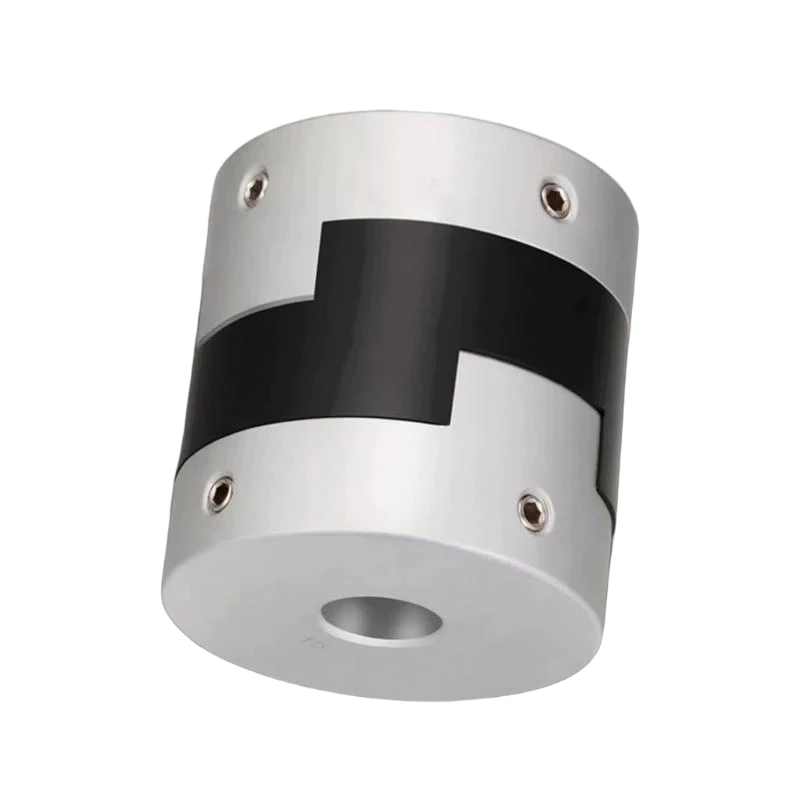
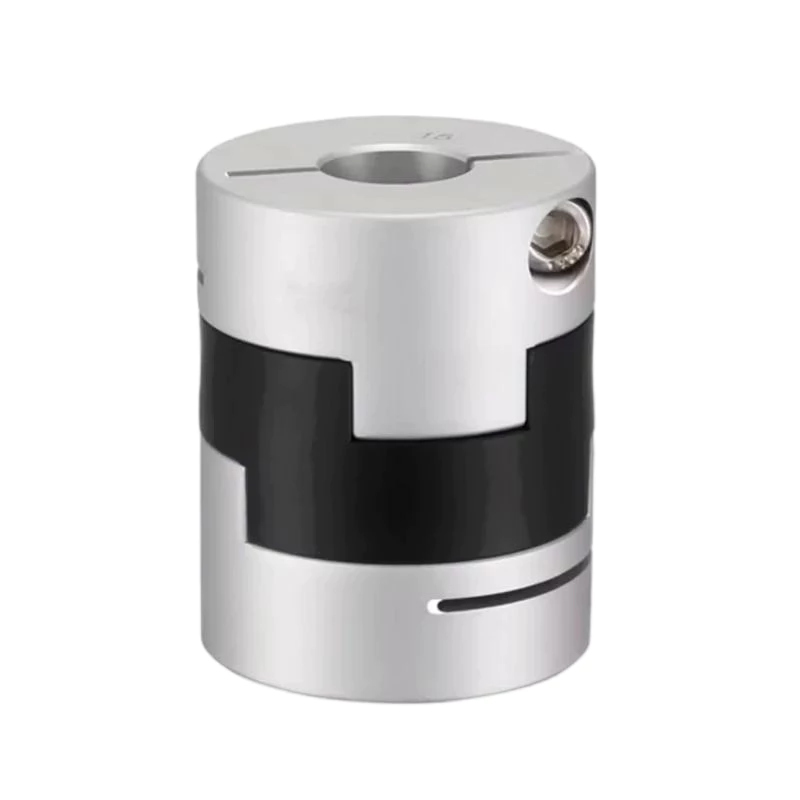
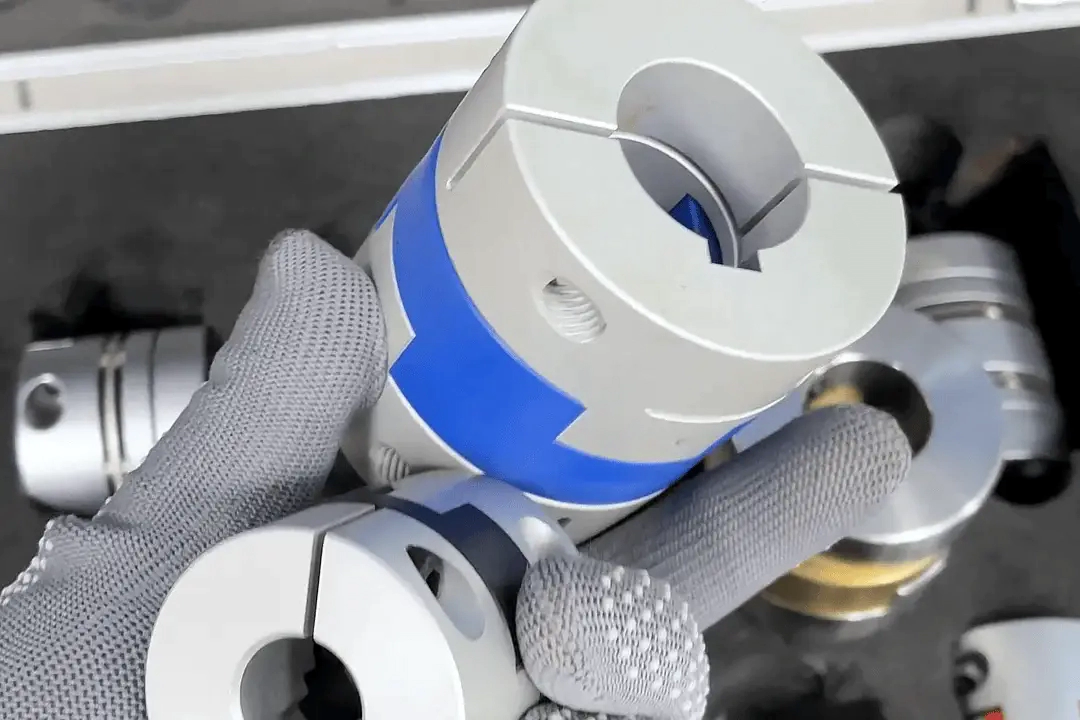
EP6C-40 Precision Clamp-Hub Oldham Coupling — 40 mm Aluminum Hub for Larger Servo and Medical Imaging Drives
The EP6C-40 precision clamp Oldham coupling brings the clamp-hub architecture into the duty class of larger-bore servo drives. With 9 N·m continuous / 18 N·m peak torque rating, 40 mm hub OD, 12–16 mm bore range, and 3 600 rpm permissible speed, the EP6C-40 is sized for the precision indexing and rotational-positioning systems that dominate modern medical imaging, semiconductor front-end equipment, and higher-end CNC machine tool spindle/auxiliary axes. The clamp-hub mounting architecture — distinguishing this product from the corresponding EP6-40 set-screw variant — eliminates shaft marking entirely, supports unlimited removal-and-reinstall cycles, and accommodates hardened-shaft installations (HRC >50) that set-screw mounting cannot grip reliably.
For OEM equipment designers specifying the EP6C-40, the clamp-mount advantage matters in three specific application contexts. First, on encoder-feedback servo systems where hub re-positioning during commissioning, service, or upgrade events is routine — set-screw marking accumulates incremental damage to the shaft surface, while clamp-mount preserves dimensional accuracy across unlimited cycles. Second, on hardened-shaft installations — typical of larger industrial servos, medical-imaging slip-ring assemblies, and semiconductor wafer-handling robots — where the substrate hardness exceeds the bite-in capability of set-screws. Third, in cleanroom and pharma-adjacent production environments where shaft marking represents a contamination-risk source and validation barrier. The EP6C-40 addresses all three of these application classes with a single catalogue specification.
Specifications
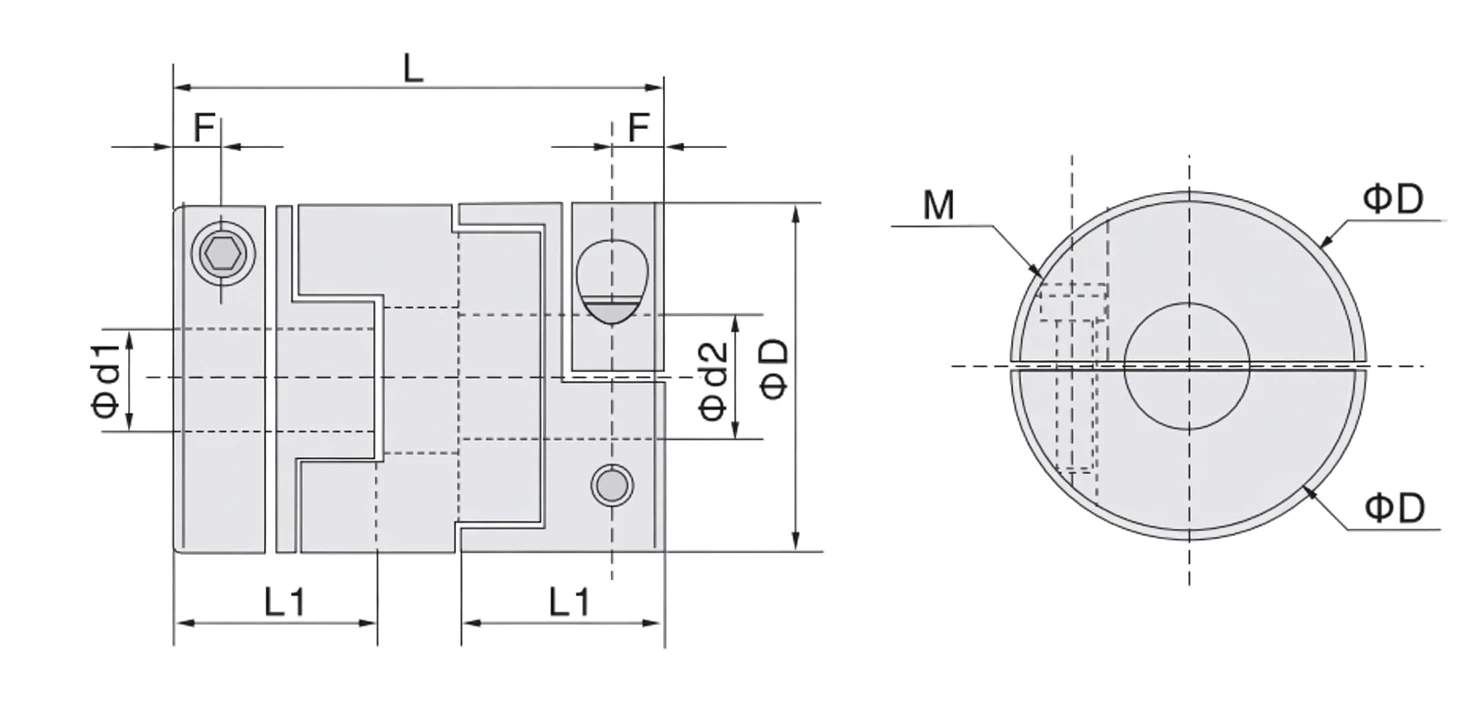
| Parameter | Value |
|---|---|
| Model | EP6C-40 |
| Continuous Torque (Tn) | 9 N·m |
| Peak Torque (Tmax) | 18 N·m |
| Permissible Speed (n) | 3 600 rpm |
| Bore Range (d) | 12 – 16 mm |
| Outside Diameter (D) | 40 mm |
| Overall Length (L) | 52 mm |
| Clamp Bolt Size | M5 (2 per hub) |
| Clamp Bolt Torque | 6 N·m |
| Radial Misalignment (Δy) | 0.5 mm |
| Angular Misalignment (Δα) | 1° |
| Axial Misalignment (Δx) | 0.5 mm |
| Mass | 95 g |
| Backlash | Zero |
| Operating Temperature | -30 °C to +80 °C |
Materials
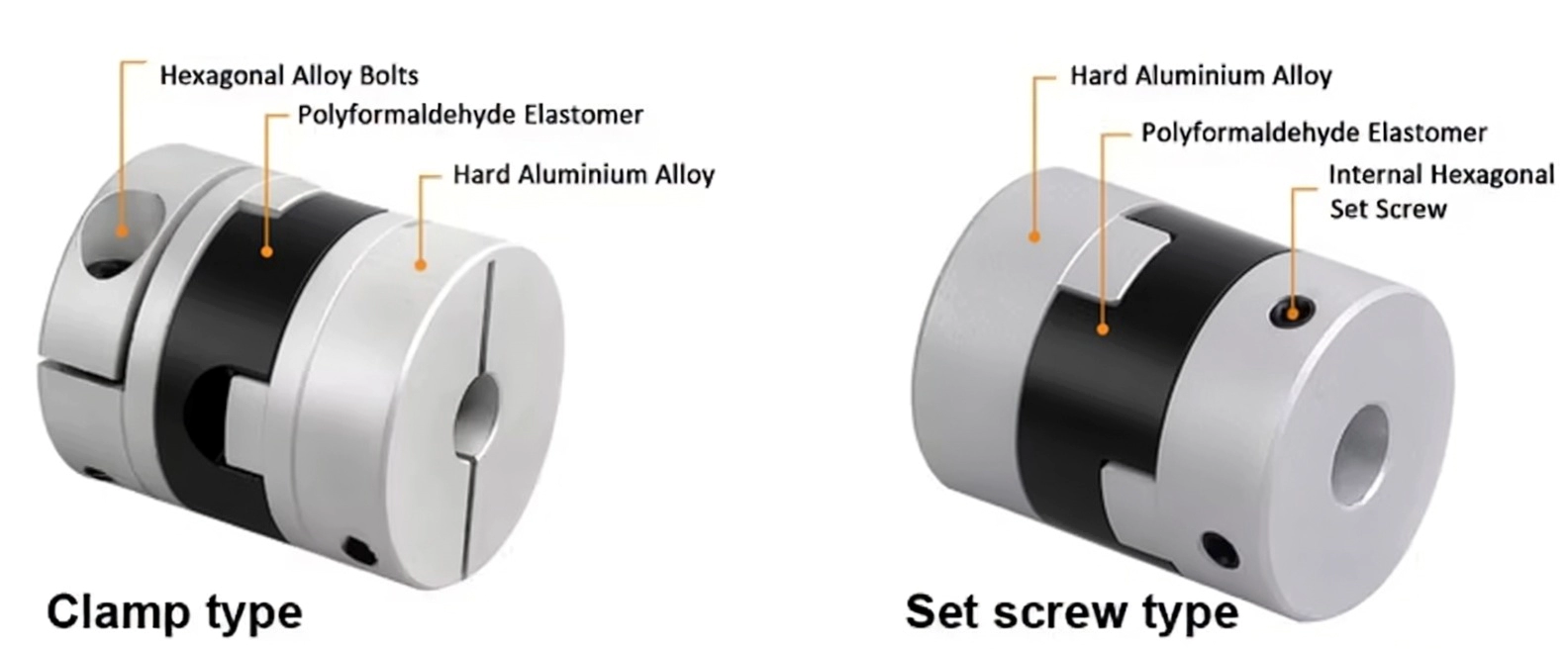
2A12 / 7075 Aluminum Clamp Hubs
Hubs are precision-machined from 2A12 aluminum alloy (or 7075-T6 for high-strength duty deployments) and anodised to mid-gloss black or natural finish. The split-collar clamp section is engineered with a 3× safety factor against the M5 clamp-bolt torque-induced hoop stress. Hub material delivers low mass (essential for low reflected-inertia in servo-feedback loops), substantial corrosion resistance, and full machinability for custom-bore variants on engineering enquiry.
POM-C Self-Lubricating Slider
The cross-slider is precision-injection-moulded from POM-C acetal polymer with PTFE additive for self-lubrication. No external grease is required across the full -30 °C to +80 °C operating temperature range. POM-C delivers low friction coefficient against the aluminum hub slots (typical 0.15–0.25), inherent vibration damping, and electrical-isolation between drive shaft and driven shaft. The polymer slider is the wear part — replacement typically occurs at 5–8 year intervals under typical servo duty.
Class 12.9 Clamp Bolt Hardware
Standard clamp-bolt hardware is M5 socket-head cap-screw to ISO 4762, property class 12.9, electro-galvanic-zinc plated. For stainless-steel hub variants, A4-80 stainless clamp hardware is supplied. Clamp-bolt torque specification (6 N·m) provides sufficient hub-to-shaft clamp force for the rated 18 N·m peak transmission without exceeding the aluminum hub’s elastic-limit. Replacement clamp-bolt sets stocked under part EP6C-40-BOLT for emergency-replacement service.
Engineering for Larger Servo-Feedback Loops
At the EP6C-40’s bore range (12–16 mm) and rated torque (18 N·m peak), the coupling is typically integrated into servo-feedback control loops where its mechanical characteristics affect the broader system’s positioning accuracy and dynamic-response profile. The zero-backlash transmission is essential: any angular lash between motor encoder and driven-axis position introduces oscillation modes that the servo controller must compensate for, ultimately limiting achievable positioning resolution. The EP6C-40’s cross-slider architecture delivers true zero-backlash — not the residual elastic-windup of an elastomer-spider coupling, not the angular dead-band of even a precision-machined disc-pack design.
The substantial misalignment envelope (0.5 mm parallel, 1° angular) addresses the realistic frame-tolerance accumulation of larger-bore servo installations. A 12 mm encoder shaft to a 16 mm reducer output shaft typically involves a motor mounting flange, a reducer mounting flange, and an intermediate bracket — each with its own dimensional tolerance stack-up. The EP6C-40’s misalignment budget comfortably absorbs the cumulative tolerance without imposing radial loads on the encoder bearings or the reducer output bearings, preserving the life expectancy of both. This is meaningfully better than the typical 0.05 mm parallel envelope of bellows couplings, which require precision laser-alignment to maintain.
For engineering guidance on integrating EP6C-class couplings into servo-feedback control architectures, see Ever-power’s precision-coupling engineering portal.
Industry Applications
Medical Imaging Indexing
CT-scanner gantry-indexing drives, MRI patient-table positioning, and PET-scanner detector-rotation axes. Clamp-mount preserves hardened shaft surface across service-life and major-equipment overhaul cycles.
Semiconductor Front-End
Wafer-handling robot wrist and elbow axes, EFEM (Equipment Front-End Module) load-port mechanisms, and CMP (chemical-mechanical-polishing) platen-rotation drives. Cleanroom-class shaft preservation through clamp mounting.
Robotic Joint Axes
SCARA-robot wrist-axis and shoulder-axis drives, collaborative-robot middle-axis joints, and articulated-arm-robot J5/J6 (wrist/end-effector) drives. Zero-backlash supports high-precision repeatability.
⚙️ Higher-End CNC Auxiliary
Auxiliary axis drives on CNC machining centres — tool-changer indexing, automatic-pallet-shuttle rotation, and rotary-table B-axis indexing for 4/5-axis machining. POM-C slider dampens machine-tool vibration coupling.
Optical Inspection Systems
Industrial machine-vision gantry drives, AOI (automated optical inspection) system camera-positioning axes, and scientific microscopy stage drives. POM-C slider provides vibration-isolation for sensitive optics.
Pharma Tablet Press Indexing
Tablet-press turret indexing drives and capsule-filling-machine main rotation axes. POM-C slider material is USP Class VI compatible; no contaminating lubricant in the load path.
Why Choose Ever-power
Quality & Compliance
EP6C-40 production runs under ISO 9001:2015. Standard documentation pack covers RoHS, REACH, and CE conformity. For pharma customers, USP Class VI compatibility documentation is supplied for the POM-C slider material. For medical-equipment customers, supplementary documentation supporting ISO 13485 medical-device QMS integration is available. For semiconductor cleanroom installations, particulate-emission documentation per SEMI standards is supplied on request.
Customisation
Catalogue bore range 12–16 mm; custom-bore variants from 10 mm to 18 mm produced under engineering review with 2-week lead time. Imperial-bore variants (1/2″, 5/8″) supported. 7075-T6 high-strength aluminum hub variant for elevated-temperature-cycling deployments. Anti-static carbon-filled POM-C slider for ATEX Zone 2 and static-sensitive electronics manufacture. A4-80 stainless clamp-bolt hardware for corrosive-ambient installations.
Aftermarket
EP6C-40 slider plates and clamp-bolt sets stocked for 1-business-day shipment. 95 g mass per coupling supports air-freight standard for emergency-replacement service. English-speaking engineering desk responds within 24 hours. For OEM partners, customer-nominated buffer-stock arrangements supported with 24-hour replenishment SLAs.
Customer Reviews & Case Studies
★★★★★
Albania — Medical-Imaging Service Provider
Used in: CT-scanner gantry-indexing drive replacement on a hospital diagnostic-imaging service installation.
Feedback: “Original OEM coupling specification was a bellows design that required precision laser-alignment after every service event. Cumulative service-time for alignment was unsustainable for our service-cycle economics. Switched to the EP6C-40 across the installed base — alignment time reduced by approximately 75 %, with no impact on imaging-accuracy specifications. Excellent retrofit solution for our service workflow.”
★★★★★
Moldova — Semiconductor-Assembly OEM
Used in: EFEM load-port wafer-handling robot wrist-axis drive on a wafer-test assembly cell.
Feedback: “Hardened-steel wrist shaft (HRC 58) was not compatible with our previous set-screw coupling specification — set-screws could not bite into the surface and required Loctite supplementary retention. The EP6C-40 clamp-hub eliminates the problem entirely. Three years of three-shift duty across 40 wafer-handling cells without coupling-attributable failure. Specification has been replicated across our subsequent equipment generations.”
★★★★☆
Armenia — Precision-Optics Manufacturer
Used in: Optical-grinding spindle auxiliary-drive coupling on a precision lens-grinding production line.
Feedback: “Optical-grinding application requires extreme vibration-isolation between drive motor and spindle. The EP6C-40’s POM-C slider has performed excellently in damping motor-side vibration content from reaching the grinding-spindle bearings. Knock one star only because the initial M5 clamp-bolt torque guidance (6 N·m) was not as prominently called out in our shipping documentation as we would have preferred — initial install at site torqued too high and required corrective re-torquing. Otherwise excellent.”
Frequently Asked Questions
Why specify clamp-mount instead of set-screw at this size?
Three engineering drivers: (1) hardened-shaft compatibility — set-screws cannot bite into shafts above HRC 50, which is standard for larger industrial servo motor outputs; (2) shaft-mark elimination — clamp-mount preserves shaft dimensional accuracy across unlimited removal-and-reinstall cycles; (3) cleanroom and pharma validation — clamp-mount removes shaft-marking as a contamination-risk source. For applications where none of these factors apply, the corresponding EP6-40 set-screw variant is the more economical specification.
What is the documented M5 clamp-bolt torque specification?
The standard M5 clamp-bolt torque is 6 N·m for property class 12.9 hardware. Lower-class hardware (e.g., property class 8.8) requires reduced torque (4 N·m). For A4-80 stainless clamp-bolt variants, torque is 5 N·m. Over-torque can cause aluminum hub yield and reduce clamp-effectiveness; under-torque produces hub-to-shaft slip under load. Calibrated torque-wrench installation is recommended for production environments.
How many removal-and-reinstall cycles does the clamp-mount support?
Documented clamp-mount cycle life is unlimited at the specified 6 N·m clamp-bolt torque. The split-collar clamp section returns to its dimensional baseline upon bolt loosening, and the clamping action is repeatable across an indefinitely large number of cycles without measurable wear. For applications expecting more than 1 000 cycles per service life, periodic inspection of the clamp-bolt threads for wear is recommended.
Is the EP6C-40 suitable for SEMI standard cleanroom environments?
Yes. The POM-C slider material is approved for cleanroom installation (ISO 14644 Class 5 / SEMI Class 100) with documented particulate-emission profile. The aluminum hub material is anodised, eliminating bare-aluminum oxide-shedding pathways. For installations requiring the highest cleanroom-class (ISO 14644 Class 1, Class 10 SEMI), full-coupling particulate-emission certification is supplied on request.
Can the EP6C-40 be specified for ATEX or static-sensitive electronics manufacture?
Yes — specify the anti-static carbon-filled POM-C slider variant. This provides a documented surface-resistance under 10⁶ Ω, preventing static-electricity buildup at the metallic interfaces. The variant is appropriate for ATEX Zone 2 installations and for static-sensitive semiconductor-manufacture environments. ATEX Zone 1 deployments require additional engineering review.
Quote EP6C-40 for Precision Larger-Servo Drives
For medical-imaging, semiconductor front-end, robotic-joint, higher-end CNC auxiliary, and pharma tablet-press indexing applications, the EP6C-40 is Ever-power’s preferred precision clamp-hub specification across the larger-bore servo range. Browse the wider EP6C clamp series catalogue, read about Ever-power’s precision-coupling capability, or move directly to a B2B enquiry below.