Description
EP6C-16 Miniature Clamp Type Oldham Coupling — Split-Collar Three-Piece Slider for Precision Encoder and Servo Connections
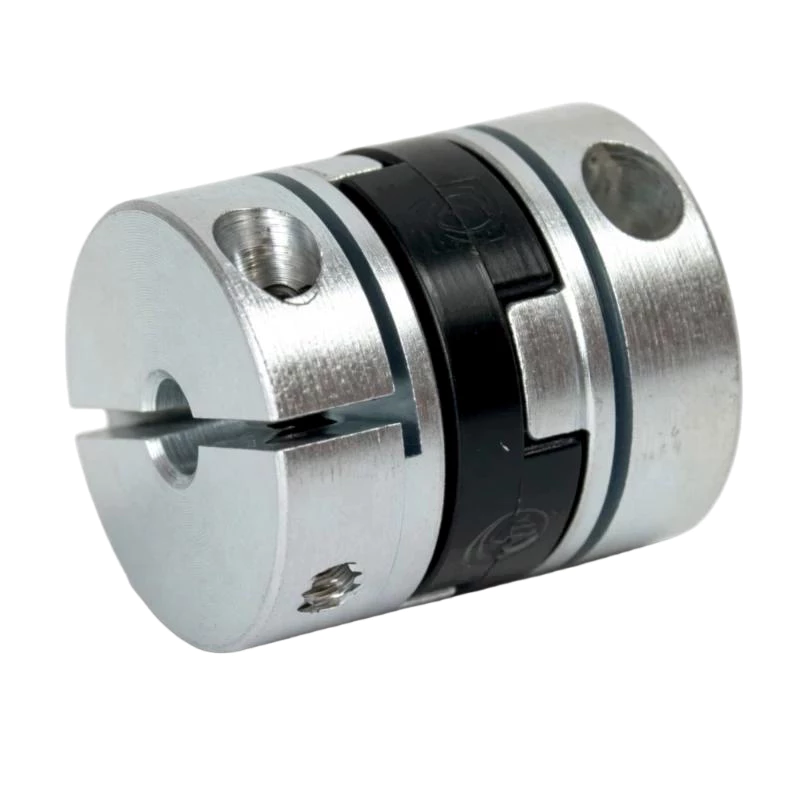
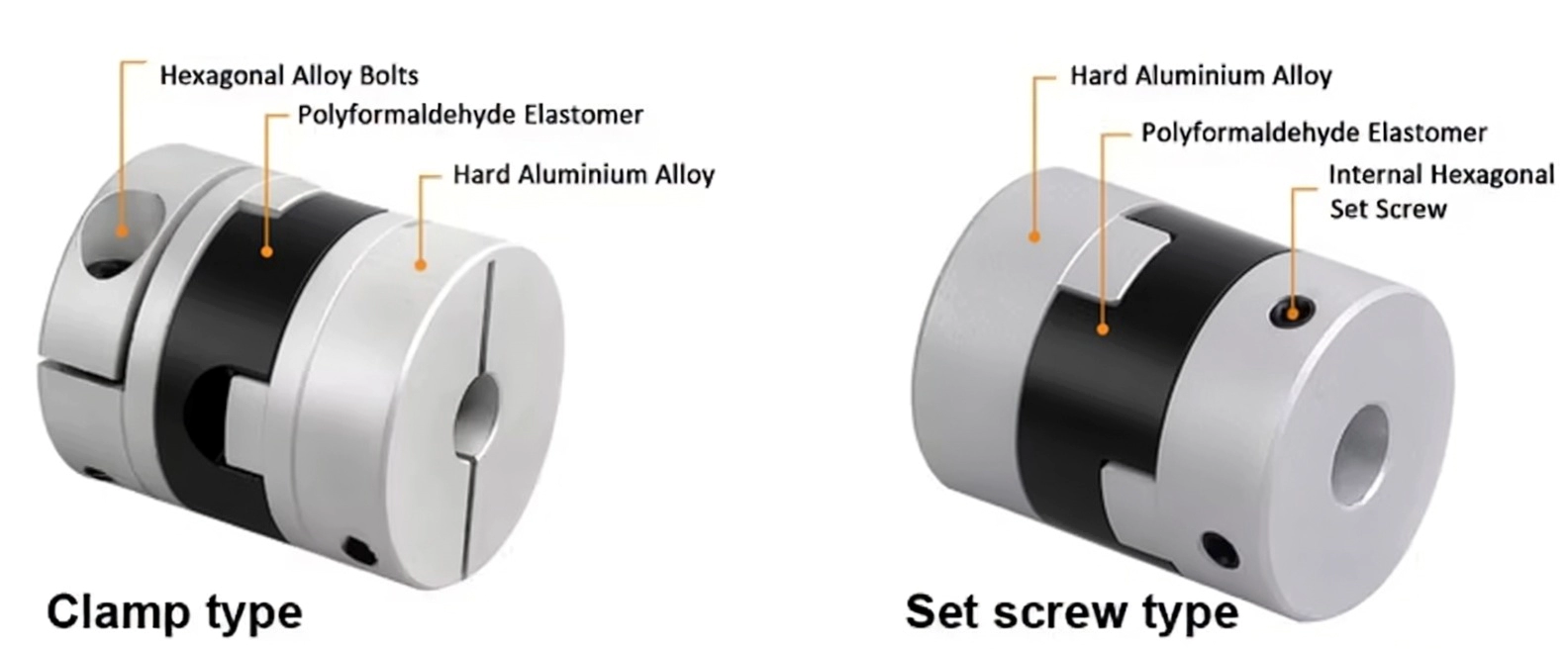
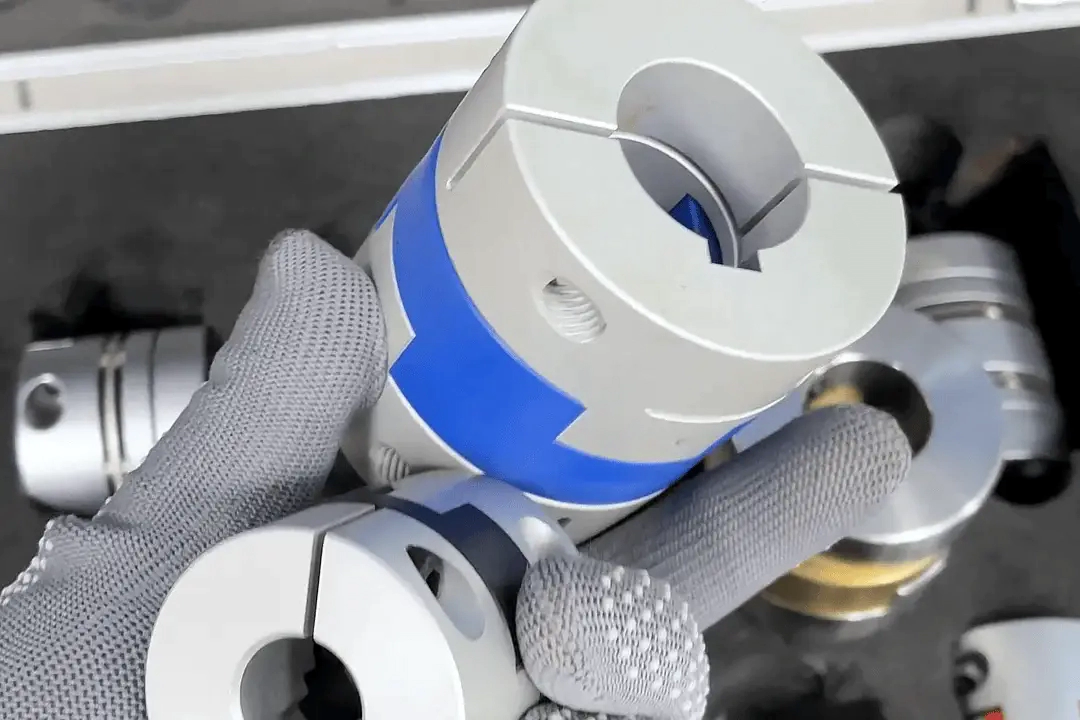
The EP6C-16 clamp type Oldham coupling takes the same three-piece sliding architecture used across the EP6 family and substitutes the conventional set-screw shaft engagement with a split-collar clamp. The mechanical consequence is significant: instead of two point loads from cup-point set-screws — which depress the shaft surface, create a “high spot” that can complicate reassembly, and risk damaging hardened motor shafts — the EP6C-16 distributes the clamping force around the entire shaft circumference. For applications where the motor shaft cannot be marked, where reassembly accuracy must be preserved through hundreds of service cycles, or where the shaft is hardened above HRC 50 and cannot accept a set-screw point, the clamp type is the architecturally correct choice.
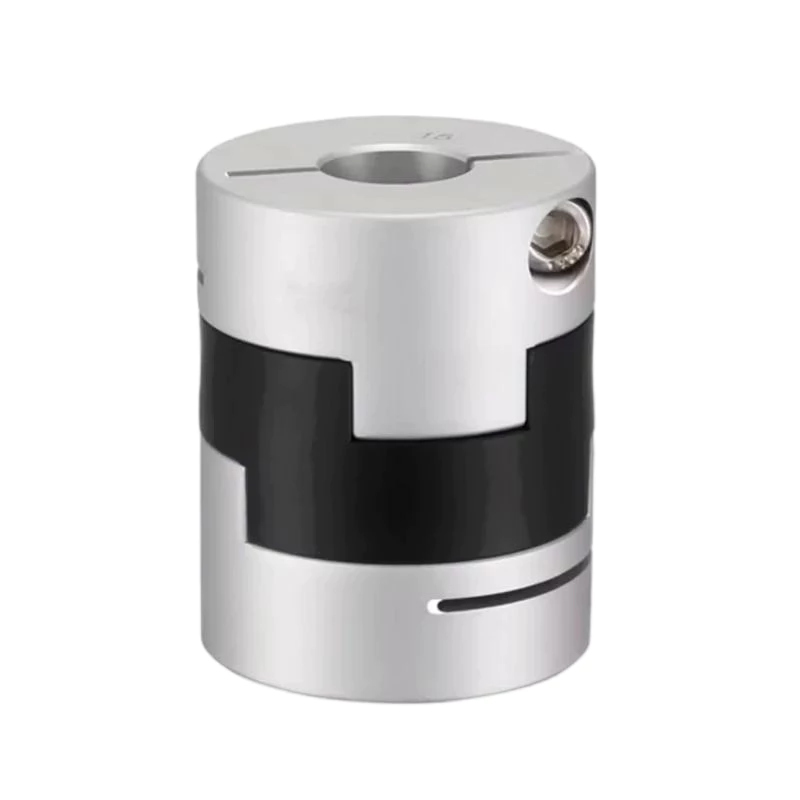
The coupling itself is a 16 mm outside-diameter, 30 mm overall length, three-piece assembly. Two CNC-machined aluminum-alloy hubs — each with a precision split-collar feature secured by an M3 socket-head cap screw — sandwich a polyacetal centre disc that carries two orthogonal sliding tongues. The slider geometry, the misalignment tolerance, and the zero-backlash torque transmission are mechanically identical to the set-screw EP6-16; what changes is the clean, repeatable, shaft-friendly mounting interface that gives the EP6C-16 its characteristic engineering appeal.
Specifications
| Parameter | Value |
|---|---|
| Model | EP6C-16 |
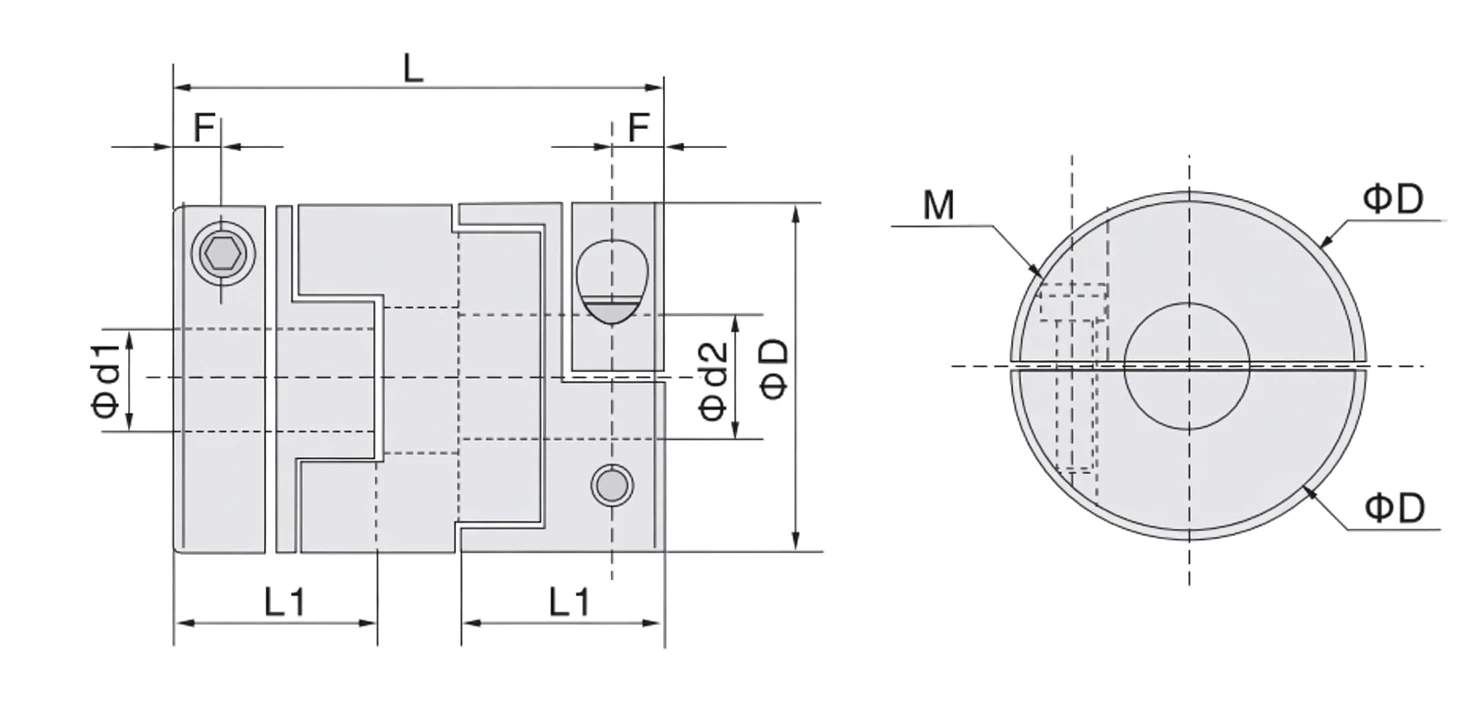
| Outside Diameter (ΦD) | 16 mm |
| Overall Length (L) | 30 mm |
| Hub Length (L1) | 10.5 mm |
| Clamp-Gap Width (F) | 4.0 mm |
| Bore-Centre Distance (E) | 9.5 mm |
| Bore Range (d1 / d2) | 4, 5, 6 mm |
| Rated Torque | 0.7 N·m |
| Maximum Torque | 1.4 N·m |
| Maximum Rotational Speed | 9 000 rpm |
| Moment of Inertia | 5.0 × 10⁻⁷ kg·m² |
| Static Torsional Stiffness | 29 N·m/rad |
| Parallel Misalignment | 1.0 mm |
| Angular Misalignment | 3.0° |
| Clamp-Screw Thread | M2.5 |
| Wrench Tightening Torque | 1.0 N·m |
| Mass (max bore) | 12 g |
| Backlash | Zero |
Materials
Split-Collar Aluminum Hubs
Hubs are CNC-turned from A2017-T4 aluminum bar and clear-anodised. The split-collar slot is precision EDM-cut to maintain consistent gap-width tolerance — a small detail that determines whether the clamping force distributes evenly around the shaft circumference. Uneven gap geometry, common in lower-quality clamp couplings, creates a high-spot on the shaft that defeats the entire purpose of the architecture.
Polyacetal (POM) Centre Disc
The centre slider is moulded from POM-C copolymer, the same self-lubricating grade used across the EP6 family. POM’s combination of fatigue endurance, electrical insulation, and oil resistance has made it the de-facto standard for Oldham slider duties for nearly four decades. Two hardness grades are offered for applications requiring extra damping or, conversely, higher torsional rigidity.
M2.5 Clamp Screws
Single M2.5 socket-head cap screw per hub, in SUS304 stainless steel grade A2-70. The 1.0 N·m wrench torque specification develops a clamping force of approximately 800 N at the split — sufficient to lock the EP6C-16 against the peak 1.4 N·m torque rating, while remaining within the screw’s elastic range for unlimited install/remove cycles.
The Engineering Case for Clamp Mounting
The fundamental question — set-screw versus clamp — turns on three engineering criteria. First, shaft material: a hardened or case-hardened motor shaft (HRC > 50) often will not accept a set-screw point cleanly. The cup-point either skates without engaging or, worse, scrapes a chip that ends up as debris between hub and shaft. The clamp’s distributed circumferential force engages the shaft without requiring surface penetration, making it the only viable option for hardened-shaft mating. Second, reassembly: a set-screw leaves a dimple in the shaft on first installation. The dimple becomes a registration feature on subsequent assembly — which is fine if the alignment is acceptable, but a problem if the original install was off-axis. The EP6C-16 leaves no dimple. You can disassemble, rotate the coupling, and reassemble with full angular freedom.
Third, precision: the clamp’s symmetric force distribution preserves shaft concentricity. A set-screw, however carefully torqued, applies a one-sided lateral load that can pull a precision motor shaft fractionally off-axis. For 16 mm encoder and feedback applications where positioning accuracy is measured in arc-seconds, that asymmetry can be the difference between meeting and missing the specification. The EP6C-16 is the right architectural choice for high-precision repeat-assembly applications. Further selection guidance is available in our technical selection portal.
Industry Applications
High-Resolution Encoders
Coupling between hardened motor output shaft and 13–16 mm optical-encoder body. Clamp mounting preserves shaft integrity through hundreds of motor swap-out cycles in test-fixture applications.
Confocal & Fluorescence Microscopy
Focus-drive linkages where the precision microscope objective shaft is hardened and surface-treated. The clamp prevents surface damage that would compromise long-term focus repeatability.
⌚ Watch & Micromechanical Assembly
Tool-spindle drives on watch-component assembly stations. The repeatable, shaft-friendly clamp engagement supports the multi-thousand-cycle service life expected on these stations.
DNA/RNA Sequencing Equipment
Flow-cell positioning stages in next-generation sequencing instruments. Symmetric clamp force preserves the micrometre-class positioning tolerance that determines base-call accuracy.
Laser-Aiming & Pointer Drives
Mirror and prism gimbals in alignment-laser instruments. Zero backlash plus symmetric clamping prevents drift in repeatedly-zeroed reference systems.
️ Aerospace Test Rigs
Servo loops in component-test fixtures where the unit-under-test shaft must be returned to OEM service without any surface damage from the test setup.
Why Choose Ever-power
Quality Credentials
EP6C-16 production runs under an ISO 9001:2015 certified quality management system. Material declarations cover RoHS, REACH, and conflict-minerals (3TG) status. CE documentation supports machinery-directive integrations. For aerospace and defense customers, AS9100-style first-article inspection records are offered as a documented add-on.
Customisation
Catalogue bores are 4 / 5 / 6 mm. Mixed-bore variants (e.g., 4 mm × 6 mm), keyway-broached versions, and tolerance-tightened bores (H6 instead of H7) are produced regularly. Anodising colours can be matched to OEM colour-coding schemes for visual line identification.
Engineering & Documentation
STEP, IGES, Parasolid, SolidWorks, and Inventor native CAD models are available on demand. Application questions receive a response within 24 hours from our English-speaking engineering desk. For OEM partnerships, dedicated technical-account-manager assignment is available with annual volume commitments.
Customer Reviews & Case Studies
★★★★★
Ireland — Precision Encoder Manufacturer
Used in: Production-test fixture coupling between calibration motor and customer-supplied encoder under test.
Feedback: “We needed a coupling that would survive 300+ encoder swap-outs per shift across our calibration fleet without damaging customer-shipped hardware. The EP6C-16 has performed without complaint for three years. The clamp leaves no surface mark, which removed an entire category of customer escalations from our QA inbox.”
★★★★★
Argentina — Microscopy Service Centre
Used in: Focus-drive replacement coupling on field service of laboratory microscopes from multiple OEMs.
Feedback: “Different OEMs use different shaft hardness specs — some are 58 HRC, some are surface-nitrided. The EP6C-16 mates cleanly to all of them. We carry it as a single-line item across our service inventory now, which dramatically simplified our parts stocking decisions.”
★★★★☆
Malaysia — Medical Diagnostic OEM
Used in: Stepper-drive coupling on a small-format blood-analyser pipette transport.
Feedback: “Symmetric clamping eliminated the small position drift we had observed with set-screw couplings over field-service cycles. Knock one star only because our service technicians initially over-torqued the M2.5 screw on a few units — adding a torque-wrench callout to our service manual resolved this, but a labelled torque value on the coupling itself would be a nice touch.”
Frequently Asked Questions
Will the EP6C-16 hold its position on a shaft hardened to HRC 60?
Yes. The clamp engagement does not depend on shaft surface penetration — it grips through distributed friction around the entire circumference. We have field data on EP6C-16 deployments on shafts up to HRC 65 with no slip incidents reported across multi-million cycle operating histories.
How does the clamping force compare to a set-screw of equivalent rating?
A correctly tightened M2.5 clamp screw at 1.0 N·m develops roughly 800 N of clamping force, distributed around the shaft. This is mechanically equivalent to the two M3 set-screws’ combined clamping force on the EP6-16, but applied as a uniform circumferential pressure rather than as two point loads.
Can the EP6C-16 be removed and reinstalled without loss of accuracy?
Yes — this is one of the architectural advantages of the clamp type. There is no dimple to register against, no shaft surface modification, and the clamping force is restored on each re-tightening cycle. Service technicians can disassemble, inspect, and reassemble without any positional drift.
What happens if the clamp screw is over-tightened?
The M2.5 screw will yield (stretch plastically) before damaging the aluminum hub. If over-tightening is suspected, replace the clamp screw — not the full coupling. The hub itself is engineered to tolerate substantial over-torque without bore distortion.
Is the EP6C-16 cleanroom-compatible?
Yes. The clamp type generates no metal swarf during installation — unlike a set-screw, which can produce small chips when first seated. This makes the EP6C-16 the preferred option for Class 7 and cleaner cleanroom assemblies. Anodised hubs are particulate-stable and do not shed.
Quote the EP6C-16
For precision encoder, microscopy, and high-accuracy positioning applications where the shaft surface must be preserved, the EP6C-16 is the architectural choice. Browse the full clamp-type coupling range, learn about Ever-power’s manufacturing pedigree, or proceed to enquiry below.