Description
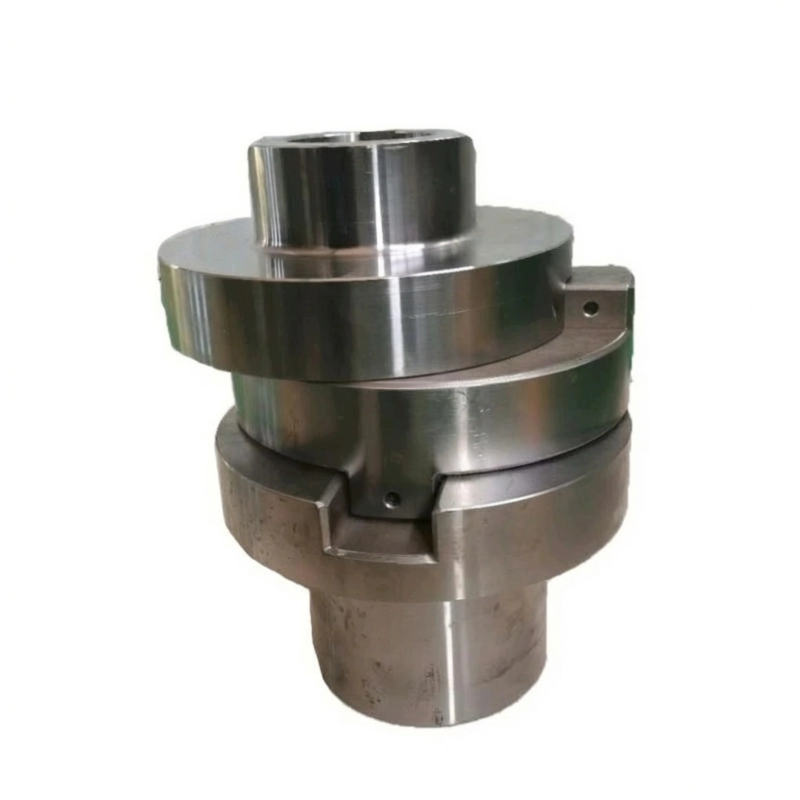
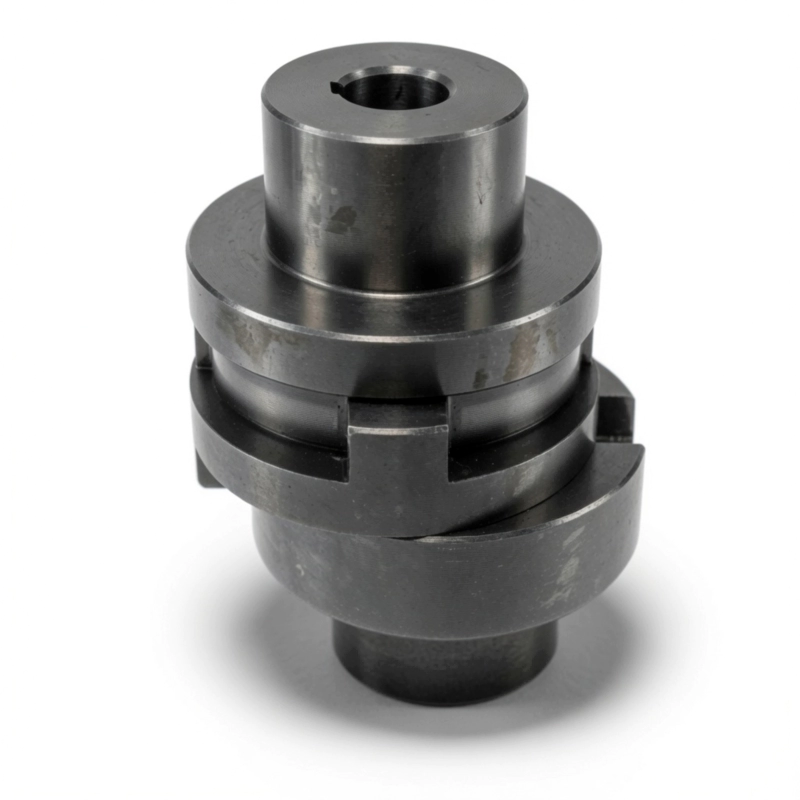
SL130 Heavy-Industrial Cross-Slider Oldham Coupling — 130 mm Cast-Iron Hub Joint for Process and Plant Drives
The SL130 cross-slider Oldham coupling represents a step-change in the SL family: the first coupling in the catalogue sized for what plant engineers call “real industrial” duty. With an 800 N·m rated torque, 130 mm hub OD, 45–50 mm bore options, and 250 r/min permissible speed, the SL130 sits in the 15–20 kW continuous-power band. This is the duty class of larger process pumps, sugar-mill cane-carrier drives, mid-range industrial mixers, larger bulk-material conveyors, and the conveyor-head ends of crusher-and-screen circuits in mining and aggregates plants. At this size, the coupling is no longer a small line item on a bill of materials — it is a deliberately selected component whose performance characteristics get reviewed by maintenance engineering before specification.
The architectural argument for the SL130 over competing flexible-coupling families remains the same as for its smaller siblings, but the engineering stakes are higher. A cascade failure from a coupling-rooted incident at 18 kW continuous can take out the upstream feed system, the downstream collection system, and impose hours of restart sequence on the host equipment. The SL130’s value proposition is therefore measured in shutdown-avoidance: a coupling architecture whose failure mode is gradual, visible, and predictable beats a coupling architecture with higher peak performance but a catastrophic failure mode, every time. This is the engineering judgement that has kept the SL130 on equipment specifications across multiple generations of OEM products and plant retrofits.
Specifications
| Parameter | Value |
|---|---|
| Model | SL130 |
| Nominal Torque (Tn) | 800 N·m |
| Permissible Speed (n) | 250 r/min |
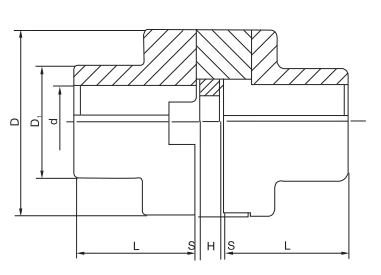
| Bore Range (d) | 45 – 50 mm |
| Outside Diameter (D) | 130 mm |
| Hub Bore Diameter (D₁) | 80 mm |
| Overall Length (L) | 90 mm |
| Slider Plate Thickness (H) | 19 mm |
| Slider Clearance (S) | 0.5 mm |
| Moment of Inertia | 0.07 kg·m² |
| Mass | 10 kg |
| Radial Misalignment (Δy) | 1.8 mm |
| Angular Misalignment (Δα) | 0.5° |
| Axial Misalignment (Δx) | 1.8 mm |
| Shaft Engagement | Keyway + setscrew |
| Lubrication | Grease (re-pack annually) |
Materials
HT250 / QT500 Hub Options
Catalogue specification is HT250 grey cast iron, sand-cast and stress-relief-annealed before machining. For mining and sugar-mill applications where shock-load events are routine, the QT500-7 ductile-iron variant (equivalent ASTM A536 65-45-12) is documented and recommended — the spheroidal-graphite microstructure delivers approximately 3× the fracture toughness of HT250 while retaining most of the machining-friendliness of grey iron.
Heavy-Section Steel Slider
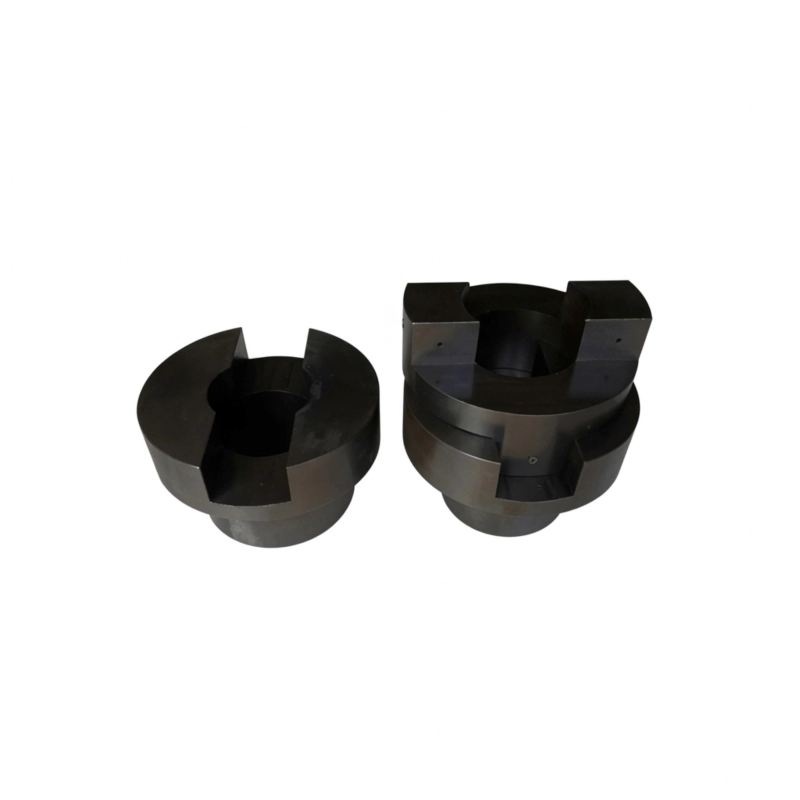
The cross-slider is machined from 45-steel medium-carbon bar (or 40Cr alloyed steel for high-cycle reversal duty), surface-induction-hardened to HRC 45–55 on the four sliding faces. At the SL130’s 800 N·m rating, slider section thickness has been specified with a fatigue margin sufficient for unlimited cycle life under typical industrial duty.
Industrial-Standard Mounting Interface
H7-reamed hub bore with parallel keyway to GB/T 1096 (DIN 6885 / JIS B 1301). M14 set-screw for axial location. For applications requiring hub-end-load capability beyond catalogue specification, taper-bushed mounting via standard locking-assembly families is available as a documented custom-build option.
Engineering Considerations for 15–20 kW Industrial Duty
At this size and power level, the SL130 begins to share design space with competing industrial flexible couplings: grid couplings (Falk Steelflex, Crossley CGT), elastomer-in-shear couplings (Dodge Para-Flex, KTR Rotex), and flexible-disc couplings (Thomas, Renold). Each of these alternatives has its merits in specific applications, but for the broad spectrum of 15–20 kW industrial drives the SL130’s combination of installation simplicity, generous misalignment tolerance, field-serviceable wear parts, and predictable failure mode wins selection battles consistently.
The 1.8 mm parallel-misalignment tolerance is a particular differentiator. Compare this to the typical 0.4–0.6 mm offered by flexible-disc couplings of equivalent torque rating: the SL130’s 3–4× wider envelope translates directly into reduced installation effort and substantially relaxed precision requirements on the machine-frame fabrication. For sugar-mill installations, where cane-carrier shaft housings can drift by 1 mm or more during a milling-season thermal cycle, the SL130 absorbs the drift without imposing radial load on the host bearings; a flexible-disc coupling of equivalent rating would have entered fatigue-cycle damage well before the season’s end.
For a discussion of the cross-slider’s role in heavy industrial drive trains, the Oldham coupling engineering page covers the mechanical kinematics in detail.
Industry Applications
Sugar-Mill Cane Carriers
Drive between reduction-output and cane-carrier belt drum on sugar mills. Cast-iron mass and shock-load tolerance absorb the irregular feed of harvested cane.
Brick & Tile Production
Pug-mill mixer and extruder drives in brick and clay-tile production. The slider absorbs the shock loads of inhomogeneous clay loading without flexure of metallic components.
⚒️ Foundry & Forge Auxiliaries
Sand-conveyor, mould-press, and shake-out conveyor drives in foundry operations. Cast-iron hubs are inherently appropriate to the high-temperature ambient and abrasive-dust environment.
Mid-Range Bulk Conveyors
Head and intermediate drive-shaft couplings on 600–1000 mm wide belt conveyors. The 1.8 mm parallel allowance forgives the cumulative misalignment of multi-section conveyor frames.
Sawmill & Wood Processing
Conveyor and infeed-roller drives on sawmills and panel-board production lines. Cast-iron section absorbs the shock-load events of log feeding without permanent deformation.
Chemical-Reactor Agitators
Mid-sized reactor-vessel impeller-shaft drives in fine-chemical and pharmaceutical-intermediate manufacturing. Misalignment tolerance absorbs the thermal growth between cold-charge and reaction-temperature equipment states.
Why Choose Ever-power
Quality Documentation Pack
SL130 production under ISO 9001:2015 with full melt-traceability. Documentation includes RoHS, REACH, and on-request CE conformity declarations. For sugar-mill OEMs, supplementary documentation covering grease-vs-cane-juice contamination compatibility is available. For brick and ceramic OEMs, dust-class certifications can be supplied with the QT500 hub variant.
Customisation Options
Catalogue bore range 45–50 mm; oversized variants up to 55 mm produced regularly. Imperial bore variants (1-3/4″, 1-15/16″, 2″) supported for North American export markets. QT500 ductile-iron hub upgrade for shock-load and corrosive environments. Taper-bushed mounting (for taper-lock or Q-Lock installations) is a documented engineering-review option.
Spare Parts
SL130 slider plates stocked as part number SL130-SLIDER. 40Cr alloy variant for high-cycle reversal duty available within 1 week. Engineering desk responds in English within 24 hours. Buffer-stock programmes available for fleet operators.
Customer Reviews & Case Studies
★★★★★
Portugal — Cork-Processing Mill
Used in: Slurry-pump drives on a cork-board adhesive-mixing plant.
Feedback: “Adhesive-slurry pumping is hard on couplings — the resin viscosity creates intermittent torque spikes that fatigue most flexible architectures. The SL130 has been in service four years across 8 mixing lines with zero coupling-related downtime events. Annual grease repack is the only scheduled maintenance touch.”
★★★★★
Algeria — Brick-Production Facility
Used in: Pug-mill mixer drive on a tunnel-kiln brick plant producing 80 000 bricks/day.
Feedback: “Pug-mill shock loads from clay feeding had been destroying our previous grid-coupling specification every 18 months. The SL130 has now reached 5 years without an unplanned event. Slider plate was replaced once during a planned kiln rebuild — a 45-minute task with hubs remaining on shafts. Best lifecycle-cost coupling we have specified.”
★★★★☆
Pakistan — Cotton-Ginning Operation
Used in: Lint-cleaner conveyor drive on a multi-line cotton-ginning facility.
Feedback: “Ginning-season duty is 16-hour shifts for 5 months continuous, then idle until next harvest. The SL130 has handled this cycle for 6 years with regular grease repacks. Knock one star only because the lint-dust environment requires more frequent grease repack (every 6 months) than the standard 12-month interval — manageable but adds to maintenance workload.”
Frequently Asked Questions
How does the SL130 handle shock-load events from material loading?
The cast-iron hub section and hardened-steel slider absorb instantaneous shock loads up to approximately 2× the rated torque (i.e., 1 600 N·m peak instantaneous) without permanent damage. For repeated shock-loading environments such as crushers and primary mining drives, the QT500 ductile-iron hub variant raises this margin to approximately 3× rated.
Can the SL130 be installed in dust-prone environments?
Yes, with one consideration: dust ingress into the slider lubrication shortens grease service life. For dusty environments (cement, brick, cotton-gin, foundry), we recommend a 6-month grease-repack interval and a sealed coupling-guard enclosure. With these provisions, the SL130 has multi-decade service history in dust-class environments.
What is the maximum permissible operating temperature?
Standard grease-lubricated specification operates up to +80 °C continuous ambient. For higher-temperature service up to +150 °C, a synthetic high-temperature grease (e.g., Klüber Asonic GHY) is documented. Above +150 °C, please consult engineering for a custom slider-clearance variant that accommodates the thermal-expansion behaviour of the metallic stack.
Is the SL130 suitable for vertical-axis installations?
Yes — the SL130’s positive torque transmission with no axial creep makes it fully suitable for vertical-axis service. For long vertical shaft installations where the coupling supports the lower shaft’s weight, please specify “vertical service” so engineering can validate that the slider clearance remains appropriate for the loaded condition.
Do you supply installation training for OEM partners?
Yes — for OEM partners with annual commitments above 200 pieces, Ever-power offers remote training via video conference (no travel) covering installation best practices, torque-and-grease procedures, and slider-replacement workflows. Training materials in English are supplied as PDF and short-form video.
Specify the SL130 for Heavy-Process Drives
For sugar mill, brick, foundry, sawmill, and mid-range chemical-process OEM equipment, the SL130 is one of Ever-power’s most-supplied heavy-industrial Oldham couplings. Browse our complete SL series catalogue, read about Ever-power’s foundry capability, or move directly to enquiry.