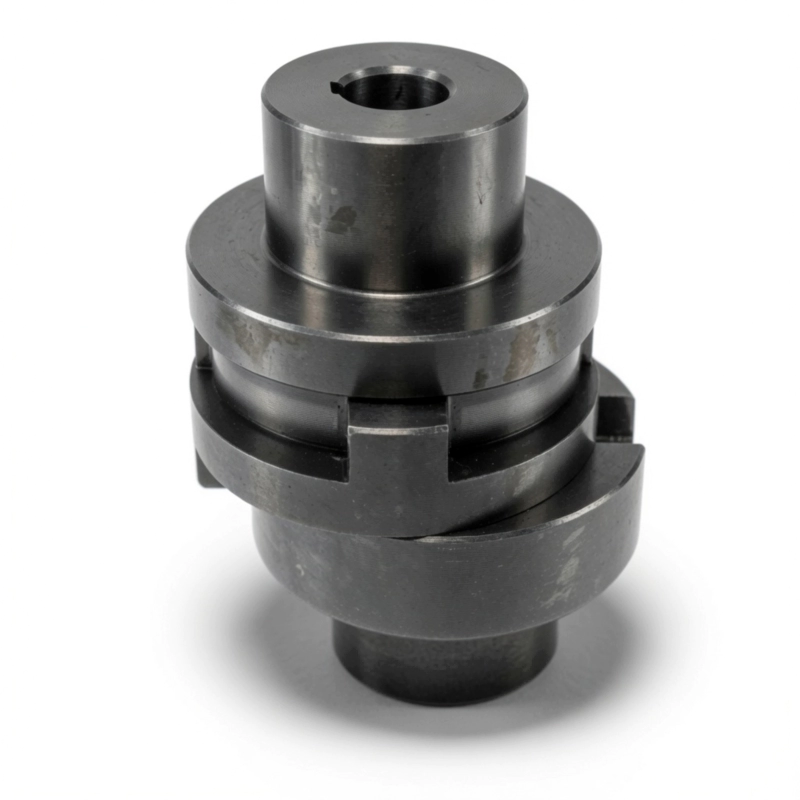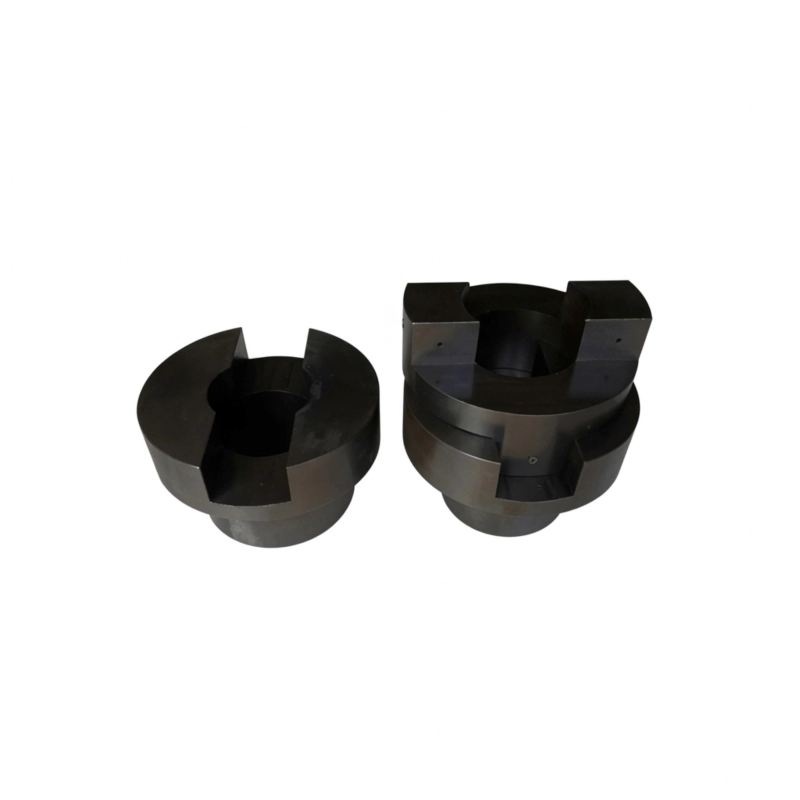
Description
SL300 Heavy-Industrial Cross-Slider Oldham Coupling — 300 mm Cast-Iron Hub for Slow-Speed High-Torque Mill Drives
The SL300 industrial Oldham coupling introduces an important transition in the SL family. With 13 000 N·m rated torque, 300 mm hub OD, 120–130 mm bore range, and — for the first time — a permissible speed of 100 r/min rather than 250 r/min, the SL300 is sized specifically for the slow-speed, high-torque duty class that dominates large mill main drives, kiln-section inputs, and the heavier-end hydropower auxiliary trains. The reduction in permissible speed is not an arbitrary catalogue choice: it reflects the engineering reality that as coupling mass grows toward 100 kg and centrifugal loads grow with the cube of diameter, the upper rotational-speed limit must be reduced to maintain reasonable hub-stress and bearing-load profiles in the host equipment.
For the integrator specifying a coupling at the SL300’s size class, the engineering question shifts from “what is the highest-rated coupling for my torque” to “what is the appropriate balance of torque, misalignment envelope, and rotational speed for my application class”. The SL300’s 13 000 N·m at 100 r/min envelope translates to approximately 135 kW of continuous mechanical power — a duty class that includes large ball-mill and SAG-mill auxiliary input drives, primary cement-kiln burner-section inputs, large bulk-material yard-conveyor drives, and the slower-end heavy process-mixer outputs. These applications share a common engineering profile: high steady-state torque, relatively low rotational speed, and a misalignment budget that grows with the substantial frame deflections of large fabricated structures.
Specifications
| Parameter | Value |
|---|---|
| Model | SL300 |
| Nominal Torque (Tn) | 13 000 N·m |
| Permissible Speed (n) | 100 r/min |
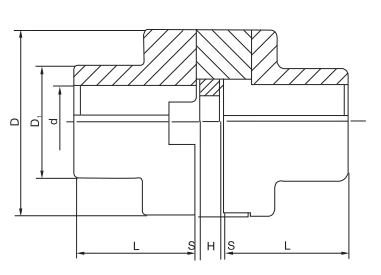
| Bore Range (d) | 120 – 130 mm |
| Outside Diameter (D) | 300 mm |
| Hub Bore Diameter (D₁) | 180 mm |
| Overall Length (L) | 210 mm |
| Slider Plate Thickness (H) | 43 mm |
| Slider Clearance (S) | 1.0 mm |
| Moment of Inertia | 4.3 kg·m² |
| Mass | 111 kg |
| Radial Misalignment (Δy) | 4.8 mm |
| Angular Misalignment (Δα) | 0.5° |
| Axial Misalignment (Δx) | 4.2 mm |
| Shaft Engagement | Keyway or taper-bushed |
| Lubrication | Grease (re-pack 6-monthly) |
Materials
QT500-7 Ductile-Iron Hubs (Standard)
Hub specification is QT500-7 nodular cast iron with full stress-relief annealing prior to all machining operations. Each hub masses approximately 52 kg. The hub-section thickness has been engineered with a 3× safety factor against the 13 000 N·m rated peak — actual peak-torque capacity before permanent-deformation risk is approximately 39 000 N·m. For ultra-aggressive shock-load profiles, an upgrade to QT600-3 cast steel is offered through engineering review.
43 mm Heavy Steel Slider
The 43 mm slider thickness — up from 33 mm on smaller SL family members — reflects the slow-speed, high-torque duty profile. Standard induction-hardened 45-steel slider; 40Cr alloyed-steel variant for reversal-duty deployments. Slider mass is approximately 13 kg; pre-machined lifting eyelets are routinely supplied for hoist-supported field service.
Taper-Bushed Mounting (Recommended Standard)
At the SL300 size, taper-bushed mounting via locking-assembly families is the engineering recommended standard rather than an upgrade option. The locking-assembly approach eliminates the keyway-shear failure mode entirely under the realistic shock-load profile of large mill drives. Keyway mounting remains available for cost-sensitive light-duty applications, but engineering does not recommend it for cement-kiln, mining-mill, or steel-mill installations.
Slow-Speed High-Torque Engineering
The shift from 250 r/min to 100 r/min permissible speed is more than a numerical change. It reflects the duty profile of equipment classes that operate in the slow-speed, high-torque envelope: ball mills, SAG mills, primary kilns, large slow-process mixers, and heavy bulk-handling conveyors with steep incline ratios. These equipment classes share an engineering feature that the SL300 is optimised for — the torque is steady-state-dominant rather than dynamic-event-dominant. The coupling needs to transmit a very high torque continuously, with shock-load events accommodated by safety factor, rather than transmit a moderate torque with the rotational-speed envelope dominated by precision-balance and centrifugal-loading considerations.
This engineering profile aligns naturally with the cross-slider architecture. At 100 r/min, the slider’s sliding-friction work over a given misalignment magnitude is approximately 2.5× lower than the same misalignment at 250 r/min. The reduced sliding-friction work translates directly into extended slider service life — typical SL300 slider replacement intervals span 8–10 years even under aggressive mill-duty profiles. For owners of cement-mill and mining-mill installations, this aligns slider-replacement scheduling with the natural cycle of major plant overhauls, eliminating the slider-replacement event from the routine maintenance touch-point list entirely.
For broader engineering discussion of slow-speed high-torque coupling selection, see Ever-power’s heavy-industrial coupling resource portal.
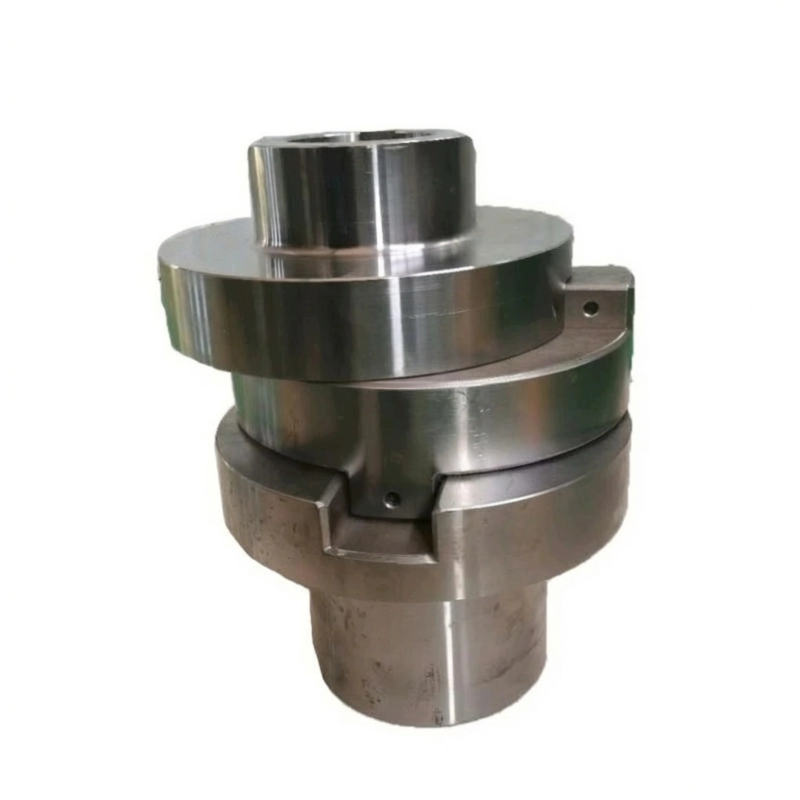
Industry Applications
⛰️ Ball-Mill & SAG-Mill Inputs
Auxiliary input couplings on large ball mills and SAG mills in minerals processing. The 4.8 mm misalignment envelope accommodates the substantial mill-shell deflection under loaded operation.
Cement-Kiln Section Inputs
Drive coupling between motor and reduction-input of cement-kiln rotating-section drives. Slow-speed duty aligns with kiln operating envelope; misalignment tolerance absorbs kiln-shell thermal expansion.
Hydropower Main-Auxiliary
Gate-actuator, intake-cleaning, and main-trash-rack drives on 25–50 MW hydropower stations. Long-cycle reliability across the 30+ year design life of hydropower infrastructure.
Heavy Bulk-Yard Conveyors
Stockyard reclaimer-conveyor and outbound-cargo terminal drives on coal, iron-ore, and minerals export terminals. Misalignment tolerance handles long-conveyor frame deflection.
Slow-Speed Process Mixers
Large industrial-mixer impeller drives in chemical, pharmaceutical-bulk, and metallurgical industries. Constant-velocity output preserves the mixing-uniformity profile that determines product-quality consistency.
⛏️ Mining-Hoist Main Auxiliary
Large mining-shaft hoist auxiliary drives in underground operations. Zero-backlash transmission supports safety-interlock integration; gradual failure mode supports SIL 1/2 application.
Why Choose Ever-power
Quality & Compliance
SL300 production runs under ISO 9001:2015 with full melt-traceability per cast-iron heat. Standard documentation pack covers RoHS, REACH, CE conformity, plus FMEA documentation. For mining and minerals-processing customers, supplementary safety-case integration documentation is available. For hydropower deployments, EN ISO 12944 corrosivity-class compatibility documentation is supplied.
Customisation
Catalogue bore range 120–130 mm; oversized variants up to 135 mm produced under engineering review. Imperial-bore variants (4-3/4″, 4-7/8″, 5″, 5-1/8″) supported for North American export markets. QT500-7 ductile-iron hub is the engineering recommended standard at this size; QT600-3 cast-steel variant available for ultra-aggressive shock-load applications. Taper-bushed mounting via standard locking-assembly families is documented and routinely supplied.
Critical-Asset Aftermarket
SL300 slider plates and 40Cr alloy variants stocked for 2-business-day shipment. Mass per coupling 111 kg; sea-freight in heavy-duty reinforced crating with secondary shock-absorbing packaging. English-speaking engineering desk responds within 24 hours. Pre-negotiated emergency-replacement protocols guarantee 5-working-day delivery for critical-asset customers.
Customer Reviews & Case Studies
★★★★★
Luxembourg — Specialty-Steel Producer
Used in: Ladle-furnace stirring-drive coupling on a specialty-steel production line.
Feedback: “Continuous-duty mixing of molten-metal ladle stir loops at elevated ambient. The SL300 with QT500 hubs, taper-bushed mounting, and synthetic high-temperature grease has now passed 6 years of three-shift duty with one slider replacement during a planned ladle-furnace overhaul. Cast-iron hubs show no measurable change in dimensional accuracy after extended thermal-cycle exposure. Excellent senior-engineered specification.”
★★★★★
Brunei — LNG-Terminal Operator
Used in: Boil-off-gas compressor auxiliary drive on a coastal LNG export terminal.
Feedback: “Coastal-salt ambient and continuous LNG-process duty had been challenging for every flexible-coupling architecture we tried. The SL300 with QT500 hubs and IP54 sealed coupling guard has handled 5 years of continuous duty with no unplanned events. The FMEA documentation that came with the specification was material in our DCS safety-case integration review — saved approximately 2 months of compliance work.”
★★★★☆
Bahrain — Aluminium-Smelter Operator
Used in: Anode-handling crane auxiliary drive on a primary-aluminium smelter.
Feedback: “High-ambient temperature and routine shock-load duty from crane indexing. The SL300 has now passed 4 years with one scheduled slider replacement. Knock one star only because the heavy 111 kg mass made installation challenging at our crane-mast location — required pre-arranged hoist support that added a half-shift to initial commissioning. Operational performance once installed has been excellent.”
Frequently Asked Questions
Why is permissible speed 100 r/min instead of 250 r/min?
As coupling mass and outside-diameter grow, the centrifugal load on the slider’s outer regions grows with the cube of diameter. To maintain reasonable slider-stress profile and host-bearing-load envelope, the catalogue permissible speed is reduced. At 100 r/min the SL300’s outer-rim speed is approximately 1.6 m/s — well within established sliding-velocity envelopes for grease-lubricated metallic interfaces.
Can the SL300 operate above 100 r/min?
For applications requiring operation up to 150 r/min, a special-balance variant with ISO 1940 G2.5 precision balance and supplementary slider clearance verification is documented and available — please specify at order entry with the actual operating-speed profile. For operation above 150 r/min the SL300 is not the appropriate selection; consult engineering for an alternative within the smaller SL250 or SL260 family.
What is the recommended TPM/RCM maintenance schedule?
For Total Productive Maintenance or Reliability-Centred Maintenance frameworks, the recommended SL300 schedule is: monthly visual inspection of coupling-guard integrity; quarterly grease-port inspection for evidence of leakage; semi-annual grease repack; annual slider-wear inspection during planned shutdown; multi-year slider replacement during major plant overhauls. This schedule integrates naturally with cement-mill, mining-mill, and large-plant maintenance cycles.
How is the SL300 shipped internationally?
Sea-freight is the standard logistics mode at this mass class. Coupling assemblies ship in heavy-duty reinforced wooden crates with secondary shock-absorbing foam packaging. Net mass per crate is 111 kg plus 25 kg of packaging; gross mass 136 kg. For consolidated multi-coupling shipments, palletised arrangements are supported. Air-freight is available for emergency replacement at substantial cost premium.
What aftermarket protocols apply for critical-asset customers?
For continuous-production critical-asset customers (large cement plants, primary minerals processors, integrated steel mills), Ever-power offers pre-negotiated emergency-replacement protocols: 5-working-day delivery of complete SL300 couplings or slider plates from confirmed PO; air-freight logistics pre-arranged to nominated customer hub; buffer-stock programmes at customer-nominated 3PL warehouses; and annual maintenance-review consultations. Programme terms are negotiated with the sales desk based on installed-base size and demand profile.
Quote SL300 for Slow-Speed Heavy-Industrial Drives
For large mill main, cement-kiln section, hydropower main-auxiliary, and heavy bulk-yard conveyor applications, the SL300 is the senior-engineered specification of choice for slow-speed high-torque drives. Browse the wider SL series catalogue, read about Ever-power’s critical-asset supply capability, or move directly to a B2B enquiry below.