Description
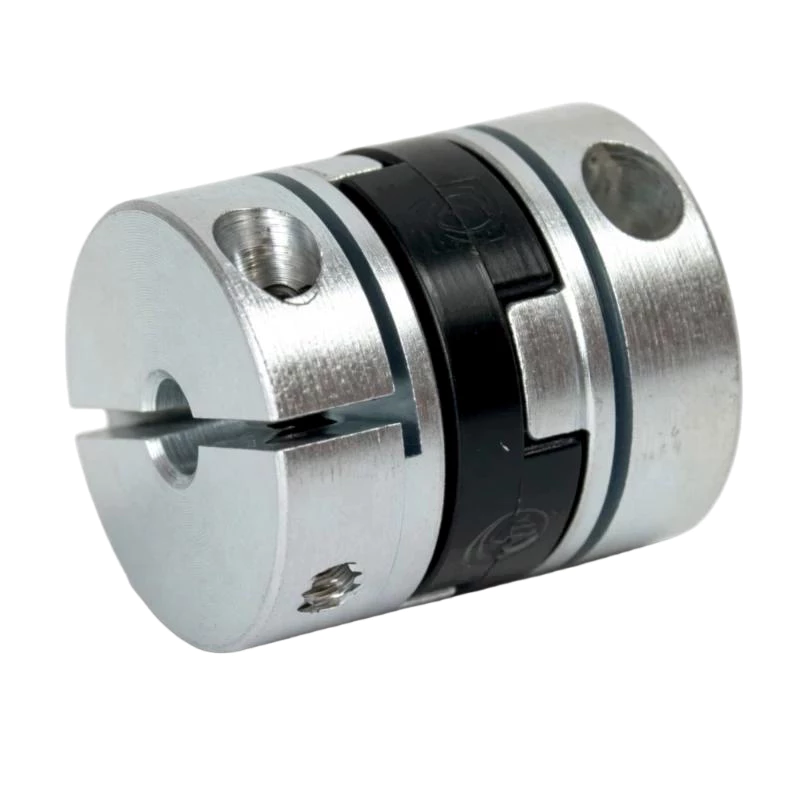
EP6-20 Set Screw Oldham Coupling — 20 mm Three-Piece Slider for Mid-Range Servo and Stepper Drives
The EP6-20 Oldham coupling bridges the gap between sub-newton-meter precision instruments and the mid-range servo drives found in benchtop automation. With a 20 mm outside diameter, a 30 mm overall length, and bore options that span the metric 6 mm / 8 mm shaft sizes and the imperial 6.35 mm (1/4″) standard, this set-screw model is the most ordered SKU in the EP6 family — the workhorse that quietly connects countless desktop CNC routers, pick-and-place heads, peristaltic pumps, and motorised valve actuators to their drive motors.
The mechanical design preserves the defining traits of the Oldham architecture: a three-piece sandwich of two aluminum-alloy hubs surrounding a polyacetal centre disc, two orthogonal sliding interfaces that decompose parallel misalignment into pure translational motion, and a constant-velocity 1:1 torque transmission with zero rotational backlash. What changes versus the smaller EP6-16 is the absolute torque envelope (1.6 N·m rated, 3.2 N·m peak) and the inertia footprint (9.0 × 10⁻⁷ kg·m²) — both still favourable for closed-loop servo systems, but now sized for NEMA 14 / NEMA 17 / Φ28 mm BLDC motor outputs.
Specifications
| Parameter | Value |
|---|---|
| Model | EP6-20 |
| Outside Diameter (ΦD) | 20 mm |
| Overall Length (L) | 23 mm |
| Bore Range (d1 / d2) | 6, 6.35, 8 mm |
| Rated Torque | 1.6 N·m |
| Maximum Torque | 3.2 N·m |
| Maximum Rotational Speed | 7 400 rpm |
| Moment of Inertia | 9.0 × 10⁻⁷ kg·m² |
| Static Torsional Stiffness | 58 N·m/rad |
| Parallel Misalignment | 1.4 mm |
| Angular Misalignment | 3.0° |
| Set-screw Thread | M4 |
| Wrench Tightening Torque | 1.7 N·m |
| Mass (max bore) | 14 g |
| Backlash | Zero |
Materials
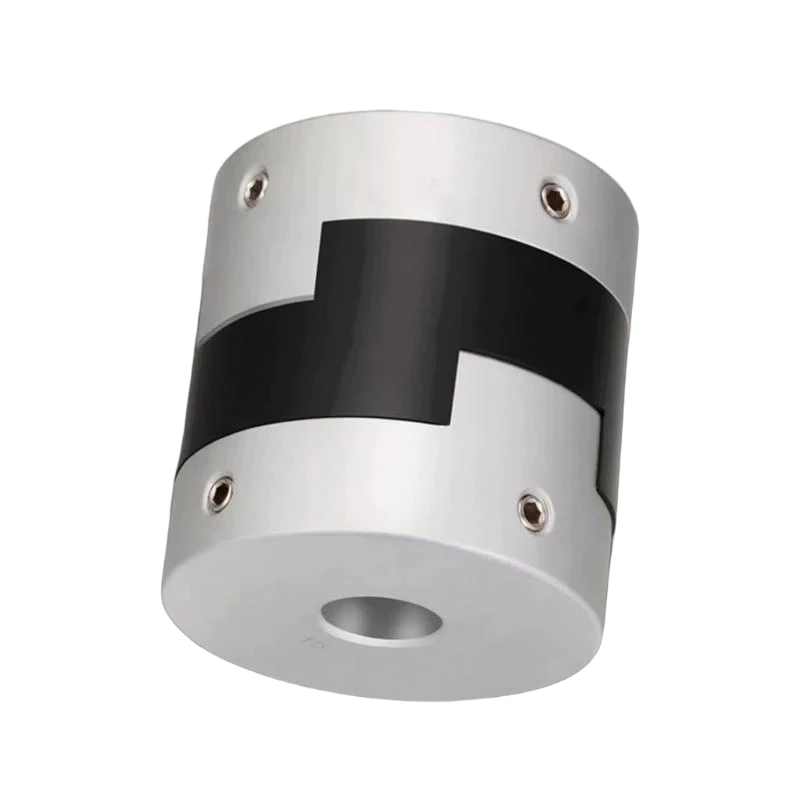
A2017 Aluminum-Alloy Hubs
Both outer hubs are machined from A2017 aluminum and clear-anodised for corrosion resistance. The alloy strikes the right balance between machinability and yield strength for set-screw seating — fastener torque can be applied to specification without deforming the bore. Heat dissipation, while rarely a limit for the EP6-20, is excellent: the entire coupling reaches thermal equilibrium with ambient within minutes, even after duty bursts.
Engineering POM Slider
The centre disc is engineered polyacetal (POM-C copolymer), the workhorse polymer for sliding plain-bearing duties. It is self-lubricating against aluminum, electrically insulating across a 12 kV/mm dielectric, and stable from −40 °C to +100 °C. For applications that demand higher torsional rigidity or impact tolerance, a 30 % glass-fibre filled grade can be substituted — please mention “GF-POM slider” at the time of enquiry.
M4 Stainless Set Screws
Hex-socket SUS304 M4 set screws — two per hub at 90° — secure each shaft. The 1.7 N·m wrench torque specification gives a generous safety margin against slip at rated load, while still being achievable with a pocket-sized 2.0 mm hex key.
How the EP6-20 Compensates Misalignment
Picture two parallel motor shafts 100 mm apart, both pointing in the same direction, but offset radially by 1.0 mm — the kind of stack-up that emerges naturally when a stepper motor is bolted onto a bent sheet-metal bracket. A rigid coupling would transmit this offset into the load bearing as a continuous radial force, accelerating bearing fatigue and producing a measurable side-load on the motor’s own ball races. A bellows coupling would absorb the offset elastically — but with a restoring force that is bidirectional, oscillating, and that injects a torsional ripple into the loop at the shaft frequency.
The EP6-20 handles the same 1.0 mm offset differently. The polyacetal slider’s two orthogonal tongues simply translate inside the two hub slots — one tongue slides “north-south”, the other “east-west” — and the slider’s centre point traces a small circular orbit at the shaft speed. Crucially, the angular velocity that exits Hub B is identical to the angular velocity that enters Hub A: there is no second-harmonic ripple, no torsional spring, and (with set-screws properly tightened) no backlash. The work of misalignment compensation is dissipated as a very small amount of sliding friction inside the slider — typically <1 % of transmitted torque under normal operation.
This makes the EP6-20 particularly useful in closed-loop encoder-feedback systems, where any elastic compliance between motor and encoder shows up as a phase lag in the velocity controller. With an Oldham coupling the encoder sees the load shaft’s true motion, not a filtered version of it.
Industry Applications
️ Desktop CNC & Hobby Mills
Linking NEMA 17 steppers to 8 mm ball-screws on benchtop 3- and 4-axis mills. The 1.4 mm parallel tolerance gives slack to absorb cabinet flex during heavy cuts.
Pharmaceutical Dispensing Pumps
Driving the rotor of peristaltic and gear-meter dispensing heads. POM’s electrical insulation eliminates galvanic coupling between fluid path and chassis ground.
Light-duty Robotics
Joints in collaborative-robot teaching units and educational arms. Constant-velocity transmission preserves the trajectory accuracy that learning algorithms depend on.
Motorised Valves & Actuators
Linking the actuator drive shaft to butterfly and ball-valve stems in process automation skids. Tolerates the cumulative misalignment of multi-housing valve trains.
️ Food-machinery Conveyor Drives
Light conveyor segments and metering augers in confectionery and bakery lines, where wash-down water can reach the coupling. POM is FDA-listed and copes with intermittent immersion.
️ Industrial Inkjet & Marking Heads
Connecting traverse motors to belt pulleys in date-coding and product-marking units. Constant-velocity is critical to maintain even pixel pitch in the printed text.
Why Choose Ever-power for Your EP6-20 Couplings
Certified Quality System
Ever-power operates under an ISO 9001:2015 quality management system. All EP6-20 production batches carry full material traceability — aluminum melt-cast lot numbers, POM resin batch IDs, and stainless-fastener heats — backed by RoHS and REACH conformity statements. CE documentation can be supplied where the coupling is incorporated into machinery for the European market.
Customisation Beyond Catalogue
The catalogue bore set (6 / 6.35 / 8 mm) covers most NEMA 17 and Φ8 mm shafts, but mixed bores (e.g., 6 mm × 8 mm), keyway-broached bores, D-cut shaft mating, and oversized OD variants are produced regularly. Anodised colours can be matched for product-line branding.
Logistics & Support
English-speaking application engineers reply within 24 hours on selection, drawing, and de-rating queries. For repeat MRP buyers, Ever-power maintains a Kanban buffer of standard EP6-20 bore combinations to keep replenishment under two weeks even during the Asian holiday calendar.
Customer Reviews & Case Studies
★★★★★
Italy — Pharmaceutical Filling Line OEM
Used in: Pump drive on a vial-filling skid running 24/6 production shifts.
Feedback: “Sliding-disc design has been working flawlessly for 14 months across 18 dispensing channels. The previous flexible-jaw coupling needed elastomer replacement every six months; EP6-20 has eliminated that maintenance task entirely. Documentation pack was complete on first delivery, which saved us a back-and-forth with QA.”
★★★★★
Mexico — Industrial Inkjet Manufacturer
Used in: Traverse drive of a continuous-jet date-coder.
Feedback: “We moved to the EP6-20 from a competitor’s bellows after the bellows fatigue-cracked at 16 months. Two years in on the EP6-20, no failure, and our printed-character vertical alignment is visibly more consistent. Worth the slightly higher unit price.”
★★★★☆
Canada — Educational Robotics
Used in: Joints of an open-source 5-axis teaching arm distributed to vocational colleges.
Feedback: “Students assemble and disassemble these arms hundreds of times per semester. The EP6-20 survives much better than the cheaper clamp couplings we used to source locally. One star removed only because we wish the keyway option were available off the shelf — but Ever-power did produce it as a custom request within their stated lead time.”
Frequently Asked Questions
Will the EP6-20 work with imperial 1/4-inch shafts?
Yes. 6.35 mm is the cataloged equivalent of a 1/4-inch shaft and is one of the three standard bore options. Mixed-bore versions (e.g., 6.35 mm × 8 mm) are also produced on request without affecting catalogue lead time.
How much radial load does it transmit to the motor bearings?
For a 1.0 mm offset at rated torque, the radial reaction on the motor bearing is typically below 5 N — an order of magnitude below the static load capacity of a NEMA 17 motor’s front ball bearing. The Oldham architecture is the only common flexible coupling that achieves this so consistently.
Can I use thread-locker on the M4 set screws?
Yes — a low-strength formulation such as Loctite 222 is recommended for vibration-prone installations. Avoid medium-strength threadlocker (Loctite 243) unless servicing access is not a concern, since 243 can require localised heating to release the M4 screws.
What happens if the rated torque is briefly exceeded?
The EP6-20 tolerates peaks up to 3.2 N·m without permanent damage. Repeated peaks above that level will accelerate slider wear; sustained operation above 1.6 N·m is not recommended. For peak demands above 3.2 N·m we suggest stepping up to the EP6-25.
Do you offer FDA-compliant variants for food contact?
Standard POM resin used in the slider is FDA-listed (21 CFR 177.2470) for incidental food contact. For direct prolonged contact we recommend specifying a food-grade PEEK slider — please mention “FDA-direct-contact” at enquiry stage so engineering can supply the appropriate declaration.
Get a Quote & Engineering Drawing
Procurement engineers across the Americas, EMEA, and APAC trust the EP6-20 for repeat MRP buys at scale. Browse the rest of our Oldham coupling catalogue for adjacent sizes, learn about our global supply network, or move straight to a tailored quote below.