Oldham couplings are among the most reliable components in a precision drive system. With no elastomeric elements to age, no springs to fatigue, and no lubrication passages to become blocked, they can operate for years without requiring attention. However, they are not failure-proof. When an Oldham coupling does fail, the failure mode usually falls into one of a small number of well-understood categories — and each category points to a specific root cause that, once identified, can be prevented through design changes, maintenance practices, or better application of the coupling’s rated limits.
This article provides a systematic analysis of Oldham coupling failure modes, explains the root cause behind each, and gives practical guidance on prevention.
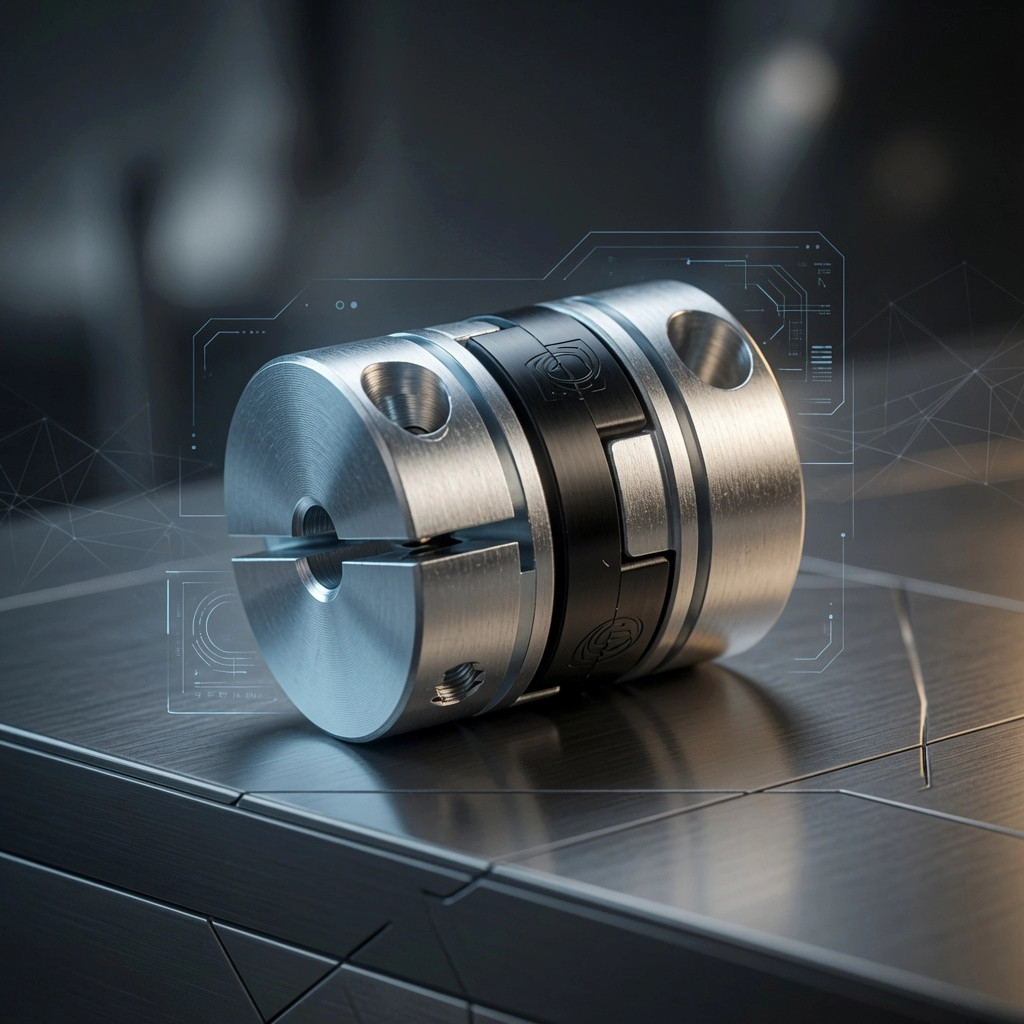
Failure Mode 1: Progressive Centre Disc Wear
What it looks like: The tenon surfaces on the centre disc show material loss, rounding, or polishing. Backlash — initially zero — gradually increases to a measurable level. In servo systems, this manifests as a growing dead band during directional reversals, which may appear as oscillation in position-controlled loops or as registration drift in printing and packaging applications.
Root causes:
- Excessive lateral misalignment: The amplitude of the disc’s sliding motion is proportional to the shaft offset. Operating at misalignment levels above the coupling rating dramatically increases surface contact velocity and therefore wear rate.
- Excessive rotational speed: Higher speed increases the frequency and velocity of the disc’s reciprocating motion, which magnifies wear per unit time even if the misalignment magnitude is within specification.
- High ambient temperature: Polymer disc materials — especially acetal — soften as temperature increases, which reduces their wear resistance and increases the rate of material loss under load.
- Incorrect disc material for the load: Using a standard acetal disc in a high-torque application causes the contact pressure on the tenon faces to exceed the material’s compressive strength, leading to accelerated surface fatigue.
Prevention: Verify that the coupling is operating within its combined speed-and-misalignment envelope — most manufacturers publish derating curves that show permissible misalignment as a function of speed. Improve shaft alignment at installation to reduce the offset to the minimum achievable value, rather than simply verifying it falls within the coupling’s maximum rating. Select a higher-grade disc material (nylon, PEEK, or metal) if load or temperature conditions are challenging. Implement a disc replacement schedule based on periodic backlash measurement rather than waiting for visible deterioration.
Failure Mode 2: Centre Disc Fracture
What it looks like: The centre disc breaks completely, usually through the body or at the root of a tenon. This is an acute failure — it typically produces audible impact noise and can cause an immediate loss of drive torque. Disc fragments may scatter inside the machine, causing secondary damage.
Root causes:
- Torque overload: The most common cause. Peak torque during machine start-up, jam clearance, emergency stops, or sudden load changes can exceed the coupling’s static or dynamic torque rating, causing the disc to fracture. This occurs most often in machines that do not have a torque-limiting device (torque limiter or slip clutch) upstream of the coupling.
- Angular misalignment beyond rating: When angular misalignment is present, the centre disc is forced to operate in a non-planar condition, which introduces bending stresses in addition to the normal torsional and contact stresses. Bending stresses are most severe at the tenon root — the highest stress concentration in the disc — and fracture initiates there.
- Fatigue after extended wear: A disc that has been in service for a long time may have significant material loss from wear. The reduced cross-section at the tenon root lowers the disc’s fatigue strength, making fracture under otherwise acceptable loads more likely.
- Low-temperature embrittlement: Acetal and nylon become more brittle at temperatures below approximately 0°C. Couplings in cold storage facilities or outdoor installations in cold climates may experience disc fractures that would not occur at ambient temperature.
Prevention: Size the coupling with a generous safety factor — a factor of 2.0 to 3.0 on the peak dynamic torque is not excessive in applications with significant shock loading potential. Install a torque-limiting element in series with the coupling in any application where machine jams or overloads are possible. Correct angular misalignment at installation; if the machine design inevitably produces angular offset, consider a different coupling type. Use a temperature-rated disc material if cold-environment operation is anticipated.
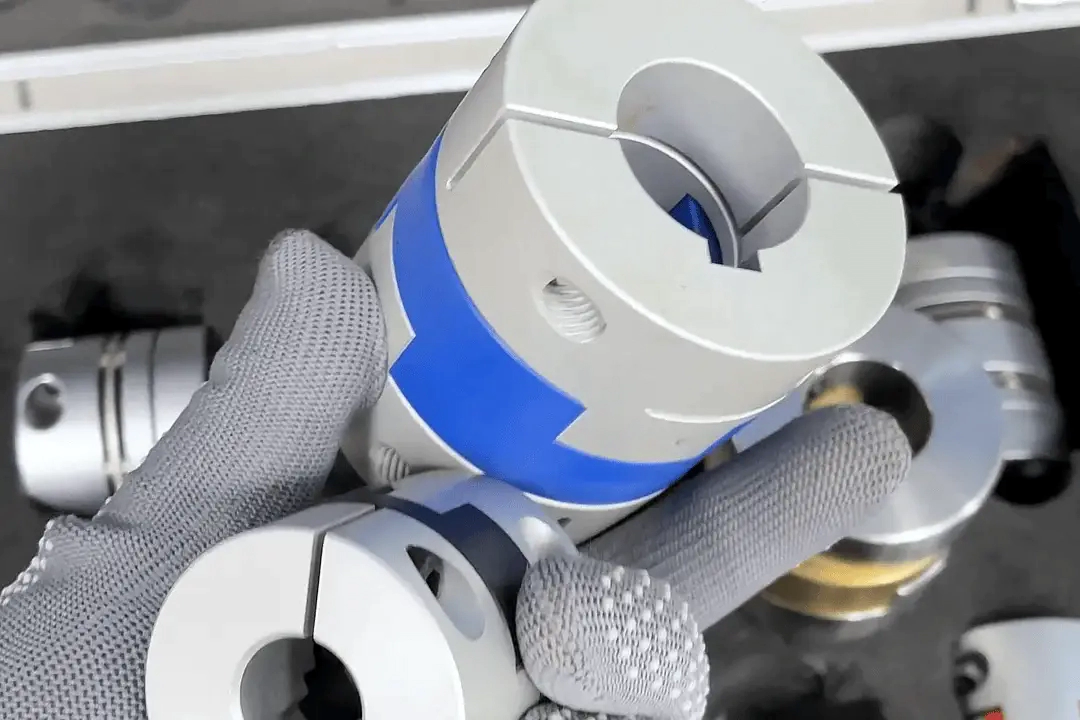
Failure Mode 3: Hub Slippage on the Shaft
What it looks like: One or both hubs rotate relative to their shaft, losing the fixed angular relationship. In set-screw hubs, the shaft develops a flat or groove where the screw has worn into it. In clamp hubs, the shaft may show a burnished band at the clamping zone. The symptom in the drive system is a gradual or sudden change in positional relationship between the motor and the load — the machine homes to a different position on each power cycle, or the drive system shows apparent backlash in one direction only.
Root causes:
- Insufficient fastener torque: Set screws or clamp bolts tightened below the specified torque value provide insufficient clamping force to resist shaft torque under peak load conditions.
- Shaft surface contamination: Oil, grease, or machining coolant on the shaft surface at the hub bore zone dramatically reduces the effective friction coefficient, allowing the hub to slip at torque levels well below the theoretical clamping capacity.
- Incorrect bore fit: A hub bore that is too large for the shaft — either from manufacturing tolerance mismatch or from hub bore damage — reduces the contact area available for clamping and lowers the slip torque.
- Repeated torque reversal causing micro-slip: In applications with frequent, high-magnitude torque reversals, micro-slip can occur at each reversal even when the hub appears to be correctly tightened. Over many thousands of cycles, this micro-slip accumulates into macroscopic hub rotation.
Prevention: For zero-backlash applications, use clamp-style hubs (split-bore hubs) rather than set-screw hubs wherever possible. Clamp hubs provide a uniform 360-degree grip on the shaft rather than a point contact, giving substantially higher slip torque for the same hub size. Clean shafts thoroughly with solvent before hub installation; apply a thin film of shaft retaining compound if the application involves frequent torque reversals. Verify fastener torque with a calibrated torque tool — do not estimate by feel. For high-reversal applications, a keyed hub provides positive angular location that is immune to slip.
Failure Mode 4: Hub Bore Damage
What it looks like: The hub bore develops fretting corrosion (reddish-brown oxide deposit), scoring, or galling on its interior surface. The hub may become difficult to remove from the shaft, or conversely, may develop excessive clearance that makes accurate re-installation impossible.
Root causes: Fretting occurs when two surfaces in nominally fixed contact undergo micro-scale relative motion — exactly what happens in a hub bore under fluctuating torque loads. The micro-motion abrades oxide from the contact surfaces; the oxide debris then acts as an abrasive, accelerating further damage. Aluminium hubs are particularly susceptible because aluminium oxide is harder than the parent metal.
Prevention: Apply a thin film of anti-fretting compound or dry molybdenum disulphide to the shaft-bore interface at installation. Where shaft removal and reinstallation frequency is high, consider stainless steel hubs rather than aluminium. Ensure bore-to-shaft fit is within the manufacturer’s recommended tolerance — excessive clearance aggravates fretting by increasing micro-motion amplitude.
Failure Mode 5: Hub Slot Wear or Deformation
What it looks like: The rectangular slots in the hub faces show visible wear, rounding at the edges, or plastic deformation. Backlash increases in a way that cannot be resolved by replacing the centre disc alone — replacing the disc restores only temporary improvement before backlash returns quickly.
Root causes: Hub slot wear is unusual in well-specified couplings because the polymer disc is intentionally softer than the aluminium hub, so the disc wears first. Hub slot damage typically indicates one of the following: the disc material was too hard for the hub material (metal disc running against an aluminium hub without lubrication); the coupling was severely overloaded, causing impact loading on the slot walls; or the coupling ran for an extended period after the disc had worn through, causing metal-to-metal contact between hub slots.
Prevention: Implement a disc inspection and replacement schedule so the hub slots are never exposed to metal-to-metal contact. If the application requires a metal disc for torque capacity reasons, specify hubs with hardened steel slots or ensure adequate lubrication of all sliding interfaces. Avoid coupling overloads through proper system design and torque limiting.
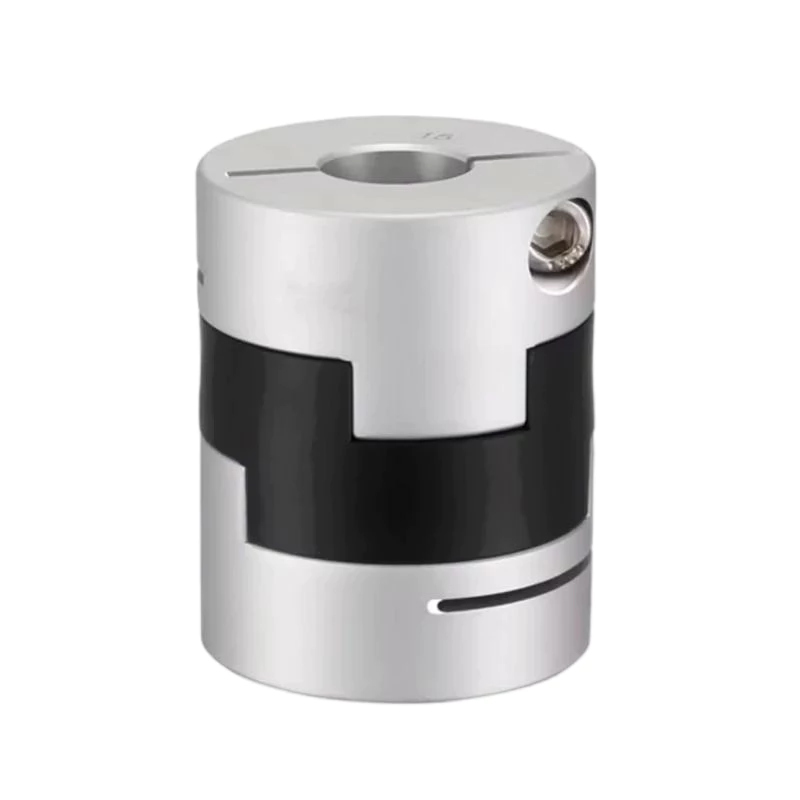
Diagnostic Checklist: What to Inspect
When investigating an Oldham coupling failure or planning a preventive maintenance inspection, work through this checklist systematically:
Backlash measurement: Clamp a dial indicator against the driven hub and rotate the driving shaft back and forth by hand. Record the angular free play. Zero or near-zero backlash indicates a healthy coupling; backlash greater than the manufacturer’s wear limit indicates disc replacement is due.
Centre disc inspection: Remove the disc and examine all four tenon contact faces. Look for material loss, surface cracking, white fatigue striations, or deformation of the tenon profile. A worn disc should be measured against the original specification — if tenon width has reduced by more than 5 percent, replacement is recommended.
Hub slot inspection: Examine the slot walls of both hubs under good lighting. The slot walls should be flat and square with sharp, clean edges. Any rounding, scoring, or debris embedded in the slot walls indicates hub damage.
Hub security check: Try to rotate each hub relative to its shaft by hand with moderate force. Any detectable rotation indicates hub slippage — check fastener torque and shaft surface condition.
Misalignment measurement: With the coupling removed, measure the lateral offset between the two shaft centrelines using a dial indicator and a precision straight-edge. Compare against the coupling’s rated misalignment capacity. If the actual offset is more than 50 percent of the coupling’s maximum rating, improve alignment before reinstalling.
Building a Preventive Maintenance Programme
For critical drive systems, a structured preventive maintenance programme for Oldham couplings should include four elements:
Baseline documentation: At installation, record the measured lateral misalignment, hub fastener torques, and disc part number. Photograph the installed coupling. This baseline makes future comparisons meaningful.
Periodic backlash trending: Measure and log backlash at regular intervals — quarterly for high-cycle applications, annually for slow-speed drives. Plot the trend. When the trend shows accelerating backlash increase, schedule a disc replacement before the next measurement interval.
Spare disc inventory: Keep at least two replacement discs in stock for each coupling type in service. Disc replacement is a planned maintenance activity; it should never cause unplanned downtime simply because a replacement part is unavailable.
Failure mode recording: When a disc is replaced, record whether it showed wear, fracture, or chemical degradation, and the operating hours since last replacement. Over time, this data reveals whether the coupling is correctly specified for the application or whether a different size or material is warranted.
Conclusion
Oldham coupling failures are rarely sudden or mysterious. They follow recognisable patterns — progressive disc wear, overload fracture, hub slippage, and hub slot damage — and each pattern has a clear root cause. By understanding these failure modes, designing the coupling installation to avoid their triggers, and implementing a simple inspection and replacement schedule, most Oldham coupling failures can be predicted and prevented well before they cause machine downtime. The result is a coupling that gives many years of zero-backlash service with nothing more than occasional disc replacement as its maintenance requirement.
For application engineering support or to source replacement discs and complete couplings, visit our product range or contact our technical team.