With dozens of Oldham coupling variants available — spanning bore sizes from 3 mm to over 100 mm, disc materials from acetal to PEEK to steel, and hub styles from set-screw to clamp to keyed — selecting the right one for a specific application is not as straightforward as it might appear. An undersized coupling fails prematurely. An oversized one wastes space and adds unnecessary inertia to the drive train. The wrong disc material may degrade in the operating environment. The wrong hub style may allow shaft slippage under dynamic loading.
This guide walks through the coupling selection process step by step, covering every parameter that matters for a reliable, long-service installation.
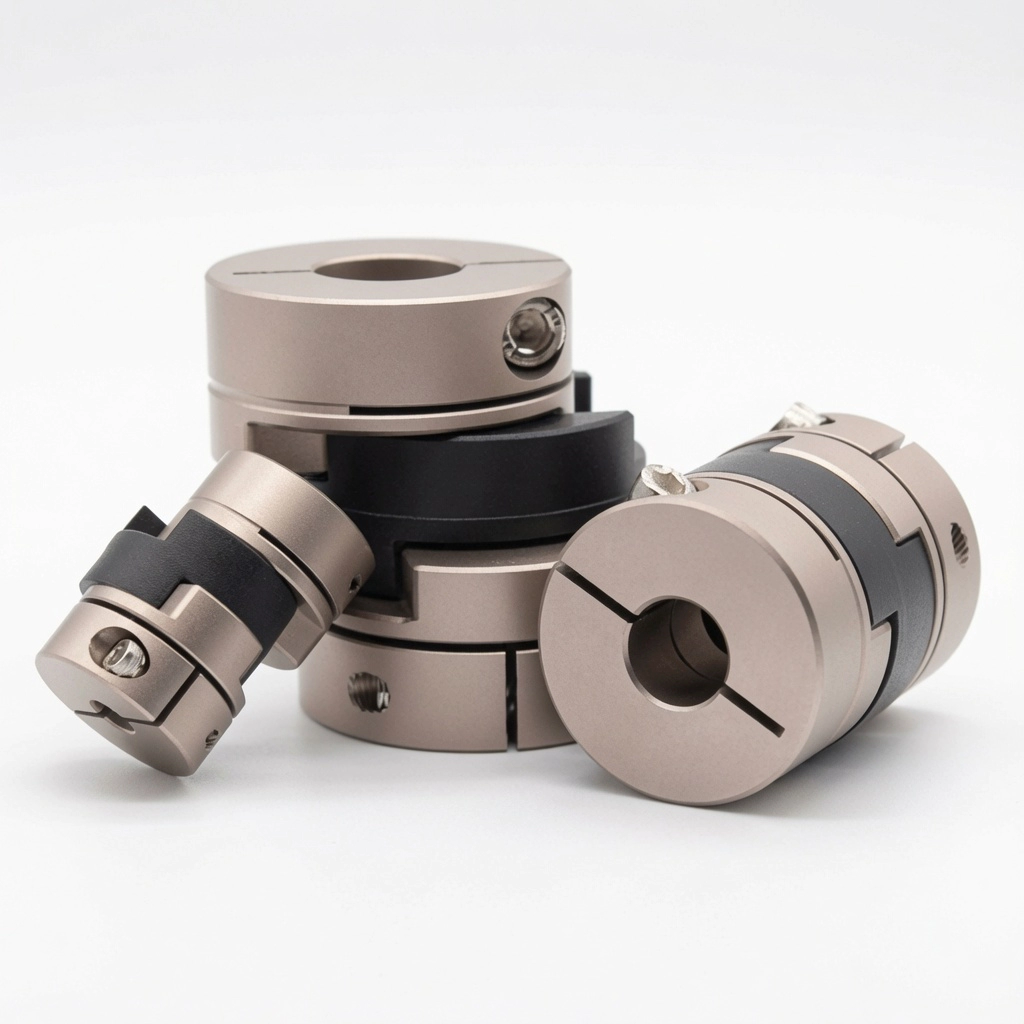
Step 1: Determine the Required Torque Rating
The first and most fundamental parameter is torque. You need to establish two torque values for your application:
Continuous (nominal) torque is the steady-state torque the coupling must transmit during normal operation. For a motor-driven system, this is typically the motor’s rated torque at the operating speed point, multiplied by any gearbox ratio between the motor and the coupling.
Peak (dynamic) torque is the maximum torque the coupling will experience during start-up, emergency stops, load changes, or machine jams. For servo systems, this is often the motor’s peak torque — which can be 2 to 5 times the continuous rated torque — applied during rapid acceleration or deceleration cycles.
The coupling’s rated torque must exceed the peak dynamic torque, not just the continuous torque. A coupling running at its rated continuous torque has a safety margin; a coupling experiencing repeated peaks at its continuous torque rating will fail from fatigue much sooner than expected.
Recommended service factors by application type:
| Application Type | Service Factor |
|---|---|
| Encoder / resolver feedback | 1.5 |
| Servo motor, smooth load | 2.0 |
| Stepper motor, moderate reversals | 2.0–2.5 |
| High-cycle servo with frequent reversal | 2.5–3.0 |
| Industrial machinery with shock loads | 3.0–4.0 |
The design torque for coupling selection is: Design Torque = Nominal Torque × Service Factor. Select a coupling whose rated torque equals or exceeds this design torque value.
Step 2: Match the Bore Sizes to Your Shafts
Oldham couplings are manufactured with specific bore sizes, and the two hubs may have different bores to accommodate a driving shaft diameter that differs from the driven shaft diameter — for example, a 10 mm motor shaft connecting to a 14 mm ballscrew shaft.
Verify that the required bore sizes are available in the coupling size you have selected for torque capacity. In some cases, the required bore sizes are only available in a coupling that is larger than the minimum torque requirement suggests — in this situation, the bore size governs the selection, and the torque rating of the larger coupling provides additional margin.
For clamp-style hubs, the bore fit is a standard h7 shaft tolerance. For set-screw hubs, the shaft should be within the hub bore’s recommended tolerance range and must have a flat ground for the set screw to bear against — never tighten a set screw directly against a round shaft surface, as this deforms the shaft and creates an eccentric grip.
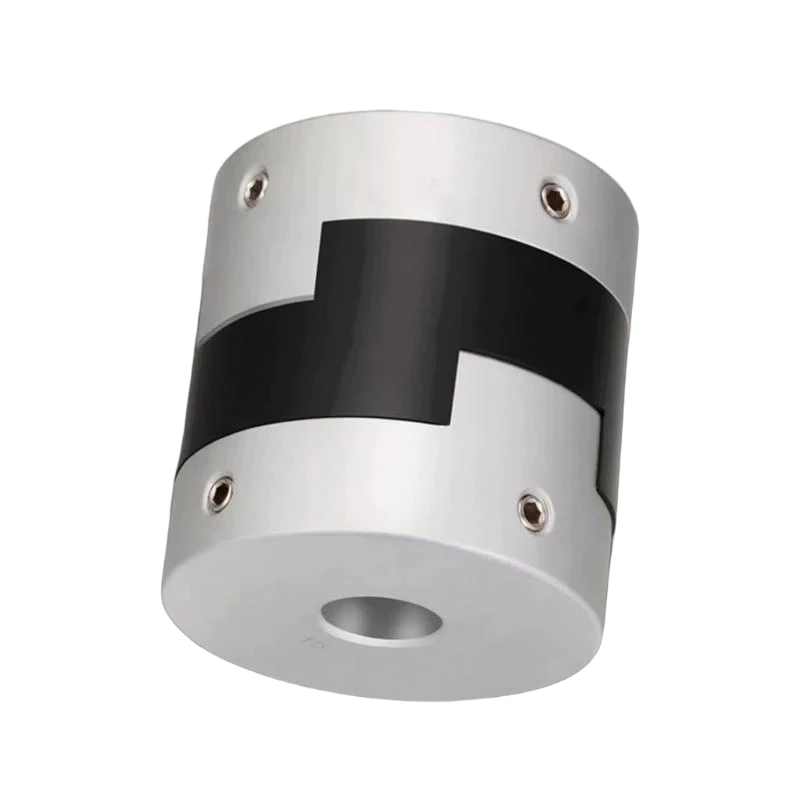
Step 3: Quantify the Shaft Misalignment
Measure or estimate the lateral (parallel) offset between the two shaft centrelines. This must be done under operating conditions — not just at room temperature during initial assembly — because thermal expansion of the machine frame, motor, and bearings can cause the offset to change significantly once the system reaches operating temperature.
As a general rule, size the coupling so that the operating misalignment is no more than 50 to 70 percent of the coupling’s maximum rated lateral offset. Running at the maximum rated offset continuously is technically within specification, but it places maximum stress on the disc and maximises wear rate. Operating at 50 percent of the rated offset leaves margin for measurement uncertainty, thermal drift, and bearing wear over the machine’s service life.
Also assess angular misalignment. If the two shafts are not parallel — if they converge or diverge along their lengths — this angular offset must be within the coupling’s angular tolerance (typically less than 1 degree). If angular misalignment exceeds this limit, correct it mechanically before installing the coupling; do not rely on the coupling to accommodate it.
Step 4: Verify the Speed Rating
The maximum operating speed of the coupling depends on both the coupling size and the operating misalignment. Larger couplings have lower speed ratings because the disc’s orbital radius — which determines the sliding velocity at the hub-disc interface — scales with the coupling’s physical dimensions. At greater misalignment, the sliding velocity is higher for the same rotational speed.
Always refer to the manufacturer’s combined speed-and-misalignment chart for the specific coupling size you are considering. If the chart shows that your operating speed and misalignment combination falls outside the permissible zone, you have two options: reduce the misalignment through better shaft alignment, or select a smaller coupling (which has a higher speed rating for a given physical offset) and verify it still meets the torque requirement.
Step 5: Select the Centre Disc Material
For most precision motion applications, acetal (POM) is the correct default choice. It provides zero backlash, runs dry without lubrication, offers good wear resistance at moderate loads, and provides electrical isolation between the two shafts.
Consider alternative disc materials in the following situations:
- Operating temperature above 100°C: Switch to glass-filled nylon (rated to ~120°C) or PEEK (rated to ~250°C).
- Chemical exposure: Acetal is resistant to most lubricants and mild acids but is attacked by strong oxidising acids and some chlorinated solvents. PEEK offers broader chemical resistance.
- Very high torque in a compact envelope: A metal centre disc (aluminium or hardened steel) with lubricated hub slots provides torque capacity 3 to 5 times higher than a polymer disc of the same physical size.
- Food, pharmaceutical, or cleanroom service: Specify FDA-compliant acetal or UHMW-PE discs, and verify that the hub material is also food-grade compliant.
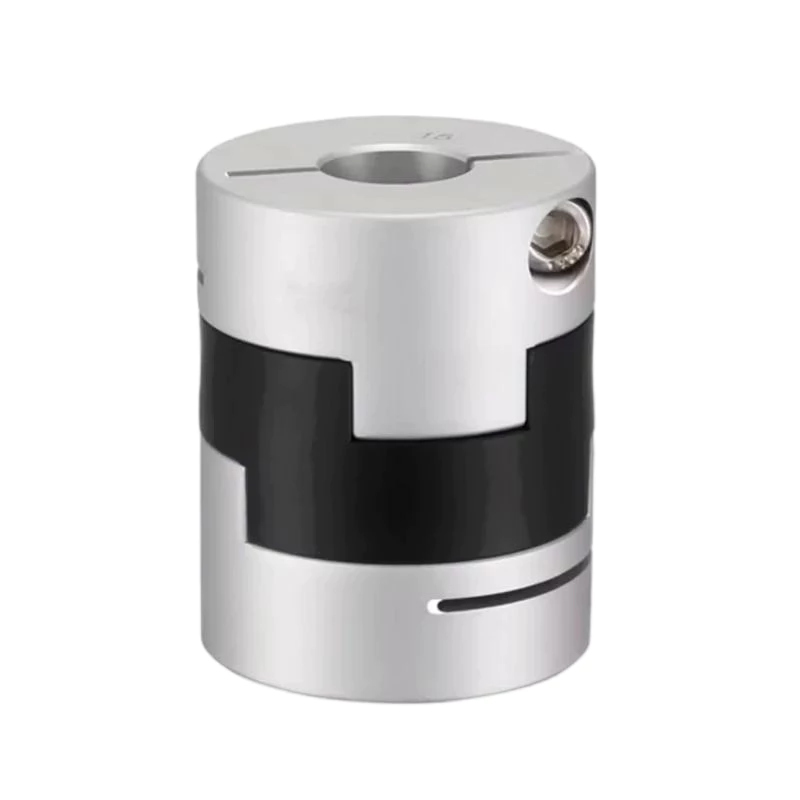
Step 6: Choose the Hub Style
Hub style affects how securely and accurately the coupling grips the shaft, which directly impacts the zero-backlash performance and service life of the installation.
Set-screw hubs are the simplest and lowest-cost option. A radial screw bears against the shaft surface (or a flat ground into it), providing clamping through localised point contact. Advantages: easy to install, low profile, works with solid or stepped shafts. Limitations: lower slip torque than clamp hubs, risk of shaft damage at the screw contact point, and eccentricity introduced by the off-centre clamping force. Best for: encoder drives, light-duty servo connections, low-cycle applications.
Clamp hubs (split hubs) have a diametral slit through the hub body that allows the bore to be closed uniformly around the shaft by tightening a clamping screw or screws. This provides 360-degree contact with the shaft, giving substantially higher slip torque, better concentricity, and no risk of shaft damage. Best for: precision servo systems, high-reversal applications, any installation where zero-backlash must be maintained over a long service life.
Keyed hubs include a keyway in the bore to accept a standard shaft key. The key provides a positive angular location that is completely immune to slippage under any torque level within the shaft’s strength limit. Best for: high-torque industrial applications, metal-disc Oldham couplings, and any application where torque reversal magnitude is high enough to risk slippage in a clamp hub.
Step 7: Check Rotational Inertia
In servo-driven systems, coupling inertia affects the dynamic response of the control loop. A coupling with high inertia relative to the load inertia makes the drive system feel sluggish and can cause servo tuning difficulties, particularly at high bandwidth.
As a practical guideline, coupling inertia should not exceed 10 percent of the total reflected load inertia at the motor shaft. If the available coupling that meets your torque and bore requirements has higher inertia than this guideline suggests, consider a coupling with an aluminium rather than steel hub, or evaluate whether the system can tolerate slightly relaxed servo bandwidth to accommodate the higher inertia.
Step 8: Consider Environmental Factors
Before finalising the selection, assess the operating environment for any factors that can degrade coupling performance:
- Temperature extremes: High ambient temperature reduces disc strength and increases wear rate. Low temperature increases disc brittleness. Both affect service life.
- Exposure to lubricants or solvents: Some cutting fluids, hydraulic oils, and cleaning agents attack acetal or nylon. If the coupling is in the splash zone of machine lubrication, verify chemical compatibility or specify an appropriate disc material.
- Humidity and washdown: Standard aluminium hubs corrode in high-humidity or washdown environments. Specify stainless steel hubs for these applications.
- Particulate contamination: Abrasive dust or swarf entering the hub-disc interface accelerates wear dramatically. A light shield or coupling guard is worth considering in grinding, cutting, or foundry environments.
Selection Summary Checklist
| Parameter | What to Specify |
|---|---|
| Design torque | Nominal torque × service factor ≤ coupling rated torque |
| Bore sizes | Driving bore and driven bore (may differ) |
| Lateral offset | Operating offset ≤ 50–70% of coupling maximum |
| Angular offset | Must be <1° — correct mechanically if exceeded |
| Operating speed | Within combined speed/misalignment rated zone |
| Disc material | Acetal (default); PEEK/nylon/metal for special conditions |
| Hub style | Clamp (preferred), set-screw (light duty), keyed (high torque) |
| Coupling inertia | <10% of reflected load inertia for servo systems |
| Hub material | Aluminium (standard), stainless (corrosive/washdown) |
Conclusion
Selecting the right Oldham coupling is a systematic process, not a catalogue lookup exercise. Working through each parameter — torque, bore, misalignment, speed, disc material, hub style, inertia, and environment — takes perhaps twenty minutes, but it produces a specification that will give reliable, zero-backlash service for thousands of hours. Skipping any step risks a coupling that is either overloaded, incorrectly fitted, or degraded by its operating environment — all of which result in premature failure and unplanned downtime.
Browse our full Oldham coupling catalogue with technical datasheets, or contact our engineering team to discuss your specific application requirements.