Stepper motors are the workhorse of low-to-medium cost motion control. From desktop 3D printers and CNC routers to laboratory dispensers and industrial indexing equipment, the stepper motor’s ability to move in precise angular increments without a position feedback device makes it an attractive and cost-effective solution for a vast range of applications. But a stepper motor’s open-loop positioning accuracy is only as good as the mechanical chain that connects its shaft to the load — and in that chain, the coupling is often the weakest link.
The Oldham coupling is particularly well suited to stepper motor drive systems, addressing the specific vulnerabilities that open-loop stepping creates. This article explains why, and provides detailed installation and specification guidance for stepper motor applications.
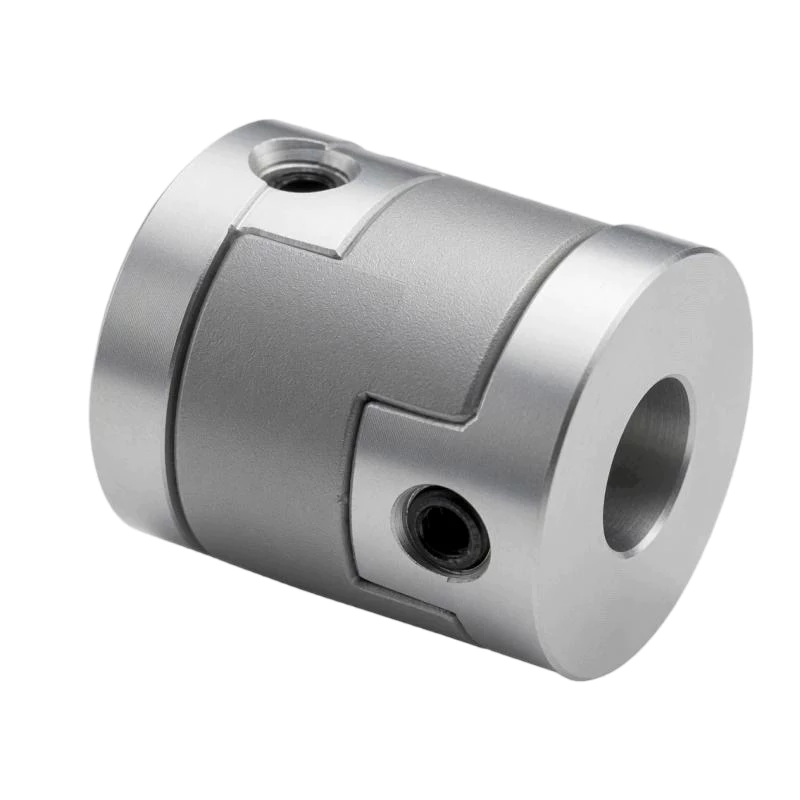
Why Stepper Motor Systems Need Zero-Backlash Couplings
A stepper motor advances in discrete steps — typically 1.8 degrees per full step, or 0.9 degrees in half-step mode. Each step is commanded by the controller regardless of whether the motor actually moves to the commanded position. This open-loop nature means there is no correction mechanism for any error introduced between the motor shaft and the load.
In this context, coupling backlash is particularly destructive. Consider a stepper driving a leadscrew for a linear axis. If the coupling has 0.5 degrees of backlash and the leadscrew has a 2 mm pitch, the backlash translates to a positioning dead zone of approximately 0.003 mm at each directional reversal. The controller commands a reversal, steps the motor accordingly, but the leadscrew does not move for the first 0.5 degrees of motor rotation. The controller has no way to know this has occurred — it continues counting steps from the wrong position. Every subsequent position command in the new direction is offset by the backlash error.
Unlike servo systems, which can partially compensate for coupling backlash through software, stepper systems have no compensation mechanism at all. The only way to eliminate backlash error in an open-loop stepper drive is to use a coupling with zero backlash.
The Stepper Motor’s Specific Loading Profile
Stepper motors produce torque in a characteristic pattern that differs significantly from servo motors, and this pattern has implications for coupling selection.
Torque ripple: As the stepper advances from one step to the next, the electromagnetic torque varies sinusoidally. Even a well-microstepped motor produces torque ripple at the step frequency. This means the coupling experiences not just steady-state torque but a continuous superimposed oscillation. A coupling with any torsional compliance will filter some of this ripple — which might seem beneficial — but it also introduces a phase lag between the motor and the load that accumulates into positional error in some motion profiles.
Resonance sensitivity: Stepper motors have a well-known mid-frequency resonance phenomenon — at certain step rates, the motor’s rotor can oscillate around each step position rather than settling cleanly. A torsionally compliant coupling between the motor and the load can lower the resonant frequency of the motor-coupling-load system, potentially moving the resonance into the operating speed range. The Oldham coupling’s relatively high torsional stiffness keeps the coupled system resonance well above the typical operating speed range.
Holding torque under vibration: A stationary stepper motor holds its position by magnetic detent and winding current. Under external vibration — common in industrial machinery — the stepper can lose steps if the vibration-induced torque on the load exceeds the motor’s holding torque. A coupling with any backlash allows the load to move through the dead zone before the motor detects the disturbance, magnifying the effective vibration sensitivity. A zero-backlash Oldham coupling ensures that any load movement is immediately resisted by the motor’s full holding torque.
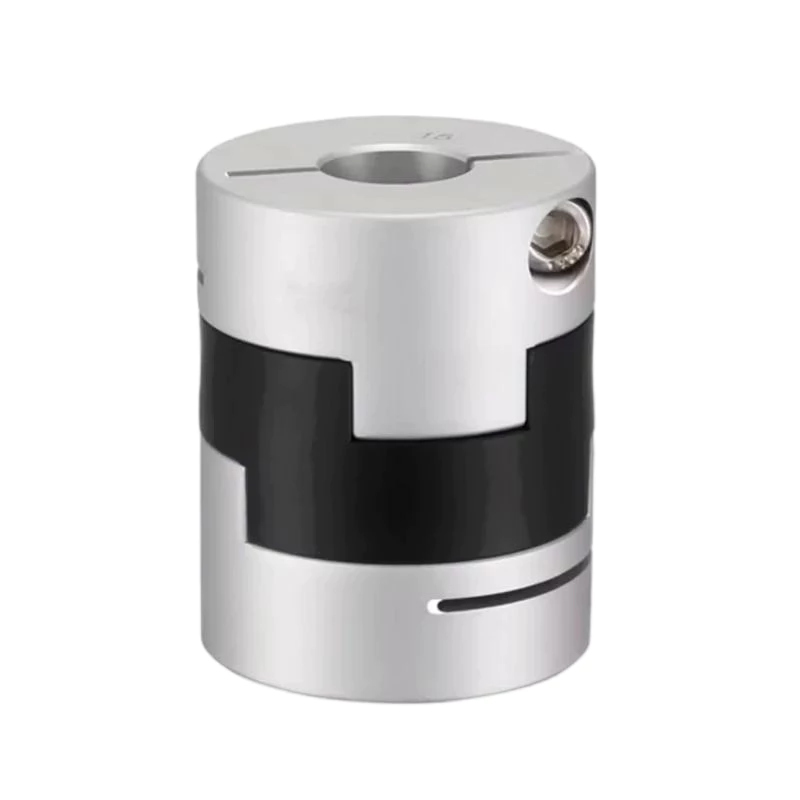
Specifying the Right Oldham Coupling for a Stepper Drive
Torque rating: Stepper motors are typically run at 50 to 70 percent of their rated holding torque to maintain a safety margin against step loss. Use the motor’s rated holding torque (not the reduced operating torque) as the basis for coupling selection, and apply a service factor of 2.0 to 2.5 to account for acceleration peaks and torque ripple. The resulting design torque should fall comfortably within the coupling’s rated continuous torque capacity.
Bore sizes: NEMA stepper motors use standardised shaft diameters — NEMA 17 motors typically have 5 mm shafts, NEMA 23 motors have 6.35 mm (0.25 inch) or 8 mm shafts, and NEMA 34 motors have 9.525 mm (0.375 inch) or 14 mm shafts. Verify the driven component shaft diameter as well — leadscrew, ballscrew, and gearbox input shafts vary widely. Oldham couplings with different bore sizes on each hub are available to accommodate mismatched shaft diameters.
Hub style: For stepper motor applications, clamp-style hubs are strongly preferred. The frequent torque reversals inherent in bidirectional stepper motion can cause incremental micro-slip with set-screw hubs over thousands of cycles. This micro-slip does not produce detectable backlash — instead it shifts the angular relationship between the motor shaft and the leadscrew, equivalent to losing steps without the controller knowing. Clamp hubs eliminate this failure mode entirely.
Disc material: Standard acetal (POM) is appropriate for the large majority of stepper motor applications. For high-temperature environments (stepper motors can run warm, particularly at high current settings), glass-filled nylon or PEEK discs are available. For very low-speed, high-torque applications — where the stepper is moving slowly but transmitting close to its full rated torque — specify a disc material with higher compressive strength to reduce tenon face wear rate.
Inertia Matching: The Often-Overlooked Parameter
Stepper motors are more sensitive to load inertia mismatch than servo motors because they operate open-loop. When the load inertia significantly exceeds the motor rotor inertia, the motor’s ability to accelerate and decelerate the load quickly degrades. At high step rates, the motor may fail to accelerate the load to the commanded velocity — losing steps — or may overshoot when decelerating.
The coupling’s rotational inertia adds directly to the load inertia seen by the motor. In a stepper drive where inertia matching is already challenging, a heavy coupling can be the difference between reliable operation and frequent step loss.
Aluminium-hub Oldham couplings with acetal discs have among the lowest inertia values of any zero-backlash coupling type. For NEMA 17 and NEMA 23 stepper applications, coupling inertia values below 0.5 g·cm² are achievable — comparable to the motor rotor inertia in many small stepper motors.
Step-by-Step Installation Guide
Step 1 — Prepare the shafts. Clean both the motor shaft and the driven shaft thoroughly. Remove any burrs, rust, or machining debris. If the motor shaft has a flat ground for a set screw (common on NEMA stepper shafts), note its angular position for hub orientation. If you are using clamp hubs, the flat is not required — clean the full circumference of the shaft within the hub clamping zone.
Step 2 — Mount the hubs loosely. Slide each hub onto its respective shaft to approximately the correct axial position. Do not tighten any fasteners yet. Leave both hubs finger-loose so they can be moved axially and rotationally during alignment.
Step 3 — Insert the centre disc. Engage the first tenon face into one hub’s slot, then bring the two hubs together so the second tenon engages the other hub’s slot. Verify that the disc moves freely — it should slide smoothly in both directions within the hub slots with no binding or tight spots. If binding is detected, check for angular misalignment between the motor and driven shaft axes.
Step 4 — Set the axial gap. Position the two hubs so there is a small axial clearance — 0.5 to 1.0 mm — between the disc faces and the hub inner faces. This gap allows the disc to float axially without being compressed, preventing axial force transmission to the motor bearings. Do not push the hubs so close together that the disc is squeezed axially.
Step 5 — Verify alignment. Before tightening any fasteners, manually rotate the motor shaft slowly through one full revolution while watching the disc. The disc should slide smoothly within both hub slots throughout the full rotation. If the disc moves in and out of one hub slot more than the other, lateral misalignment is present — adjust the motor mounting position to reduce it as much as possible before proceeding.
Step 6 — Tighten hub fasteners. Tighten clamp screws or set screws to the torque specified by the coupling manufacturer. Use a calibrated torque tool — do not estimate by feel. Over-tightening a clamp screw can crack the hub; under-tightening allows micro-slip. For NEMA 23 and NEMA 34 applications, typical clamp screw torques are in the range of 0.5 to 2.0 Nm depending on coupling size.
Step 7 — Final backlash check. Hold the driven shaft stationary and attempt to rotate the motor shaft by hand in both directions. There should be no detectable angular play. Any play indicates either a loose hub, a worn disc, or incorrect coupling assembly.
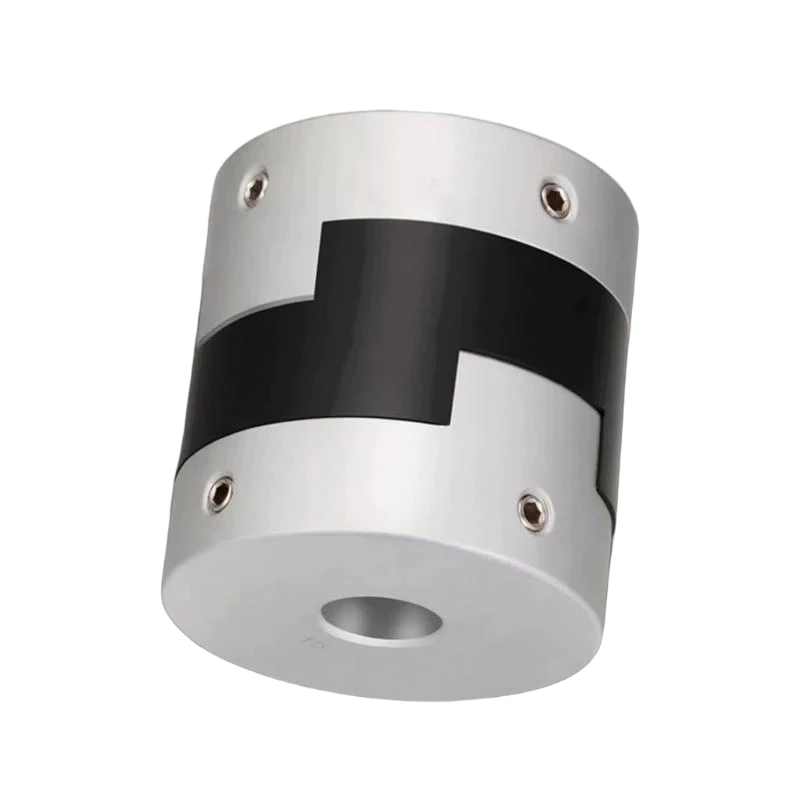
Common Installation Mistakes and How to Avoid Them
Hub too far from motor face: If the motor-side hub is positioned too far down the motor shaft — away from the motor face — the shaft’s unsupported length increases, raising the risk of shaft deflection under the coupling’s weight and drive forces. Mount the hub as close to the motor face as the shaft length and coupling design allow, typically with 1–2 mm clearance between the hub face and the motor bearing housing.
Axial compression of the disc: A common error is to push the two hubs fully together until the disc is sandwiched tightly. This transmits axial forces from thermal expansion or shaft end-float directly into the motor and driven shaft bearings. Always maintain the 0.5–1.0 mm axial clearance described above.
Ignoring angular misalignment: Many stepper drive installations rely on flexible shaft couplings to compensate for poor motor mounting alignment. While the Oldham coupling tolerates lateral offset well, it has almost no angular misalignment capacity. If the motor mounting plate is not perpendicular to the driven shaft axis, the Oldham coupling will bind periodically, generating impact loads that accelerate disc wear and can cause irregular step loss.
Using a coupling that is too large: Over-sizing the coupling to be conservative on torque rating results in a larger, heavier coupling with higher inertia — the opposite of what a stepper drive needs. Select the smallest coupling that meets the torque and bore requirements, not the largest one that fits the shaft.
Maintenance in Stepper Applications
In open-loop stepper systems, coupling wear presents a particular challenge: because the system has no position feedback, the gradual backlash increase from disc wear is not automatically detected by the controller. The system continues operating as if everything is normal, but the positioning accuracy silently degrades with each disc wear cycle.
Implement a periodic manual backlash check — at least every 2,000 operating hours — using the hand-rotation method described in the installation section. Set a replacement trigger at 0.3 degrees of measured backlash, or whenever positioning accuracy complaints begin. Keep one spare disc per coupling type on the shelf; disc replacement is a five-minute task that restores the system to new-coupling accuracy.
Conclusion
The Oldham coupling is an ideal match for stepper motor drive systems. Its zero-backlash performance eliminates the positioning errors that open-loop stepping cannot self-correct. Its lateral misalignment tolerance accommodates the real-world alignment imperfections that are inevitable in low-cost machine frames. Its low inertia preserves the stepper’s dynamic response, and its clamp-hub option prevents the micro-slip that can gradually shift step count accuracy. With correct specification, careful installation, and periodic disc inspection, an Oldham coupling will deliver reliable, zero-backlash performance throughout the life of the stepper drive system.
Browse our Oldham coupling range for stepper motor applications, or contact our team for sizing advice.