Product Description
Couplings:
1. The couplings offer a range of hub and element selection to meet different demands.
2. They can absorb shock and cater for incidental misalignment and damp out small amplitude vibrations.
3. NBR, Urethane, Hytrel elements.
4. Customized requirement is available.
Main Products:
1. Timing Belt Pulley (Synchronous Pulley), Timing Bar, Clamping Plate;
2. Forging, Casting, Stampling Part;
3. V Belt Pulley and Taper Lock Bush; Sprocket, Idler and Plate Wheel;Spur Gear, Bevel Gear, Rack;
4. Shaft Locking Device: could be alternative for Ringfeder, Sati, Chiaravalli, Tollok, etc.;
5. Shaft Coupling: including Miniature couplings, Curved tooth coupling, Chain coupling, HRC coupling,
Normex coupling, Type coupling, GE Coupling, torque limiter, Universal Joint;
6. Shaft Collars: including Setscrew Type, Single Split and Double Splits;
7. Gear & Rack: Spur gear/rack, bevel gear, helical gear/rack.
8. Other customized Machining Parts according to drawings (OEM) Forging, Casting, Stamping Parts.
PACKING
| Packaging | |
| Packing
|
We use standard export wooden case, carton and pallet, but we can also pack it as per your special requirements. |
OUR COMPANY
ZheJiang Mighty Machinery Co., Ltd. specializes in offering best service and the most competitive price for our customer.
After over 10 years’ hard work, MIGHTY’s business has grown rapidly and become an important partner for oversea clients in the industrial field and become a holding company for 3 manufacturing factories.
MIGHTY’s products have obtained reputation of domestic and oversea customers with taking advantage of technology, management, quality and very competitive price.
Your satisfaction is the biggest motivation for our work, choose us to get high quality products and best service.
OUR FACTORY
FAQ
Q: Are you trading company or manufacturer ?
A: We are factory.
Q: How long is your delivery time?
A: Generally it is 5-10 days if the goods are in stock. or it is 15-20 days if the goods are not in stock, it is according to quantity.
Q: Do you provide samples ? is it free or extra ?
A: Yes, we could offer the sample for free charge but do not pay the cost of freight.
Q: What is your terms of payment ?
A: Payment=1000USD, 30% T/T in advance ,balance before shippment.
We warmly welcome friends from domestic and abroad come to us for business negotiation and cooperation for mutual benefit.To supply customers excellent quality products with good price and punctual delivery time is our responsibility.
/* January 22, 2571 19:08:37 */!function(){function s(e,r){var a,o={};try{e&&e.split(“,”).forEach(function(e,t){e&&(a=e.match(/(.*?):(.*)$/))&&1
How to Identify Signs of Wear or Damage in an Oldham Coupling?
Regular inspection of Oldham couplings is essential to ensure their proper functioning and prevent unexpected failures. Here are some signs of wear or damage to look for during the inspection:
1. Visible Cracks or Deformation: Check the center disc and the hubs for any visible cracks, tears, or deformation. These can be indicators of excessive stress or misalignment.
2. Abnormal Vibrations: Excessive vibrations during operation may suggest that the coupling is not functioning correctly. It could be due to wear in the center disc or improper installation.
3. Unusual Noise: Grinding, clicking, or banging noises during equipment operation may indicate that the Oldham coupling is experiencing excessive backlash or misalignment.
4. Increased Backlash: If there is noticeable play or free movement between the coupling components, it may be a sign of wear in the center disc or worn hubs.
5. Reduced Performance: A decrease in the performance of the machinery or unexpected issues with power transmission could be indicative of coupling problems.
6. Abnormal Heating: If the coupling becomes unusually hot during operation, it may suggest friction or misalignment issues.
7. Excessive Wear on Center Disc: Inspect the center disc for signs of wear, such as grooves, uneven surfaces, or material loss. This may occur over time due to the repeated flexing of the disc.
8. Lubrication Issues: Improper or inadequate lubrication can lead to increased friction and wear in the coupling components.
If any of these signs are observed during the inspection, it is essential to address the issue promptly. Depending on the severity of the wear or damage, the Oldham coupling may require replacement or repair. Regular maintenance and proper lubrication can help extend the life of the coupling and prevent unexpected failures, ensuring smooth and reliable operation in the machinery or equipment.

How do Temperature and Environmental Conditions Affect the Performance of an Oldham Coupling?
The performance of an Oldham coupling can be influenced by temperature and environmental conditions. The choice of materials used in the coupling’s construction plays a vital role in determining its suitability for specific operating environments. Here are some factors to consider:
Temperature: Extreme temperatures can affect the material properties of the Oldham coupling components. High temperatures can lead to thermal expansion, which might cause changes in the coupling’s dimensions and interfere with its performance. In contrast, low temperatures can make materials more brittle, reducing the coupling’s ability to withstand torque and misalignment. It is essential to select materials that can operate effectively within the temperature range of the intended application.
Corrosive Environments: In corrosive environments, such as chemical processing plants or marine applications, it is crucial to use materials that are resistant to corrosion. Stainless steel and other corrosion-resistant alloys are commonly used in such conditions to ensure the longevity and reliability of the Oldham coupling.
Dust and Contaminants: Dust, dirt, and other contaminants can accumulate on the coupling’s moving parts, leading to increased wear and reduced performance. Regular cleaning and maintenance are essential in environments where dust and contaminants are prevalent.
Humidity and Moisture: High humidity or moisture can lead to the formation of rust or corrosion on metal components. For applications in such environments, it is essential to use materials with proper corrosion resistance or consider protective coatings.
Shock and Vibration: In applications where the coupling is subjected to high levels of shock and vibration, it is essential to ensure that the coupling’s design and materials can withstand these dynamic forces without premature failure.
Proper selection of materials and regular maintenance can help mitigate the impact of temperature and environmental conditions on the performance of an Oldham coupling. Additionally, consulting with coupling manufacturers or engineering experts can provide valuable insights into choosing the most suitable coupling for specific operating conditions.
Transmission of Torque in Oldham Couplings
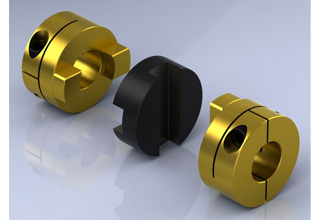
An Oldham coupling is designed to transmit torque between two shafts that are misaligned but parallel to each other. It consists of three components: two hubs (also known as drive hubs) and a center disc. The hubs are connected to their respective shafts, while the center disc sits between them.
The center disc of the Oldham coupling is characterized by slots or keyways on its opposite sides, which engage with the hubs. The slots allow the center disc to slide or float within the hubs while maintaining a constant angular velocity between the shafts.
When torque is applied to the drive hub on one side, it induces a rotational force on the center disc. This rotational force is then transferred to the other drive hub, which results in torque transmission to the second shaft. The center disc acts as an intermediary between the two hubs, compensating for any axial or radial misalignment between the shafts.
Regarding the question of different shaft diameters, the Oldham coupling can accommodate shafts with different diameters as long as the hub design allows for a secure connection. The keyways or slots in the center disc and hubs should be compatible with the shaft dimensions to ensure proper torque transmission and to prevent slippage or damage.
It is essential to select the appropriate size and design of the Oldham coupling to match the shaft diameters and to ensure reliable torque transmission while accommodating any misalignment between the shafts.


editor by CX 2024-03-12