Product Description
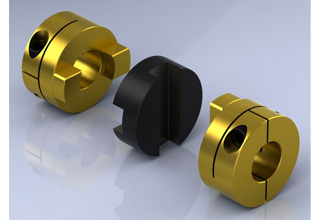
GHC Oldham type coupling cross sliding clamp coupling
Description of GHC Oldham type coupling cross sliding clamp coupling
>The colloid material is imported PA66, which has good wear resistance, corrosion resistance and electrical insulation
>Sliding design can compensate radial and angular deviation more effectively
>Detachable design, easy to install
>Fastening method of clamping screw
Dimensions of GHC Oldham type coupling cross sliding clamp coupling
| model parameter | common bore diameter d1,d2 | ΦD | L | LF | LP | F | M | tightening screw torque (N.M) |
| GHC-16X21 | 4,5,6,6.35 | 16 | 21 | 8.6 | 11.6 | 2.5 | M2.5 | 1 |
| GHC-16X30 | 4,5,6,6.35 | 16 | 30 | 13.1 | 11.6 | 3 | M2.5 | 1 |
| GHC-20X22 | 5,6,6.35,7,8 | 20 | 22 | 8.6 | 12.7 | 2.5 | M2.5 | 1 |
| GHC-20×33 | 5,6,6.35,7,8 | 20 | 33 | 14.1 | 12.7 | 3 | M2.5 | 1 |
| GHC-25×28 | 5,6,6.35,8,9,9.525,10,11,12 | 25 | 28 | 11.7 | 16.65 | 3 | M3 | 1.5 |
| GHC-25X39 | 5,6,6.35,8,9,9.525,10,11,12 | 25 | 39 | 17.2 | 16.65 | 4.2 | M3 | 1.5 |
| GHC-32X33 | 5,6,8,9,9.525,10,11,12.12.7,14,15,16 | 32 | 33 | 14 | 19.5 | 3 | M4 | 2.5 |
| GHC-32X45 | 5,6,8,9,9.525,10,11,12,12.7,14,15,16 | 32 | 45 | 20 | 19.5 | 4.5 | M4 | 2.5 |
| GHC-40X50 | 8,9,9.525,10,11,12,14,15,16,17,18,19 | 40 | 50 | 23 | 18.4 | 7 | M5 | 7 |
| GHC-45X46 | 8,9,9.525,10,11,12,14,15,16,17,18,19,20,22 | 45 | 46 | 21 | 18.4 | 7 | M5 | 7 |
| GHC-50X53 | 10,11,12.7,14,15,16,17,18,19,20,22,24 | 50 | 53 | 24 | 15 | 7.5 | M6 | 12 |
| GHC-50X58 | 10,11,12.7,14,15,16,17,18,19,20,22,24 | 50 | 58 | 26.5 | 17.5 | 8 | M6 | 12 |
| GHC-55X57 | 10,11,12.7,14,15,16,17,18,19,20,22,24,25,28,30,32 | 55 | 57 | 26 | 17.5 | 7.8 | M6 | 12 |
| GHC-63X71 | 14,15,16,17,18,19,20,22,24,25,28,30,32 | 63 | 71 | 33 | 24 | 10 | M8 | 20 |
| GHC-70X77 | 14,15,16,17,18,19,20,22,24,25,28,30,32,35,38 | 70 | 77 | 29.5 | 25 | 12 | M8 | 20 |
| model parameter | Rated torque (N.M)* |
allowable eccentricity (mm)* |
allowable deflection angle (°)* |
allowable axial deviation (mm)* |
maximum speed rpm |
static torsional stiffness (N.M/rad) |
moment of inertia (Kg.M2) |
Material of shaft sleeve | Material of shrapnel | surface treatment | weight (g) |
| GHC-16X21 | 0.7 | 0.8 | 3 | ±0.2 | 8500 | 30 | 5.5×10⁻⁷ | High strength aluminum alloy | P A 6 6 | Anodizing treatment | 8 |
| GHC-16X30 | 0.7 | 0.8 | 3 | ±0.2 | 9000 | 30 | 5.9×10⁻⁷ | 12 | |||
| GHC-20X22 | 1.2 | 1.2 | 3 | ±0.2 | 6500 | 58 | 1.3×10⁻⁶ | 13 | |||
| GHC-20×33 | 1.2 | 1.2 | 3 | ±0.2 | 7000 | 58 | 1.5×10⁻⁶ | 19 | |||
| GHC-25X28 | 2 | 1.6 | 3 | ±0.2 | 5500 | 130 | 4.0×10⁻⁶ | 24 | |||
| GHC-25X39 | 22 | 1.6 | 3 | ±0.2 | 6000 | 130 | 4.5×10⁻⁶ | 35 | |||
| GHC-32X33 | 4.5 | 2 | 3 | ±0.2 | 4500 | 270 | 1.3×10⁻⁵ | 48 | |||
| GHC-32X45 | 4.5 | 2 | 3 | ±0.2 | 4800 | 270 | 1.5×10⁻⁵ | 67 | |||
| GHC-40X50 | 9 | 2.4 | 3 | ±0.2 | 3600 | 520 | 4.2×10⁻⁵ | 114 | |||
| GHC-45X46 | 12 | 2.5 | 3 | ±0.2 | 3500 | 800 | 4.5×10⁻⁵ | 140 | |||
| GHC-50X53 | 19 | 2.6 | 3 | ±0.2 | 3000 | 800 | 1.0×10⁻⁴ | 190 | |||
| GHC-50X58 | 19 | 3 | 3 | ±0.2 | 3000 | 800 | 1.1×10⁻⁴ | 215 | |||
| GHC-55X57 | 25 | 3.2 | 3 | ±0.2 | 3000 | 900 | 1.3×10⁻⁵ | 260 | |||
| GHC-63X71 | 33 | 3 | 3 | ±0.2 | 2550 | 1200 | 3.5×10⁻⁴ | 455 | |||
| GHC-70X77 | 56 | 3.5 | 3 | ±0.2 | 2500 | 1260 | 4.1×10⁻⁵ | 520 |

What are the Potential Limitations or Drawbacks of Using an Oldham Coupling?
While Oldham couplings offer numerous advantages, they also have some limitations and drawbacks that should be considered when selecting a coupling for a specific application:
1. Limited Misalignment Capacity: Oldham couplings can only accommodate small amounts of angular and axial misalignment between the shafts. They are not suitable for applications with high levels of misalignment as excessive misalignment can lead to premature wear and failure of the center disc.
2. Speed Limitations: Oldham couplings are generally not recommended for high-speed applications. The flexible center disc has a maximum speed limit, and exceeding this limit can cause the disc to fatigue and fail over time.
3. Temperature Sensitivity: The performance of Oldham couplings can be affected by temperature fluctuations. Extreme temperatures can impact the flexibility and integrity of the center disc material, leading to reduced coupling performance.
4. Backlash in High-Precision Systems: While Oldham couplings minimize backlash compared to some other couplings, they may still have some inherent clearance between the hubs and the center disc, leading to a slight amount of backlash. In ultra-high-precision systems, this slight backlash may be a concern.
5. Material Compatibility: The material used for the center disc must be chosen carefully to ensure compatibility with the specific application’s environment and the media being conveyed. Some aggressive chemicals or harsh environments may degrade the material over time.
6. Maintenance: Oldham couplings require periodic inspection and maintenance to ensure proper functioning. The center disc may wear out over time and need replacement, especially in applications with high torque or frequent start-stop cycles.
Despite these limitations, Oldham couplings remain a popular choice in many applications due to their vibration reduction, backlash minimization, and moderate misalignment compensation capabilities. However, it is essential to carefully assess the specific requirements of the application and consider the potential drawbacks before selecting an Oldham coupling.
Real-World Examples of Oldham Coupling Usage in Mechanical Engineering
Oldham couplings are widely used in various mechanical engineering applications due to their ability to transmit torque while compensating for angular misalignment. Here are some real-world examples of Oldham coupling usage:
- Packaging Machinery: Oldham couplings are commonly employed in packaging machines that require precise and continuous motion. These couplings help connect the motor shaft to various components in the packaging process, such as conveyor belts, rollers, and cutting blades.
- Automated Assembly Lines: In automated assembly lines, Oldham couplings are utilized to transfer torque from the motor to the robotic arms or handling mechanisms. The couplings enable smooth and accurate movement, ensuring precise positioning of components during assembly.
- Printing Equipment: Printing machines utilize Oldham couplings to transmit power from the motors to the printing cylinders and rollers. The couplings accommodate any misalignment between the shafts and minimize vibration, resulting in improved print quality.
- Material Handling Systems: Material handling systems, such as conveyor systems, use Oldham couplings to connect drive motors to the conveyor belts. These couplings facilitate the efficient transfer of goods while compensating for any misalignment that may occur during operation.
- Industrial Pumps: Oldham couplings are employed in industrial pumps to transfer power from the motor to the pump impeller. They aid in absorbing vibration and maintaining alignment, which is crucial for the pump’s optimal performance and longevity.
- Medical Devices: Some medical devices, such as scanning equipment and diagnostic machines, incorporate Oldham couplings to ensure precise and reliable motion, contributing to accurate medical imaging and diagnosis.
These examples demonstrate the versatility of Oldham couplings in various mechanical engineering applications. Their ability to handle misalignment, reduce vibration, and transmit torque makes them a valuable component in many industrial sectors.

How an Oldham Coupling Accommodates Misalignment Between Shafts
An Oldham coupling accommodates misalignment between shafts through its unique design, which consists of three main components:
- Two Hubs: Each hub is attached to the shaft of the connected equipment. The hubs have a series of slots around their circumference.
- Middle Block: The middle block fits between the two hubs and has perpendicular slots on its inner diameter. It connects the two hubs while allowing relative movement between them.
When the shafts experience angular or axial misalignment, the middle block slides within the slots of both hubs. The perpendicular slots on the middle block engage with the slots on the hubs, creating a parallelogram linkage.
This parallelogram linkage allows the Oldham coupling to compensate for angular misalignment by enabling the hubs to rotate independently about their own axes. The sliding action of the middle block accommodates axial misalignment by allowing the hubs to move slightly closer or farther apart.
The use of sliding contact instead of direct physical contact between the hubs minimizes friction, backlash, and wear, making the Oldham coupling an efficient and reliable method for transmitting torque while accommodating misalignment.
Overall, the Oldham coupling’s ability to handle both angular and axial misalignment ensures smooth and precise torque transmission between shafts, reducing stress on connected equipment and extending the lifespan of mechanical components.


editor by CX 2023-09-28