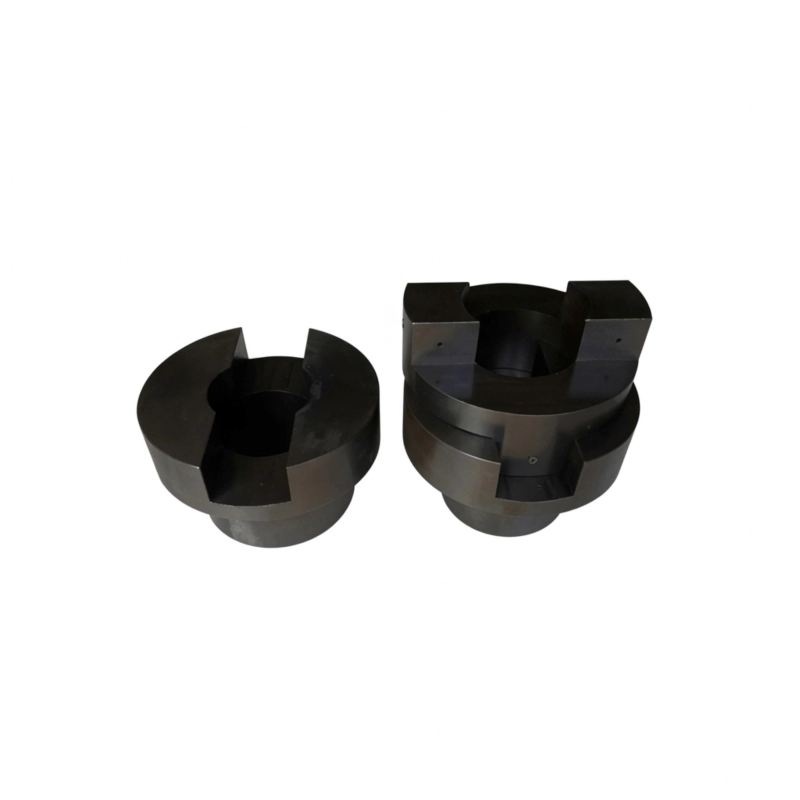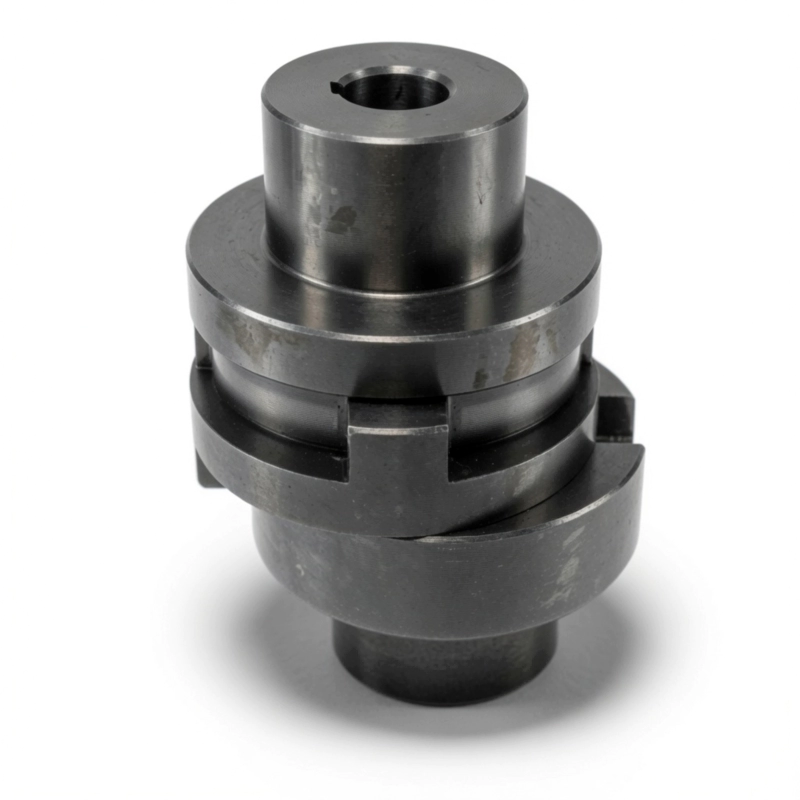
Description
SL70 Heavy-Duty Cross-Slider Oldham Coupling — 70 mm Cast-Iron Hub Joint for Coaxial Industrial Drives
The SL70 industrial Oldham coupling opens the SL family of cast-iron cross-slider couplings, a product line built around a completely different engineering brief from the precision Oldham couplings of the EP6 range. Where the EP6 family targets servo accuracy and zero-backlash micro-motion, the SL series targets the cement-mill, pump-house, conveyor-head reality of heavy industrial drive trains — where torque is measured in hundreds or thousands of newton-metres, where shafts are hand-keyed and pressed onto motor flanges with crane assistance, and where a coupling failure means a production-day loss running into five-figure currency. The SL70 is the entry point: 70 mm hub OD, two HT250 grey cast-iron hubs, a hardened-steel centre disc, key-and-keyway shaft mounting, and a 120 N·m continuous torque rating at 250 r/min that suits the typical small irrigation pump, agricultural take-off shaft, or light marine auxiliary line.
The architectural principle remains pure Oldham — two orthogonal sliding interfaces, a centre disc that translates rather than flexes, constant-velocity 1:1 torque transmission with no torsional spring — but the embodiment is industrial rather than precision. Cast-iron hubs deliver the section modulus needed for industrial torque without flexure. A hardened-steel slider survives the sliding-friction work of misalignment compensation under high contact pressures. Grease lubrication of the slider interfaces is specified and re-applied at scheduled intervals; this is the long-standing industrial-coupling maintenance pattern, well understood in plant maintenance practice for a century.
Specifications
| Parameter | Value |
|---|---|
| Model | SL70 |
| Nominal Torque (Tn) | 120 N·m |
| Permissible Speed (n) | 250 r/min |
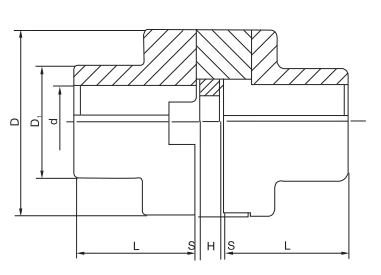
| Bore Range (d) | 15 – 18 mm |
| Outside Diameter (D) | 70 mm |
| Hub Bore Diameter (D₁) | 32 mm |
| Overall Length (L) | 42 mm |
| Slider Plate Thickness (H) | 14 mm |
| Slider Clearance (S) | 0.5 mm |
| Moment of Inertia | 0.002 kg·m² |
| Mass | 1.5 kg |
| Radial Misalignment (Δy) | 0.6 mm |
| Angular Misalignment (Δα) | 0.5° |
| Axial Misalignment (Δx) | 1.2 mm |
| Shaft Engagement | Keyway + setscrew |
| Lubrication | Grease (re-pack annually) |
Materials
HT250 Grey Cast-Iron Hubs
Both hubs are sand-cast from grey iron grade HT250 per Chinese national standard GB 9439, equivalent to EN-GJL-250 or ASTM A48 Class 35. This is the de-facto industrial material for medium-duty coupling hubs: damped flexural response that absorbs torsional shock, excellent machinability for bore and keyway finishing, and decades of plant-maintenance familiarity. For aggressive environments, ductile-iron QT500-7 (equivalent to ASTM A536 65-45-12) is offered as a documented upgrade.
Hardened Steel Centre Slider
The cross-slider plate is machined from 45-steel (medium-carbon, equivalent to AISI 1045) and quenched to HRC 40–45 surface hardness on the four sliding faces. This combination delivers the wear life needed against the cast-iron hub slots under grease-lubricated sliding contact. For high-cycle reversal duty, a 40Cr alloyed-steel slider grade is offered, raising surface hardness to HRC 50 with proportionally extended service life.
Keyway & Set-Screw Mounting
Shaft engagement is via parallel keyway to GB/T 1096 (≈DIN 6885 / JIS B 1301) plus a single M8 set-screw for axial location. The hub bore is reamed to H7 tolerance for a precision sliding fit on the shaft. For very high-torque applications where keyway shear may be a concern, taper-bushed mounting via locking assemblies is offered as an alternative.
Working Principle for Heavy Industrial Drives
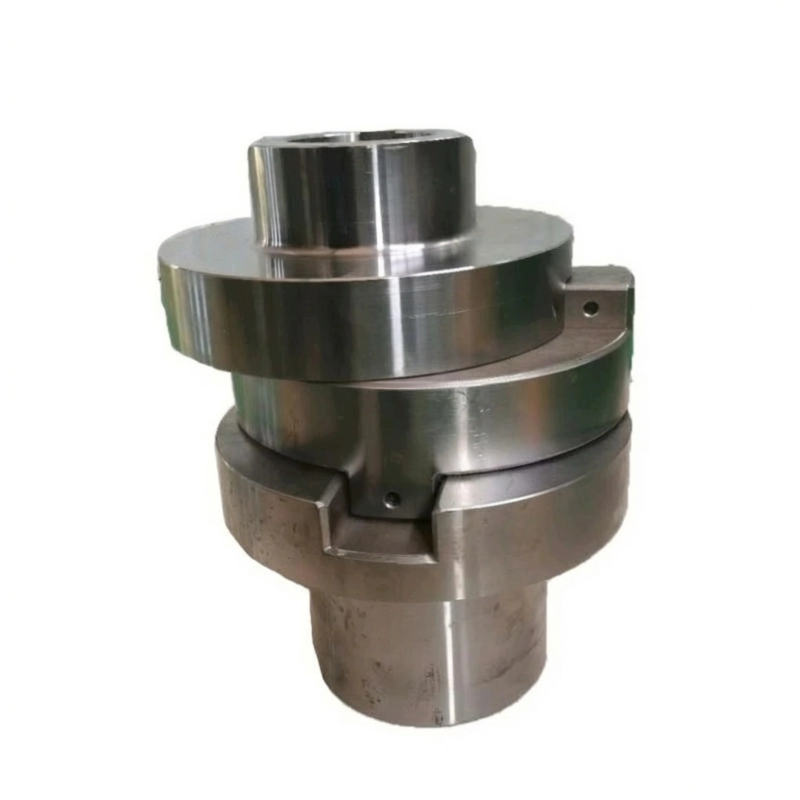
The SL70 is the small end of the heavy-industrial Oldham family, but the working principle is identical to its larger SL siblings: two cast-iron hubs engage a hardened-steel cross-slider through two orthogonal tongue-and-slot interfaces. When the two shafts are perfectly coaxial, the slider rotates with the assembly as a rigid body. When the shafts are radially offset — by up to 0.6 mm on the SL70 — the slider’s centre traces a small circular orbit at shaft speed, with sliding contact on the four engagement faces absorbing the misalignment as friction work.
The defining engineering virtue of this architecture in industrial duty is that the misalignment compensation does not require flexure of any metallic component. There is no metal-fatigue mechanism in the load path, no elastomer to fatigue-crack or chemically degrade, no precision-ground bellows to corrupt under shock load. The wear surfaces — the four sliding faces of the slider against the hub slots — are accessible, inspectable, and consumable. When wear progresses to the point of detectable lash, the slider can be replaced individually without disturbing either of the cast-iron hubs from their shafts. The same hubs that go into service today are typically still in service 15–20 years later.
For applications where the driven load is mostly a steady-state torque — irrigation pumps, agricultural blower drives, conveyor head pulleys — the SL70’s combination of moderate misalignment tolerance, generous overload capacity, and field-replaceable wear part has made it the default specification across decades. Browse the full Oldham coupling family for adjacent sizing.
Industry Applications
Small Irrigation Pumps
Coupling between electric motor and centrifugal-pump impeller shaft in farm and orchard irrigation skids. The 0.6 mm offset tolerance forgives the cumulative misalignment of skid-mounted equipment.
Agricultural Take-Off Drives
PTO-driven small implements where a flexible coupling decouples the implement’s frame distortion from the tractor PTO bearing.
⛵ Light Marine Auxiliaries
Anchor-winch and capstan drives on inland and harbour craft. Cast-iron resists chloride pitting better than aluminum in marine ambient.
Food & Honey Processing
Small-batch mixer and pump drives on artisanal food, honey, and condiment processing lines. Greased metallic interfaces meet plant-maintenance familiarity.
Rural Water Supply
Borehole pump motor drives in village water-supply networks. Long maintenance interval and field-replaceable wear part suit remote-asset duty.
Dairy & Feed Mill
Feed-mixer and pellet-press auxiliary drives on small-to-medium dairy and animal-feed operations.
Why Choose Ever-power
Quality & Compliance
SL70 production runs under ISO 9001:2015 certified controls. Cast-iron raw material is sourced under documented melt-traceability with chemical-composition certification per heat. Standard documentation pack includes RoHS, REACH, and on-request CE conformity declarations for European market integration.
Customisation
Beyond the catalogue 15–18 mm bore range, custom bores from 12 mm up to 22 mm are produced regularly. Imperial-bored variants (5/8″, 11/16″, 3/4″) are released for North American export markets. Ductile-iron QT500-7 hub upgrade for marine and chloride-rich environments is documented and available within standard lead times.
Aftermarket
Slider plates for the SL70 are stocked separately under part number SL70-SLIDER and ship in 2 business days. Engineering desk responds in English within 24 hours on selection, retrofit, and de-rating queries. For fleet operators, Ever-power maintains buffer stock at customer-specified levels.
Customer Reviews & Case Studies
★★★★★
Bulgaria — Orchard Irrigation Integrator
Used in: Centrifugal-pump skid drives across 40 orchard-scale irrigation deployments in the Plovdiv region.
Feedback: “Skid-mounted pump packages accumulate misalignment from transport and on-site installation. The SL70’s 0.6 mm tolerance has handled this without an alignment-shimming step on any of the 40 sites. Annual grease repacking is the only scheduled maintenance — exactly the simplicity our farm-operator customers want.”
★★★★★
Ukraine — Sunflower-Oil Processing Plant
Used in: Auger-feed drive coupling on cold-press oil-extraction line.
Feedback: “Field-replaceable slider plate has now been replaced once in 11 years of continuous duty — at zero impact to production schedule. Cast-iron hubs are visually identical to when first installed. Total cost of ownership over the lifecycle is materially below any flexible-disc alternative we considered.”
★★★★☆
Kenya — Coffee-Processing Cooperative
Used in: Pulper-drum drive coupling on wet-process coffee mills serving smallholder cooperatives.
Feedback: “Equipment operates seasonally — 4–5 months of continuous duty per year, then 7 months idle. The SL70 has performed well across the duty cycle. Knock one star only because the QT500 hub variant for our coastal sites took 6 weeks lead time — engineering had quoted 4 — but the operational performance once installed has been excellent.”
Frequently Asked Questions
What grease specification do you recommend for SL70 lubrication?
Lithium-complex grease to NLGI grade 2 (e.g., SKF LGEP 2, Mobilgrease XHP 222) is the catalogue specification. For ambient temperatures consistently above +60 °C, a calcium-sulfonate grease is preferred. Re-pack every 12 months under normal industrial duty; re-pack every 6 months for marine or high-humidity service.
How is the SL70 installed onto a motor shaft?
The hub bore is finished to H7 tolerance. The shaft must have a matching parallel keyway to GB/T 1096 (or equivalent DIN/JIS). Slide the hub onto the shaft until the inner face seats against the shaft shoulder, fit the parallel key, and torque the M8 set-screw to 25 N·m. Repeat on the second shaft, then assemble the slider between the two hubs.
Can the SL70 be used in continuous-reversal applications?
Yes — the cross-slider architecture is symmetric and tolerates frequent reversal. For high-cycle reversal duty (more than 100 reversals per hour), specify the 40Cr alloyed-steel slider variant for extended service life; the standard 45-steel slider may show accelerated wear under continuous reversal beyond that cycle rate.
What is the expected service life of the slider plate?
Under typical industrial duty — 60 % rated load, 250 r/min continuous, parallel offset below 0.3 mm, annual grease maintenance — slider service life exceeds 50 000 operating hours, or roughly 7 years of 16-hour-day service. Slider replacement is a 30-minute operation in the field, with hubs remaining keyed to their shafts.
How does the SL70 compare to a flexible-disc industrial coupling?
Flexible-disc couplings at this rating offer marginally lower mass but require precision laser-alignment for service-life predictability and offer roughly half the parallel-misalignment tolerance. The SL70 trades a small mass premium for substantially simpler installation, longer maintenance intervals, and field-serviceable wear parts — economics that strongly favour the SL70 over a 10-year ownership horizon.
Quote the SL70 for Industrial Drive Lines
For irrigation, agricultural, light marine, and rural-equipment OEMs, the SL70 has been a default specification for decades. Explore Ever-power’s full SL industrial coupling catalogue, read about our foundry and machining capability, or proceed to enquiry below.