Description
EP6-16 Miniature Set Screw Oldham Coupling — Compact Three-Piece Flexible Connector for Precision Motion
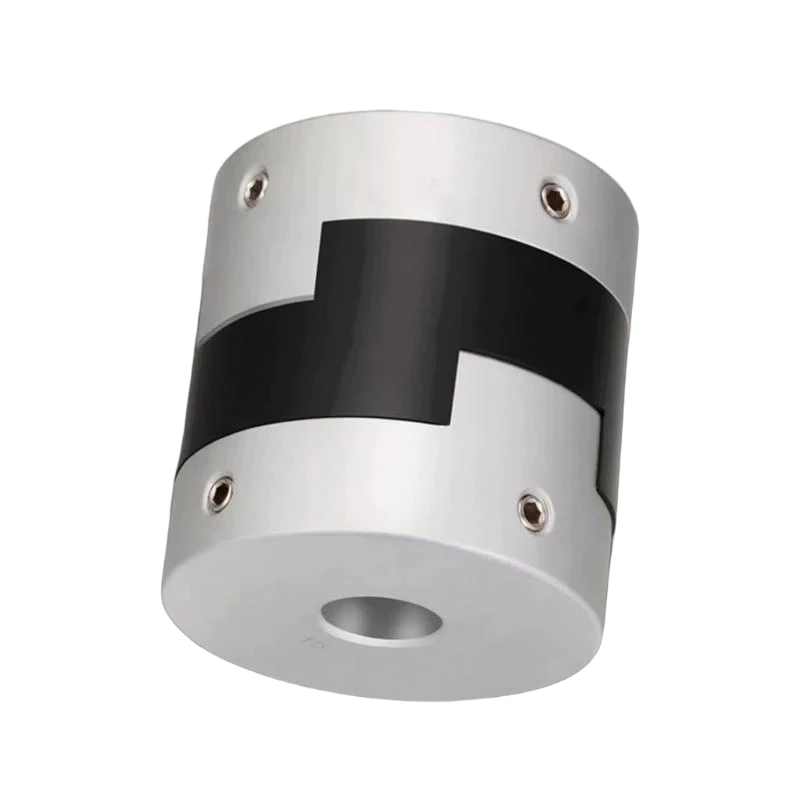
The EP6-16 miniature Oldham coupling is the smallest member of the EP6 set-screw family — a 16 mm outside-diameter, three-piece flexible shaft coupling built for sub-newton-meter precision drives where parallel misalignment must be absorbed without introducing rotational backlash. Two anodised aluminum-alloy hubs sandwich a self-lubricating polyacetal (Delrin/POM) slider; the slider’s two orthogonal tongues engage matching slots in each hub, allowing the hubs to glide laterally while preserving an exact 1:1 angular relationship. The result is a constant-velocity transmission that tolerates up to 1.0 mm of radial offset, all in a package light enough (about 6 g) that the host motor barely notices it.
Engineers selecting the EP6-16 typically need to mate a small DC, brushless, or stepper motor — NEMA 8 / NEMA 11 frame, or a 13 mm encoder shaft — to a downstream load such as a leadscrew, optical chopper, or rotary indexer. In those situations a rigid coupling would translate every micron of mounting eccentricity into bearing side-load, shortening service life and degrading positioning repeatability. A bellows or beam coupling, on the other hand, would react against misalignment with a spring force that pulses through the loop and excites resonance. The Oldham architecture sidesteps both failure modes: the centre disc slides instead of flexing, so there is no restoring force and no reflected torsional spring.
Specifications
| Parameter | Value |
|---|---|
| Model | EP6-16 |
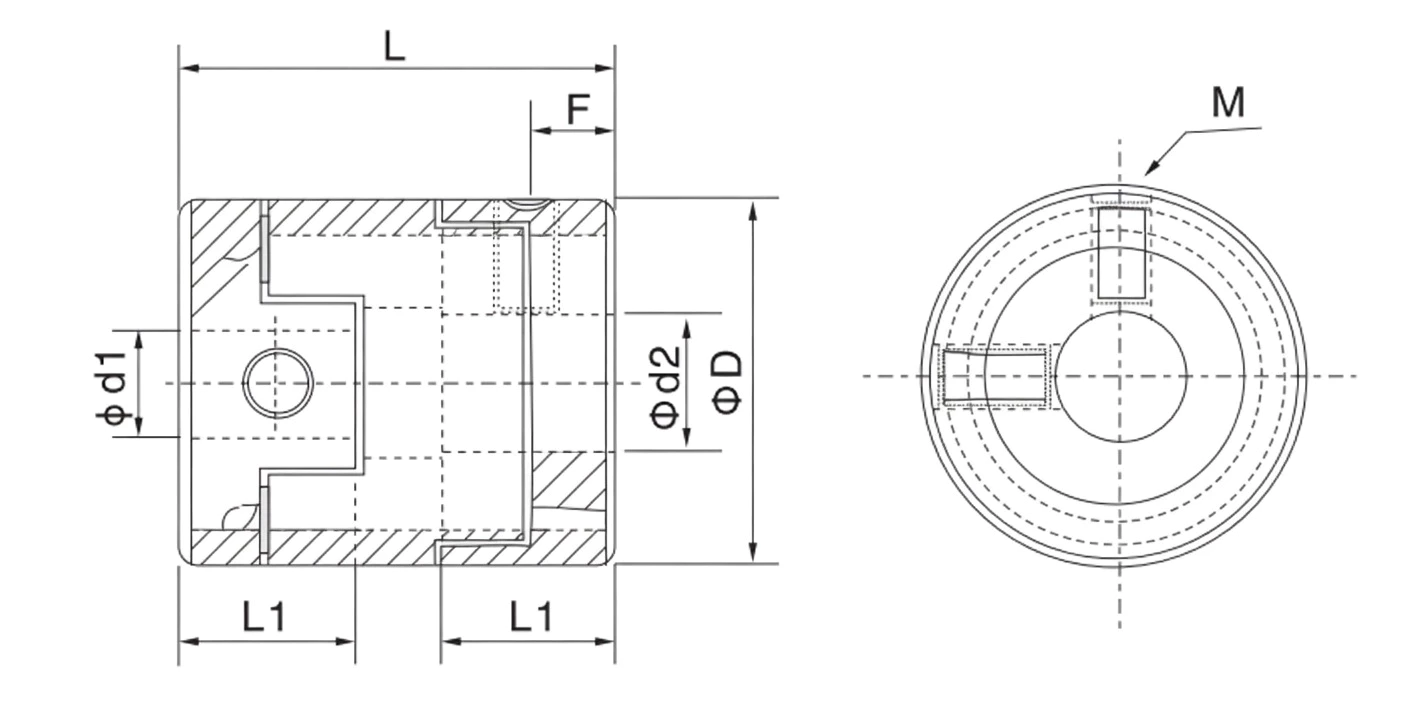
| Outside Diameter (ΦD) | 16 mm |
| Overall Length (L) | 18 mm |
| Bore Range (d1 / d2) | 4, 5, 6 mm |
| Rated Torque | 0.7 N·m |
| Maximum Torque | 1.4 N·m |
| Maximum Rotational Speed | 9 000 rpm |
| Moment of Inertia | 3.0 × 10⁻⁷ kg·m² |
| Static Torsional Stiffness | 29 N·m/rad |
| Parallel Misalignment | 1.0 mm |
| Angular Misalignment | 3.0° |
| Set-screw Thread | M3 |
| Wrench Tightening Torque | 0.7 N·m |
| Mass (max bore) | 6 g |
| Backlash | Zero |
Materials
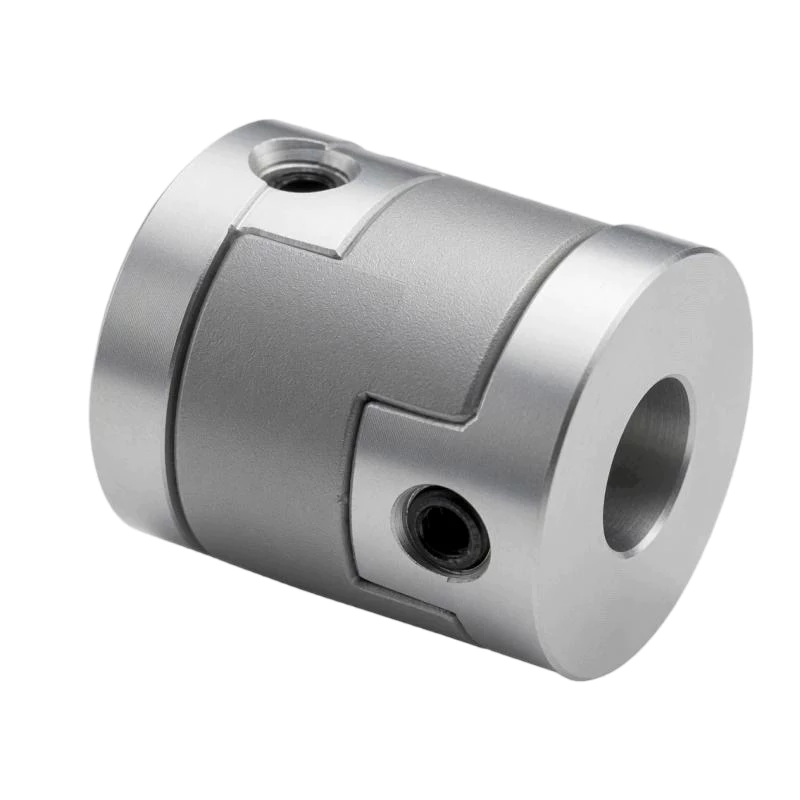
Aluminum-Alloy Hub (A2017)
The two outer hubs are CNC-machined from anodised aluminum 2017, an aerospace-grade alloy that combines high specific strength with low rotational inertia. For a 0.7 N·m duty rating this is the optimal hub material: it keeps the reflected inertia at the motor shaft low (3.0 × 10⁻⁷ kg·m²), accelerates with the servo, and remains dimensionally stable across the −20 °C to +80 °C range typical of indoor automation.
Polyacetal (POM) Centre Disc
The sliding disc is moulded from engineering polyacetal — known commercially as Delrin or POM. POM offers a self-lubricating sliding interface, electrical insulation between the two shafts, oil resistance, and a fatigue endurance that easily covers tens of millions of cycles at the EP6-16’s rated load. Two hardness grades are available on request when the application requires extra damping or, conversely, higher torsional rigidity.
Stainless Hardware
Set screws are SUS304 stainless steel, hex-socket M3. The stainless grade is specified to prevent galvanic interaction with the aluminum hub and to survive light condensation in semi-conditioned enclosures — a small detail that pays dividends in field reliability.
Working Principle of the Three-Piece Oldham Structure
An Oldham coupling is, in essence, a planar four-bar linkage compressed into three concentric discs. Hub A locks to the driving shaft via two opposed M3 set screws at 90°. Hub B locks to the driven shaft in the same manner. Between them sits the polyacetal slider, whose front face carries a tongue that engages a slot in Hub A, and whose back face carries a second tongue, rotated 90° from the first, that engages a slot in Hub B.
When the two shafts are perfectly concentric, the slider does nothing — it spins with the assembly as a rigid body. When the shafts are offset by, say, 0.4 mm radially, the slider’s centre traces a small circle once per shaft revolution: it slides one way against Hub A in the first half-turn, then the other way against Hub B in the second half-turn. Because the slot orientations are exactly orthogonal, the angular velocity transmitted from Hub A to Hub B is identical to the input — there is no second-harmonic ripple of the kind a universal joint introduces, no torsional wind-up of the kind a bellows produces.
For an EP6-16 in a typical encoder feedback loop, this matters in three concrete ways. First, position accuracy is preserved: a 0.5 mm parallel offset does not corrupt the angular reading at the load. Second, motor side-loads are eliminated: the slider absorbs the lateral force component, so the upstream bearing is not preloaded by the misalignment. Third, the absence of an elastic restoring element means the closed-loop controller does not have to fight a parasitic torsional spring — a major advantage in high-bandwidth servo tuning.
Industry Applications
Laboratory & Analytical Instruments
Driving optical choppers, filter wheels, and sample carousels in spectrometers and microplate readers. The EP6-16’s zero backlash protects the angular registration that determines wavelength accuracy.
Medical & Diagnostic Equipment
Pipette positioning heads, blood-analyser rotors and centrifuge indexers benefit from the coupling’s electrical insulation between drive and load — relevant when patient-contact circuits must be galvanically isolated from chassis ground.
Encoder & Resolver Feedback Lines
Linking incremental encoders (typically 13 mm or 16 mm housings) to motor shafts in stepper-based positioning stages. The 3.0 × 10⁻⁷ kg·m² inertia is negligible against typical encoder rotors.
️ Desktop 3D Printers & Engravers
Connecting NEMA 11 / NEMA 14 steppers to lead-screws on Z-axes. The Oldham architecture forgives the parallel misalignment that comes from low-cost extruded-frame assemblies.
Optical & Imaging Systems
Focus-drive motors in microscopy, motorised iris assemblies and small-format cinema lenses. The slider acts as an electrical insulator, preventing ground loops between camera body and motor driver.
⚙️ Miniature Linear Stages
Coupling stepper motors to 6 mm and 8 mm ball-screws in research-grade XY tables. Position repeatability of ±2 µm is achievable when the EP6-16 replaces a rigid hub-and-collar joint.
Why Choose Ever-power for Your EP6-16 Couplings
Quality Certifications
Every EP6-16 leaving our line is inspected against drawings traceable to an ISO 9001:2015–certified quality system. The aluminum and POM raw materials carry RoHS and REACH declarations of conformity, and finished couplings can be supplied with CE declarations for inclusion in machinery destined for the European Economic Area.
Customisation
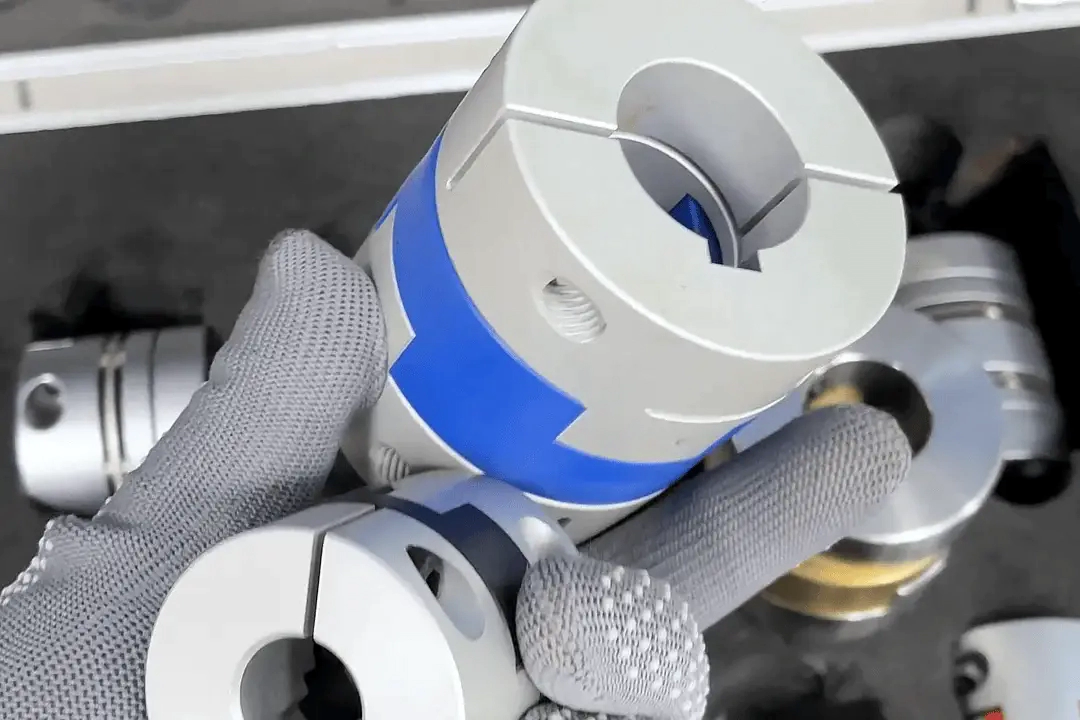
Standard bore set is 4 / 5 / 6 mm, but the EP6-16 is regularly produced with custom bore tolerances (H7, F7), keyway slots, flats, set-screw points (cup, flat, or oval), and alternative anodising colours for visual line identification. POM hardness can be swapped to a glass-filled grade when the load is closer to the upper end of the torque envelope.
Engineering & After-sales Support
Our English-speaking technical team responds to selection and CAD-model requests within 24 hours. STEP files, 2D PDFs, and torque-de-rating curves at elevated temperature are available on request. For volume programmes we maintain a buffer inventory of standard bores to keep MRP-line replenishment under two weeks.
Customer Reviews & Case Studies
★★★★★
Germany — Bio-analyser Manufacturer
Used in: Filter-wheel drive of a benchtop fluorescence reader, 6 000 rpm continuous.
Feedback: “We replaced an in-house bellows coupling with the EP6-16 to remove the 1.7 kHz resonance peak we were chasing in our control loop. The Oldham architecture flat-lined our spectrogram in that band. Mechanical assembly time also dropped because the M3 set-screws are accessible without dismounting the encoder.”
★★★★★
South Korea — Semiconductor Test Equipment
Used in: Probe-station Z-axis of a wafer-level test cell, 0.4 N·m peak duty.
Feedback: “The 1 mm of allowable parallel misalignment matched the worst case from our motor-mount stack-up perfectly. Two years and tens of millions of dwell cycles later, no measurable change in position repeatability.”
★★★★☆
United States — Desktop 3D Printer OEM
Used in: Z-axis lead-screw to NEMA 11 stepper, dual-coupling tower configuration.
Feedback: “Cost per axis is unchanged versus the rigid coupling we previously specified, but warranty returns for binding lead-screws dropped by half in the first quarter after the switch. Would recommend, with a note that operators should keep set-screw torque conservative — these are small fasteners.”
Frequently Asked Questions
Can the EP6-16 be reversed in direction without performance penalty?
Yes. The three-piece architecture is rotationally symmetric — clockwise and counter-clockwise transmission characteristics are identical. There is no preferred direction, which is why the EP6-16 is commonly specified for bidirectional indexing applications.
What is the typical service life at rated torque and speed?
For a continuously operating EP6-16 at 0.5 N·m and 6 000 rpm with parallel offset under 0.3 mm, expected disc life exceeds 50 million revolutions before slider wear becomes detectable. Replacement of the centre disc only — without removing the hubs from their shafts — restores as-new performance.
How do I tighten the M3 set screws correctly?
Use a 1.5 mm hex key and apply 0.7 N·m. Both set screws on a hub are separated by 90°; tighten each in two passes. Light Loctite 222 is recommended where shock or vibration is expected; do not apply Loctite to the slider face.
Is the EP6-16 suitable for vacuum environments?
POM has a modest outgassing rate that disqualifies it from UHV (<10⁻⁶ Pa) service. For high vacuum below 10⁻³ Pa we recommend specifying an alternative slider material — PEEK or PTFE-filled grades are typically suitable. Please contact engineering for vacuum-rated variants.
What lead time can I expect for 100 pieces?
Standard bore combinations (4-4, 5-5, 6-6, 5-6, 4-6) ship in 5–7 business days from order confirmation. Custom bore-to-bore combinations add roughly 7 working days. Air freight to most regions arrives within 3–5 days thereafter.
Need a Bulk Quote or a Custom Bore?
Whether you are specifying the EP6-16 for a 50-piece prototype build or a 50 000-piece annual MRP plan, our engineering desk is ready to help you finalise bore, keyway, and material selection. Visit our about-us page to learn how we serve global OEMs, browse the full product catalogue, or jump straight to a quote.